
ANKARA — Security was tight at the Turkish Aerospace Industries, as journalists discovered during a recent visit here.
That could be because of the armed attack that took place here just less than a year ago. But it could also be because the facility in Ankara is the headquarters to the few production airframes of a defense project in which President Recep Tayyip Erdogan has taken a personal interest: the fifth-generation stealth fighter known as KAAN.
As reporters filed into the TAI facility, walking past busy technicians at work on different components, one full-sized KAAN fighter greeted them at the entrance, while two others sat further in the facility, awaiting parts that are assembled in an unusual upright position.
“This is the first upright production line in the world,” a TAI official said as he and others guided journalists to a screen where a video showed the phases of KAAN production, which involves the integration of eight modules. The second and third prototypes are expected to conduct test flights by May 2026.

The KAAN is perhaps the most high-profile, but hardly the only major indigenous Turkish defense project.
On a series of tours in Turkey late last month, reporters visited missile-producer Roketsan, Steel Dome project lead Aselsan, vehicle-manufacturer FNSS and drone-maker Bayraktar, in addition to TAI. (Breaking Defense accepted travel and accommodation from the Turkish government for the trip, as did other media outlets.)

Three exercises that proved a new approach to C-UAS
Architecture that linked sensors, C2, RF effects, and lasers into a distributed c-UAS kill chain.
From the trip, two major themes emerged: Turkey’s defense industry is racing to bolster the domestic production to supply its own armed forces, but it’s also emphasizing its ability to export, building on a growing trend for the nation that sits at a geostrategic crossroads.
Inside Turkey’s Major Defense Firms
During the trip Roketsan hosted journalists in its research and development facility, where new buildings were still under construction, and concrete is still visible on the exterior of many buildings.
The missile producer develops and manufactures missiles from short-range to long-range fires, which can be airborne or launched from the land systems. It is also producing micro-munition systems that can be fitted on small drones, the company said.
“Roketsan is a provider of missiles not only for armed forces, but also be international customers,” Roketsan CEO Murat Ikinci said. “Right now, we are exporting our products to more than 40 countries, and we have successfully completed all of the production in this facility.”
He added that the company is part of Turkey’s indigenous layered missile defense project Steel Dome. “We have partnered with Aselsan, they are providing radar and data link solutions,” he said. “We are providing weapon systems and missiles.”
Earlier in July this year, Roketsan unveiled six new missiles including Tayfun 4 ballistic missile, which the CEO expected will enter serial production in 2026.
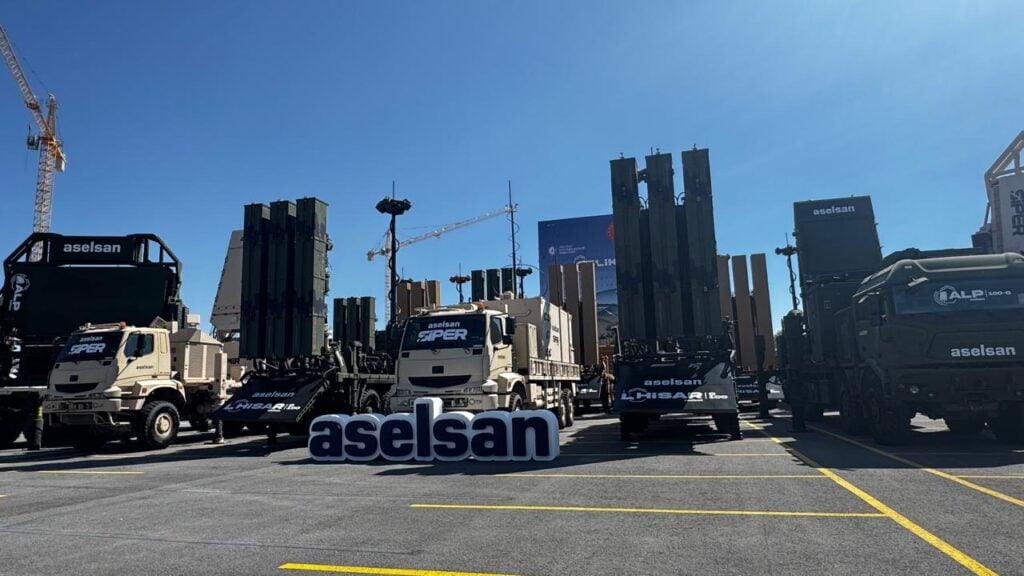
Meanwhile, electronics giant Aselsan, the firm leading the Steel Dome project, displayed 47 vehicle-based systems it said were to play a part in the integrated air defense network, and which had been formally delivered to the Turkish armed forces. The systems included the long-range SIPER, medium-range HISAR, and very short-range KORKUT air defense systems.
Aselsan highlighted its technology-oriented approach in the sector.
In the building where Gallium Nitride radars are being produced, Aselsan CEO Ahmet Akyol said, “From Gallium nitride to the chips to the subsystems, it [the missile defense systems] is fully designed, developed and delivered by Aselsan.”
“Now we are working on early-warning, UAV-based radars. This is totally new,” he said, noting that the firm recently teamed up with the Turkish government’s defense industries agency to “develop early warning radar, not for only manned aircraft, but also for unmanned aircrafts.”
He added that Aselsan is using AI actively. “We are following the trends and trying to be ahead of the trends,” Akyol told journalists.
At a factory for vehicles manufacturer, the company displayed its vehicles capabilities with bumpy rides up and down a steep cliff, showing off its flexibly rotating wheels to observers. The firm also showed a prototype of its Kaplan hybrid vehicle, which the company said can be traditionally fueled and electric powered. The vehicle “could give up to 200 KW to power directed energy weapon system to shoot down drones,” officials at the facility said, though the vehicles on display were not equipped with one.
As part of the tour, Breaking Defense also attended Teknofest in Istanbul, a naval-themed homeland defense expo mainly featuring competition between startups and student projects in Istanbul.
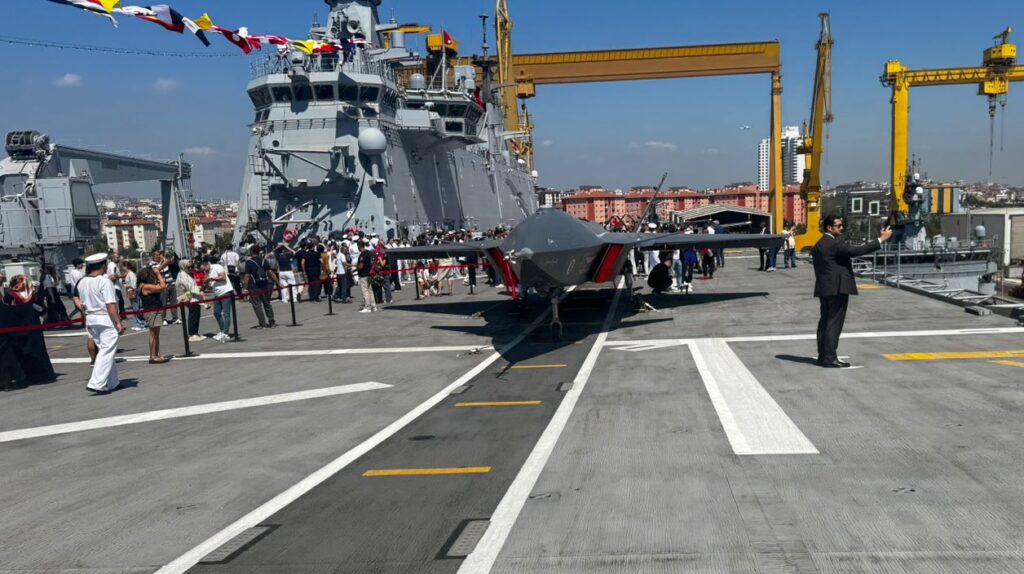
There Selcuk Bayraktar, Baykar’s chairman and chief technology officer, spoke to journalists on board the TCG Anadolu aircraft carrier. Also on board were two of Baykar’s unmanned aerial vehicles, the Kizilelma and TB3 Bayraktar.
Bayraktar said that Kizilelma unmanned combat aerial vehicle is already in “slow rate initial production” and that the company aims to be delivering the platforms next year. He added that the firm didn’t sign a contract yet but expected the first local contract for Turkish armed forces to be an order of 10 airframes.
“It’s essential in this day and age to build our independence in indigenous defense capacity, not just in not just in defense, but in all sectors of technology,” he said.
Rear Adm. Recep Erdinc Yetkin, the Istanbul shipyard commander, said the commissioning of TB3 Bayraktar on board of the TCG Anadolu will take place in September this year.
Looking Abroad, Including To The Gulf
Walking among journalists who spoke different languages, European-accented English and Arabic stood out — a hint, perhaps, at the defense markets in which Turkish officials see opportunity.
Turkish firms consider exports a vital part of their expansion plans. As Roketsan’s Ikinci put it, “We have to focus on exports in our growth.”
One market in which some Turkish companies have already made significant headway is in the Gulf.
In 2023, Baykar signed its largest ever export deal with the Kingdom of Saudi Arabia, to export Akinci UAVs worth $3 billion. The deal included technology transfer to the Kingdom; specifically to Saudi Arabian Military Industries. Bayraktar said production lines are being built in Saudi Arabia and that the first delivery should take place “very soon.”
Meanwhile FNSS officials said they are in advanced talks to export and coproduce PARS Alpha 8×8 vehicle to Saudi Arabia alongside its sister company’s Nurol Makina’s Ejdir Yalcin 4×4 vehicles.
Roketsan’s Ikinci said his firm is looking southward as well.
“We are open to cooperating with different countries, including Saudi Arabia, Qatar and other countries [Arabian Gulf States]. But currently we don’t have any cooperation, but we are [looking for] business cooperation opportunity in this area,” he said.
Aselsan’s CEO offered cooperation and joint production with these countries. “The main approach from our side is to build technology together. We are not only serving as a company, we are together building technology. This is our approach,” Akyol said.
The companies are also looking much farther from home. Akyol noted that its Steel Dome tech is all NATO compatible, opening the door to potential sales to its fellow alliance members.
“We have tested, and delivered systems in NATO links and also national links,” he said.
And then there’s the KAAN. The visit to TAI’s facilities came just weeks after Turkey announced it reached a deal with Indonesia to export 48 of the in-development fighter jets.
“This agreement showcases the progress and achievements of our domestic and national defense industry,” Erdogan said at the time.