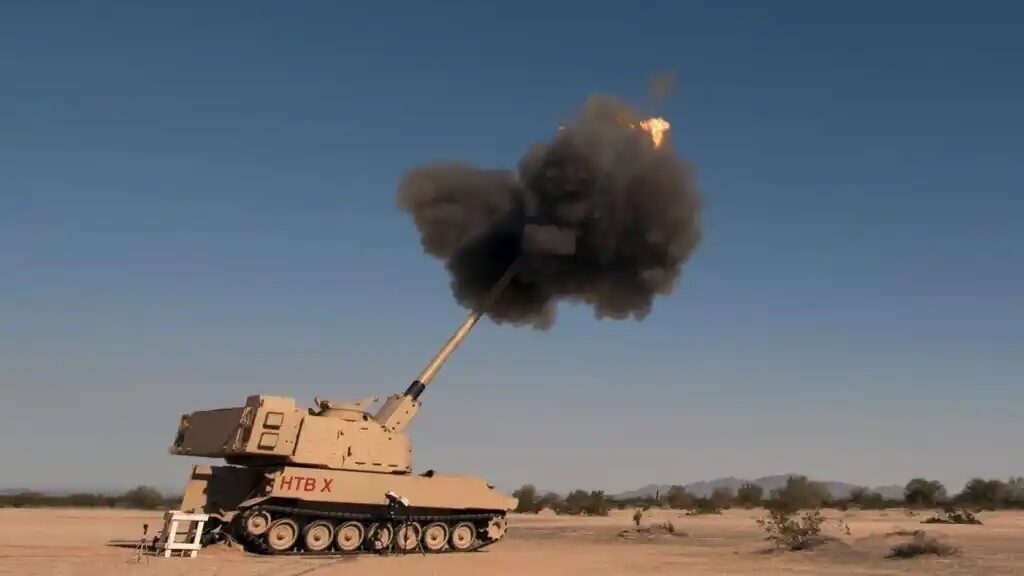
WASHINGTON — The US Army has issued formal requirements for its next self-propelled howitzer, which includes provisions requiring domestic production, a high level of armor and the ability to fire US ammunition, according to a copy obtained by Breaking Defense.
“To survive and support expanded maneuver on a sensor soaked and precision munitions battlefield, our artillery formations require robust and organic fire support with rapid emplacement and displacement, ever increasing range, rate of fire, and reduced sustainment to deliver dominant long-range, massed, and precision fires,” said the directed requirement document.
“To achieve this goal, we will equip two Transformation in Contact units with advanced weapons systems that include both firing platforms and mated, substantial resupply capabilities from available manufacturers,” it added.
The document, dated Oct. 20, is marked controlled unclassified information and supports a recently released request for information (RFI) for a self-propelled howitzer.
One industry source said that this new requirements document closely mirrors an earlier version released in mid-2024 that Breaking Defense has not obtained or viewed. However, the source highlighted two changes from that earlier document: a “domestic production” clause for both the howitzer and resupply vehicle, and a provision that the howitzer can fire US ammunition.
Among the companies known to be bidding are South Korea’s Hanwha, Germany’s Rheinmetall, US-based Elbit America and a team-up of US-based Leonardo DRS and European land defense specialist KNDS. However, some of those companies have American subsidies that either have tentative plans to stand up production lines inside the US or have already done so.
US prime contractor General Dynamics is also a likely contender, as is British BAE Systems through its American subsidiary that currently produces the Army’s M109A7 Paladin Integrated Management (PIM) program.
The RFI released in late September asked interested companies to describe their onshore production capacity, but this requirements document solidifies domestic production as a key component of the competition.
Of course, a production requirement is not a death knell for any foreign-based firm that wants to take part. For instance, Mike Coulter, Hanwha’s defense head, told Breaking Defense last week that he’s not concerned about any domestic requirement that could emerge with its offering.
“Our intent is to create capacity, build them here,” he said during an interview in Washington, although “I don’t think we have fully fleshed out options. We have not committed to a plan.”


Streamcaster Nexus: Empowering the connected soldier at the tactical edge
On today’s battlefield, mobility isn’t optional - it’s mission-critical.
Tracked Vs Wheeled Requirements
The requirements document also includes a call for the new howitzer to be as heavily armored as the currently fielded M109A7, while also providing increased “mobility & transportability.”
Getting that level of armor and mobility could prove to be a tricky needle to thread. Traditionally, wheeled vehicles are lighter and built more for roads, while tracked vehicles are associated with heavier vehicles that more easily maneuver in muddy conditions. The source speculated that the mention of armor equivalent to the M109A7, could be a sign the Army prefers a tracked system or the upgraded M109A7. (Of the currently known competitors, Hanwha’s K9 is the only tracked option while BAE is still producing the M109A7.)
The requirements document also includes:
- A sustainment provision for a platform that delivers higher levels of reliability, availability, and maintainability to ensure sustained combat operations and minimize logistical burden/cost.
- A mobility provision for air/sea/rail/road transport and on/off-road mobility performance up to that of HIMARS.
- The requirement for a weapon that can reach “max range massed lethal effects” up to 58km (36 miles) and precision fires up to 70km (43.5 miles) and a min range of 4km (2.5 miles).
- The platform should be able to store more than three precision rounds (e.g., Excalibur) and be able to fire at least six rounds per minute unguided and three rounds per minute if guided.
After scrapping internal development of the Extended Range Cannon Artillery platform, Army officials embarked on a world tour last year searching for existing self-propelled howitzers. After seeing offerings from five companies — BAE Systems, Elbit America, General Dynamics, Hanwha and Rheinmetall — the Army announced plans to launch a competition to pick an existing platform rather than embarking on development of an entirely new weapon.
However, that competition was temporarily placed on hold as part of the Army Transformation Initiative. Then in late September, the service launched forward and released the RFI.
The RFI, authored by the Program Executive Officer for Ground Combat Systems, called on vendors to offer solutions that will “likely involve temporarily” providing their howitzer systems to brigades participating in the Army’s Transformation in Contact (TiC) initiative — the service’s push to rapidly test new equipment with units both inside the US and abroad to understand how that technology will operate in real-world environments.
This article was updated on10/24/2025 at 9:25 am to clarify that some foreign companies either have plans to stand up US production facilities or have already done so.
Aaron Mehta contributed to this report.