
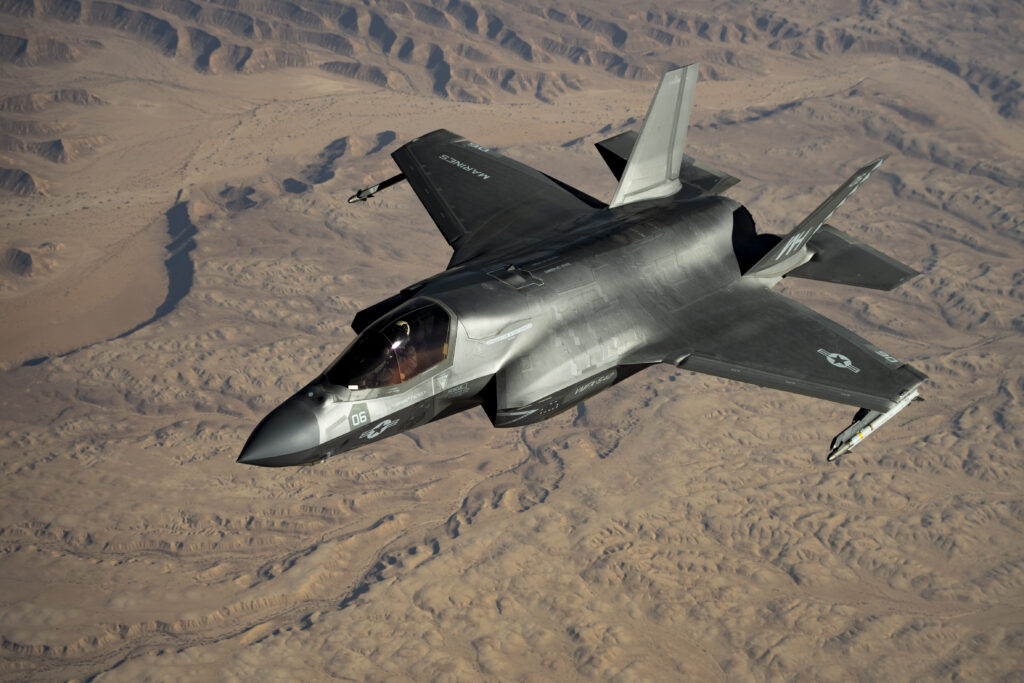
The F-35 Lightning II has faced significant challenges over the years, but is now considered the world’s dominant fighter, with 1,245+ aircraft produced and 19 customers globally. To remain relevant in the battlespace, serve as a node for multi-domain operations, and to possibly control uncrewed collaborative combat aircraft (CCA) in the future, the F-35 will need new sensors, weapons, and capabilities, including upgraded radar and electronic warfare systems.
As it flies today, the F-35 doesn’t have the cooling capacity to drive the core processing capabilities that the Joint Program Office (JPO) wants without an upgraded or new power thermal management system (PTMS). The JPO is considering a competitive program to improve the PTMS, which Honeywell has manufactured for every F-35 worldwide.
The JPO’s desired state for the F-35 is for current cooling capacity to climb from 32 kilowatts to the 62-80 kW range, which is needed for post-Block 4 and beyond upgrades.
“The power thermal management unit is an integral system of the F-35 aircraft that basically integrates four major systems on board: auxiliary power unit, emergency control systems, and environmental control and thermal management or cooling capacity requirements for the aircraft itself,” said Honeywell Aerospace Technologies President and CEO Jim Currier. “Within those four integrated systems are 14 major functions that are all commanded and controlled through the PTMS, including the On-Board Inert Gas Generation System (OBIGGS) and On-Board Oxygen Generation System (OBOGS), as well as cabin pressurization.”
Honeywell integrated those 14 functions into the single PTMS unit back in the mid-2000s, which allowed F-35 prime Lockheed Martin to cut aircraft weight by about 1,000 pounds and which played a role in the contract award, according to Honeywell.
Honeywell’s recommended solution is to upgrade the existing system at low risk and cost – as opposed to designing and installing a completely new PTMS, which is another option the JPO is considering.
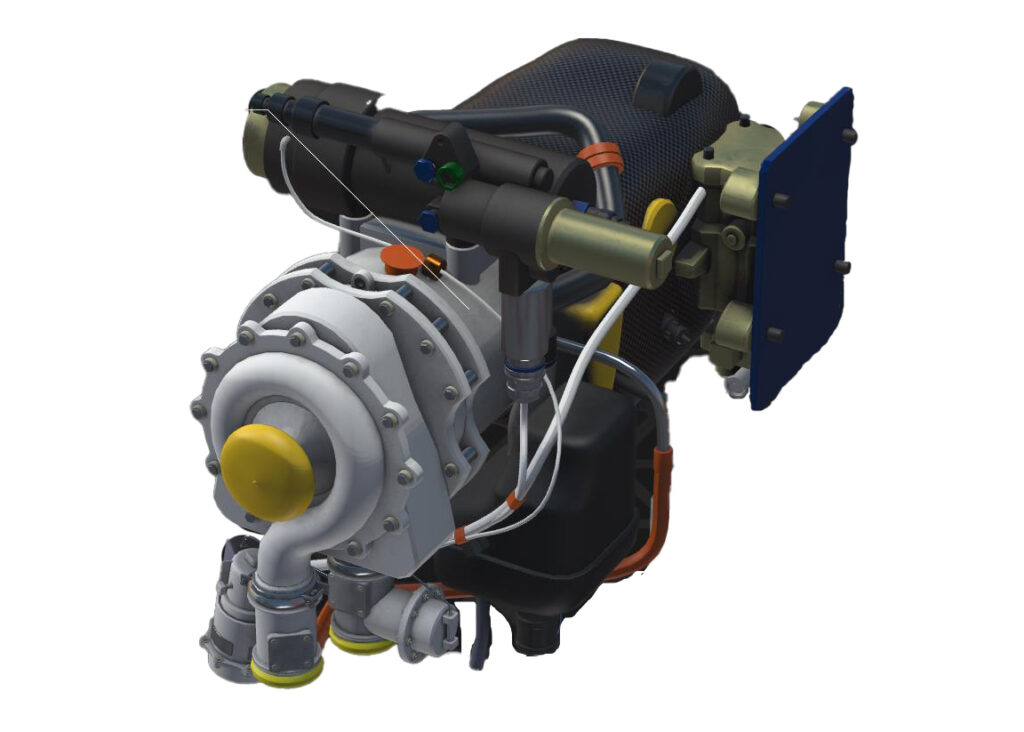
“The upgrade path that we are proposing for our solution reuses 95 percent of the hardware with a simple change out on a few components,” said Currier, talking to Breaking Defense as part of its Future of the F-35 Special Video Series. “None of the interfaces change in the PTMS system. None of the bracketry changes. None of the electrical wiring will change, so it’s a rather straightforward upgrade of existing aircraft to incorporate both the 40 kW solution and then ultimately the 80 kW solution.”
Initially, Honeywell’s low-risk solution to increase cooling capacity by 25 percent to get to 40 kW of cooling capacity is a straightforward software upgrade only, according to Currier. That software solution has the added benefit of increasing F135 engine life by reducing engine bleed air usage by about 40 percent.
For the longer-term climb to 80kW, Honeywell has a proven path to get there with its F-35 PTMS digital twin.
“Based upon the fact that this system is installed on over 1,245 aircraft, we have an accurate digital twin model that we can use with fidelity based upon a million flight hours of experience,” said Currier. “We’ve been able to demonstrate the ability to upgrade to 80 kW of cooling capacity in a straightforward manner, meaning we can do it by reutilizing 95 percent of the existing equipment and 80 percent of the existing software that is used to control the system.
“There are multiple paths to ultimately get to the 80 kW cooling capacity needs that are required. And, again, it’s done in a very low-cost proven way to enable that capability to go forward.”
Regarding the timetable, Currier said that Honeywell can get to a 40 kW solution in two to three years given that it’s a software-only upgrade and the physical PTMS is already available to work on. Two to three years beyond that will come the 80 kW solution, a relatively short timeframe made possible by the ability of Honeywell to reuse most of the hardware and software for the integrated system, allowing the PTMS upgrade to move forward in an expeditious manner that’s low risk and built on a proven capability flying today.