WASHINGTON — As part of a war of words last weekend with Colombian President Gustavo Petro, President Donald Trump made a stark statement: that “as of today,” any payments from the US government to Colombia will “no longer be made.”
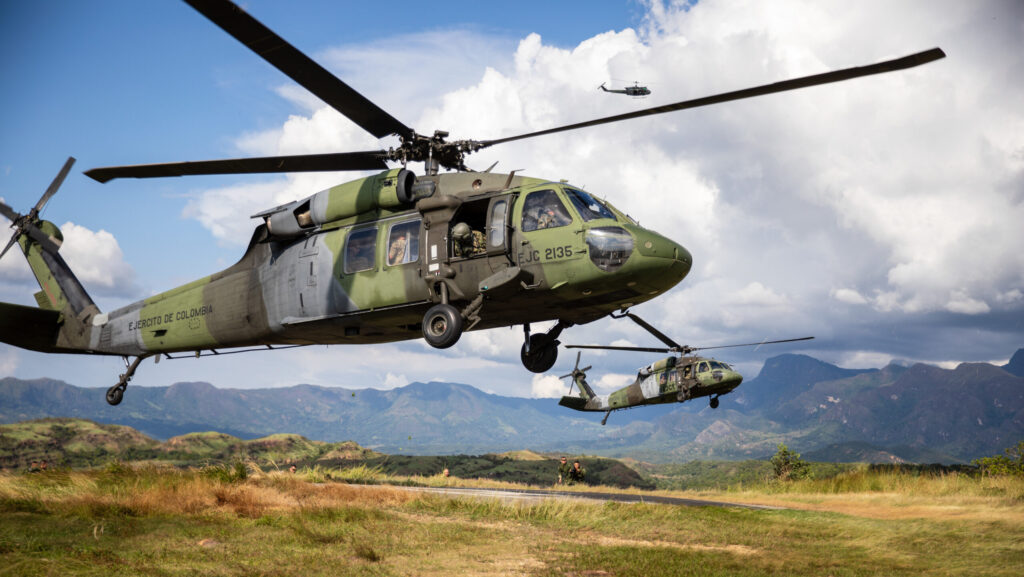
If that threat is carried out — and it’s presently unclear if it actually will be — it would seemingly include cutting military aid to Bogota, something that could impact that country’s internal security. And though analysts said it’s difficult to calculate how badly Colombia could be hurt by the sudden cessation of American support, one platform is likely the first to feel its effects: Colombia’s fleet of Black Hawk helicopters.
“These are vital issues, vital equipment [with] training and maintenance for Colombia,” said Rep. Mario Diaz-Balart, R-Fla., chairman of the House Appropriations Subcommittee on National Security, the Department of State, and Related Programs. “Colombia has used them [the Black Hawks] to fight narco-terrorists, Marxist terrorists. [They’ve] been essential and still are.
“If the mil-to-mil relationship can be salvaged and can be kept, that’s worthwhile, and that’s meritorious,” he later added.
Elias Yousif, a Stimson Center fellow and deputy director for Conventional Defense, echoed the lawmaker’s takeaway during a recent call with Breaking Defense, saying if the Trump administration ultimately halts all aid to Bogota, the flow of spare parts and associated maintenance to keep Black Hawks up in the air will likely be an “immediate operational effect.”
“Colombia is dependent on the United States for its fleet of Blackhawks … for spare parts, for maintenance and things like that,” Yousif said.
“Over the medium and long term, it would be support for professionalization training, and then its ability just to generally acquire US supplies,” he added.


Undersea superiority: ASELSAN’s integrated approach to naval defense
As global navies adapt to evolving underwater threats, ASELSAN’s integrated sonar, countermeasure, and sonobuoy solutions offer a scalable, future-ready approach.
But beyond, he said, it’s challenging to assess what impact a total revocation of funding would have on Colombia’s military, due to the complicated nature of historical US support for Bogota.
“When you ask me, ‘What do I think the impact of a suspension would be?’ Part of my challenge in answering is that I don’t really know what is on the table and how much in what buckets,” Yousif said. “I might have a big number about what was appropriated for foreign assistance, but without any granularity, I can’t tell you if that’s for sustainment, if that’s support operations. I can’t tell you if that’s for training purposes, or if it’s really just to keep those helicopters in the air.”
Bogota-Washington Relations At The Breaking Point
Colombia has been a security partner to the US dating back decades, including during a key point in the counter-drug war of the 1990s when the US assisted the Colombian operation that killed drug kingpin Pablo Escobar in 1993. In 2022 the country was named, and officially remains, a major non-NATO ally to the US.
However, tensions have been on the rise since Trump returned to office, and took another step in the last few weeks. The US military has spent months building up its presence in the Caribbean, striking small vessels manned by people the Trump administration claims to be Venezuelan narco-terrorists. The head of US Southern Command, Adm. Alvin Holsey, who oversaw mil-to-mil ties with Colombia, announced plans last week to step down.
Then over the weekend, tensions ratcheted up even more when Petro asserted that a Sept. 16 US strike on a vessel actually killed a Colombian fisherman.
“US government officials have committed a murder and violated our sovereignty in territorial waters,” he wrote. “Fisherman Alejandro Carranza had no ties to the drug trade and his daily activity was fishing. The Colombian boat was adrift and had its distress signal up due to an engine failure.”
Trump later retorted, calling the Colombian president “an illegal drug leader” on social media and vowing to immediately stop all US payments and subsidies to Colombia, using all caps for emphasis.
The White House, US State Department and US Defense Department have not responded to questions about the status of Trump’s threat to pull all aid from the South American country, or how it would affect military relations between the two countries.
Michael O’Hanlon, Brooking’s director of Research for Foreign Policy, surmised that such a move could ultimately jeopardize the “excellent personal and professional rapport we have with the Colombian military.”
For now, though, a representative for the Embassy of Colombia told Breaking Defense that the two countries are continuing to have a “frank and constructive discussion.”
“Following his recall to Bogotá by President Gustavo Petro Urrego for consultations, Ambassador Daniel García-Peña joined President Petro and U.S. Chargé d’Affaires John McNamara for a frank and constructive discussion, marking a step towards resolving the current bilateral impasse,” the Embassy of Colombia wrote in a statement to Breaking Defense this week.
“Both sides agreed to continue dialogue in a spirit of cooperation and mutual respect,” it continued. “The meeting reaffirmed the shared commitment towards efforts against illicit drug trafficking, grounded in accuracy, coordination, and security.”
What’s At Stake
While diplomatic ties between the two countries are growing more strained by the day, Diaz-Balart characterized the mil-to-mil relationship as still “pretty good,” at least for now.
“It would make sense to try to keep that mil-to-mil relationship that has been very positive for a long, long time … despite the erratic and irresponsible decisions of President Petro,” he added during an interview with Breaking Defense on Wednesday. Diaz-Balart and Petro, themselves, have a contentious relationship.
But if the Trump administration ultimately decides to suspend all aid to Colombia, including military support, it may be difficult to pinpoint the impact the decision will have, according to Yousif. That, he explained, is because of the lack of granularity over where the US funds are flowing. There are topline numbers and details on some pipelines, like a person-by-person accounting for training, but there are black holes in other coffers.
In fiscal 2024, the US provided Colombia with $377 million in foreign assistance, according to a 2025 Congressional Research Service report. That pot, according to the report, included $37 million in Foreign Military Financing, money the US government gives to foreign nations that must be used on American-made weapons and training.
Some of that FMF naturally goes into Foreign Military Sales cases, though it’s unclear if Trump’s threat would include cancelling any potential deals in the works. A State Department fact sheet from Jan. 20 notes that the US had approximately $71.6 million in active Foreign Military Sales cases to Colombia.
In the most recent Foreign Military Training Report to Congress, posted this March, the DoD and State Department told lawmakers Washington spent $16.6 million in FY22 and $13.3 million in FY23 on various pipelines to train both Colombian military and police.
O’Hanlon explained that from his vantage point, it’s easy to see the flow of dollars for things like International Military Education and Training flow and FMS which is detailed through the State Department. Sometimes, less clear, he added, is exactly what support and activities DoD is involved with.
And as Yousif asserted, the lack of transparency around what security assistance in general, including to Colombia, looks like is becoming “really difficult” to track.
Whether US aid to Colombia will stop or not, the Trump administration does not appear to be backing down from its deployments in the Western Hemisphere. Today the Pentagon announced the Gerald R. Ford Carrier Strike Group and its carrier air wing is headed to SOUTHCOM’s area of responsibility to “bolster U.S. capacity to detect, monitor, and disrupt illicit actors and activities that compromise the safety and prosperity of the United States homeland and our security in the Western Hemisphere.”