PARIS — President Emmanuel Macron of France today outlined a major evolution in France’s nuclear deterrent doctrine, including an increase in the overall number of nuclear weapons controlled by Paris — a move he described as necessary in this period of “ambient animosity” that “justifies a toughening of our [defense] model.”
Additionally, Macron revealed that France is in discussions with Germany, the United Kingdom, Poland, the Netherlands, Belgium, Greece, Sweden and Denmark about potentially linking up on a “forward deterrence” effort related to France’s nuclear umbrella, though he stopped short of saying France would consider deploying its nuclear weapons to foreign soil.
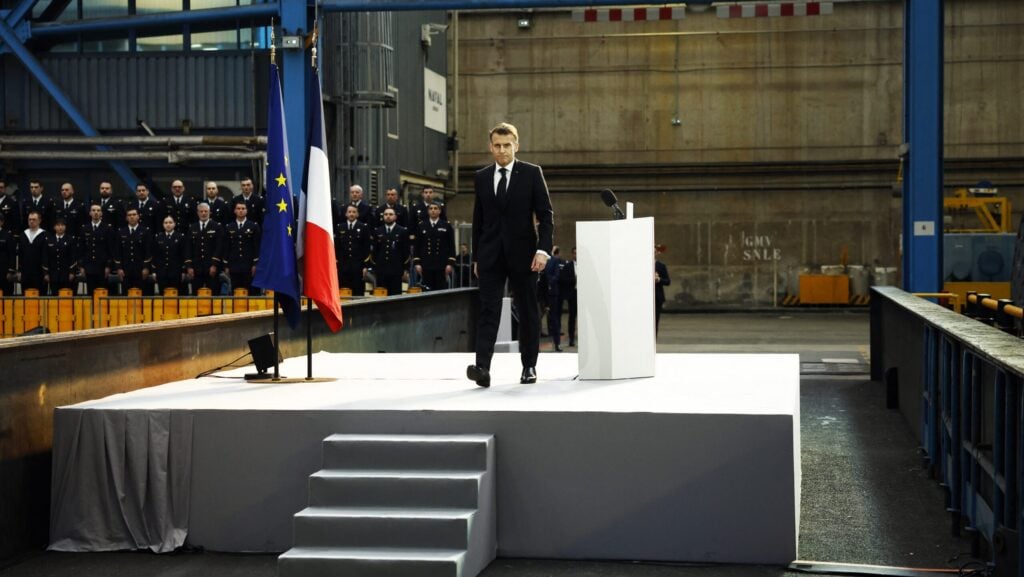
In a 45-minute speech to armed forces personnel and officials at a dry-dock featuring a French SNLE (sous-marin nucléaire lanceur d’engins) nuclear ballistic missile submarine, Macron said that it was “indispensable” for France to “upgrade [its] arsenal,” though he said France “will no longer communicate on their numbers.”
Macron acknowledged that his speech was one of “assumed might in the service of peace,” explaining that “we cannot be satisfied with our current trajectory, and I owe the nation the absolute assurance that our nuclear deterrence remains credible.”
“Our doctrine is not based on the idea of a graduated nuclear response,” he said. “France’s nuclear armament is strategic and exclusively strategic.”
He also did not mince his words of warning to potential enemies: “If we have to use our nuclear arsenal then no state, however powerful it might be, will be able to avoid it. None, however vast it might be, would recover. A single one of our submarines carries more strike power than all the bombs that fell in Europe during World War II. It’s almost 1,000 times greater than the first nuclear bombs.”
He remarked that “our adversaries have changed, our partners too, the world is getting tougher as the last few hours have shown,” referencing the war in Iran.

European-made Black Hawk gets an armed upgrade
New kits turn Black Hawks into attack Hawks in just three hours.
“We must reinforce our nuclear deterrence against the combination of threats, and we have to think of our strategic deterrence within the depths of the European continent in the full respect of our sovereignty with the progressive implementation of what I will call an advanced deterrent,” he said.
He acknowledged that France’s nuclear might “is not achieved without effort,” but that this was paying off because in the next few months the new M51.3 missile will be carried by the French navy’s SNLE, and a “new, optimized oceanic nuclear warhead to penetrate all defenses.”
Macron also announced that a fifth SNLE, to be named “Invincible,” will be built and ready to launch by 2036.
The French president added, “This year we are going to launch the very ambitious program for a hypersonic and maneuverable strategic missile which will equip our combat aircraft and our future aircraft carrier in the next decade.”
Turning to Europe, Macron first mentioned the tightening of ties with the United Kingdom in July 2025. “The UK is a major partner and nuclear power with whom we have recognized since 1995 that there is no situation that engages the vital interests on one without those of the other being affected.”
He also noted that France has intentionally never outlined what exactly its vital interests are.
Forward Deterrence
Part of the speech was announcing to European allies “the possibility of participating in our deterrence exercises” and also providing for the possibility of deploying elements of the French strategic force on their territories.
The French president told his audience that forward deterrence “is a progressive procedure,” one which does not mean every country will be taking an active part in France’s nuclear umbrella.
The forward deterrence “offers partner nations the possibility of participating in our deterrence exercises. It could also imply warnings, including beyond our borders, or allied forces taking a conventional part in our nuclear activities. It also provides for the deployment of our strategic air forces to disseminate in depth across the European continent […] like an archipelago of forces which will complicate the calculations of our adversaries and will give this forward deterrence a lot of value for us.”
Germany, the United Kingdom, Poland, the Netherlands, Belgium, Greece, Sweden and Denmark “have agreed” to take part, he said.
Macron specifically noted that “Germany will be a key partner in this effort.” Shortly thereafter, German Chancellor Friedrich Merz tweeted, “Emmanuel Macron and I have established a nuclear steering group in which we coordinate on deterrence issues. We intend to take concrete steps before the end of this year, including conventional German participation in French nuclear exercises.”
“Poland is in talks with France and a group of closest European allies on the programme of advanced nuclear deterrence,” Donald Tusk, Poland’s Prime Minister, said on X after the speech. “We are arming up together with our friends so that our enemies will never dare to attack us.”
Swedish Prime Minister Ulf Kristersson had previously revealed discussions with France.
Macron said the value for the European allies would be “very strong,” stressing that this “distinct effort has its own value which is perfectly complementary to that of NATO” and noting that “the work was done in full transparency with the United States and in close coordination with the United Kingdom.”
But he was very clear that “there will be no sharing in the ultimate decision [to launch a nuclear strike], nor in its planning or implementation, [responsibilities] which lie only with the President of the Republic.”
Macron specified that the first steps in this forward deterrence would be joint exercises and visiting strategic sites, and noted that discussions were ongoing with a number of other, unspecified European nations also interested in joining the program to strengthen Europe’s defense in three key areas.
The first is early warning of ballistic and hypersonic threats by satellites and radar, notably the Franco-German Joint Early Warning for a European Lookout (JEWEL) initiative launched on October 15, 2025.
The second is the Franco-Italian SAMP/T NG Mamba air defense system recently acquired by Denmark and Ukraine.
The third is the European Long-range Strike Approach (ELSA) program signed by six European nations (France, Germany, Italy, Poland, Sweden and the UK) to advance long-range strike and defense capabilities.
Macron concluded saying that what he wants is “for Europeans to retake control of their own destiny.”
Breaking Defense Video