JERUSALEM — Earlier this month Axios published a report that raised some eyebrows here in Israel. It said that Israeli officials were seeking a 20-year military aid commitment from the US — double the 10-year pledges Jerusalem and Washington have worked out in the recent past.
And while Israeli Prime Minister Benjamin Netanyahu appeared to distance himself from the story, experts here appear to be taking the development seriously, while suggesting a change of course: Rather than seeking more aid, Israel should seek to change the relationship’s dynamic.
“The understanding that will be reached with the present administration should be used to build a trajectory that leads from the current model of the aid package to partnership,” Eran Lerman, a former deputy for foreign policy and international affairs at the national security council in the Israeli prime minister’s office, told Breaking Defense.
Israel currently receives $3.8 billion a year in defense aid based on a Memorandum of Understanding signed in 2016. The aid is largely spent in the US to buy platforms and systems from American defense giants such as Lockheed Martin. But the current MOU will expire in 2028, and negotiations over a new one would need to be concluded during the Trump administration’s current second term. Axios, citing two Israeli officials and a US official, said the 20-year idea had been floated in recent weeks.
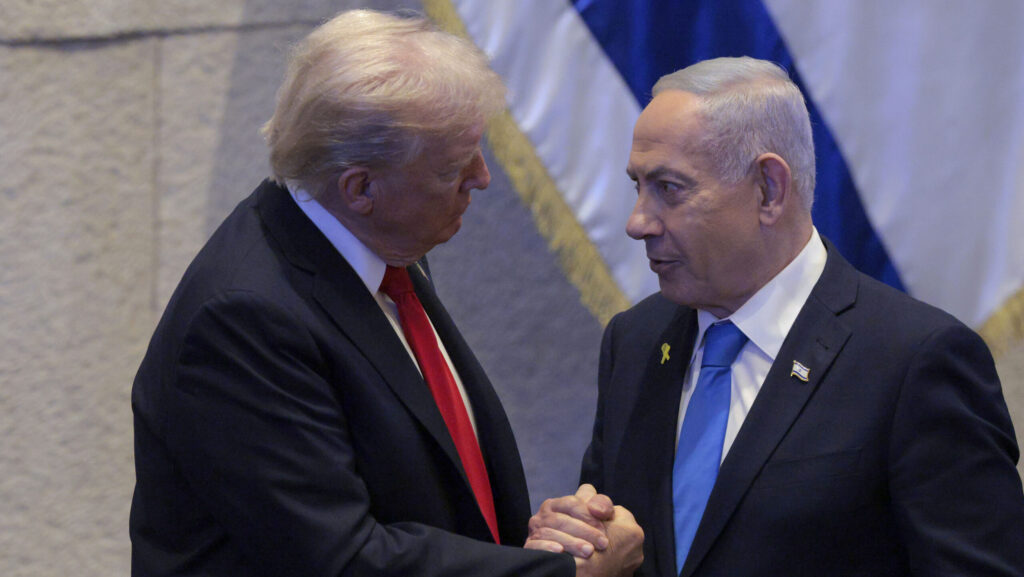
Netanyahu rejected the report, saying in an interview with Australian TV host Erin Molan, “My direction is the exact opposite. … I think it’s time to ensure that Israel is independent.” Those comments came just weeks after Netanyahu said the country needed to be more self-sufficient in a speech where he referenced the ancient Greek city-state of Sparta.
There’s also the matter of US President Donald Trump and his America First agenda.
“The challenge is that Trump has already made very clear that he doesn’t like giving money, and he’s also spoken about how Israel already gets a lot of money,” said Yaakov Katz, a fellow at the Jewish People Policy Institute.


The gap between demand and delivery is widening. AI can help close it.
Supply chains are only as strong as their weakest link, which has been repeatedly proven to be true over the last few years.
Axios did say that more joint research and development programs are under discussion, part of what it described as “America First tweaks” that could better appeal to Trump.
Lerman suggested this was a step in the right direction, but it needed to go farther. He said more of a partnership model would mean the US and Israel both benefit from work on defense technology, and doesn’t make Israel dependent on aid. Lerman said that such a partnership should preserve Israel’s legally mandated Qualitative Military Edge in the region, a key foundation of US-Israel ties.
“There should be other ways for sustaining Israeli military superiority in the regional context that does not necessarily depend on the American taxpayer,” he added. “Down the road, through a long and well-planned transition, this will benefit the strategic interests and defense establishments of both countries.”
Lerman also pointed out that there is a precedent for this shift. Israel used to receive economic and military aid, but the economic aid was phased out by 2007.
Katz said he believed officials were discussing “a new model, and I think that’s what they’re trying to do is not to make it a one-way street where it’s just money being given to Israel.”
Jon Hoffman, a research fellow at the Washington, DC-based libertarian-leaning CATO Institute, said he was skeptical that smaller changes would be beneficial to the US. He responded to the Axios report in a post on X noting that “there is no such thing as ‘America first’ tweaks to such a deal. … This is the epitome of America LAST. Israel is a strategic liability — walk away.”
In an interview with Breaking Defense he elaborated, saying Israel is “very aware of the changing winds in the US.”
“The current status quo is unsustainable,” he added, saying Israel does not need US aid to keep its relationship with Washington “special.”
Hoffman said the US should approach Israel “the way we approach South Korea or Germany; or any other country. That means any decision we make should be approached from arm’s length and US interests. Stopping this knee-jerk of unquestioning support.”
However negotiations continue, the recent conflicts in the Middle East have provided evidence for either side in the argument. Israeli military technology has grown by leaps and bounds so that Jerusalem is less dependent on US cutting-edge tech — but only somewhat less. American missile defenses, for instance, were used to fend of Iranian missiles and drones during barrages this year.
Economically speaking, “We [Israel] have a GDP per capita higher than Japan for the last decade and perhaps higher than Germany,” noted Lerman. “At a point it becomes obvious the current model cannot be sustained, on the other hand the US needs to sell a huge amount of weapons.”
Whatever happens, he said, there must be a “path to sustaining the QME, because that is the foundation of stability in the region.”
Breaking Defense Video