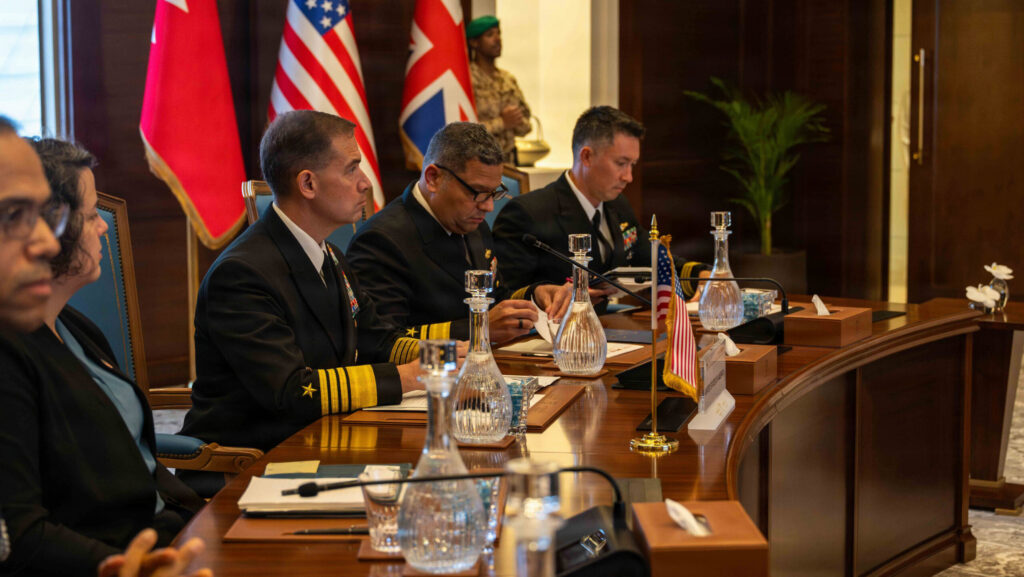
MANAMA — With the United Kingdom’s first ever participation, the Comprehensive Security Integration and Prosperity Agreement’s defense working group with the US and Bahrain officially became a trilateral affair this weekend.
“We know each other very well. We know our collaboration extremely well, but to be in this bilateral framework, is really important,” UK Ambassador to Bahrain Alastair Long told reporters Saturday at the Manama Dialogue here.
As described by Bahraini commander of the Royal Guard Lt. Gen. Shaikh Nasser bin Hamad Al Khalifa, the working group “serves as a key platform addressing all shared security and defense issues among member states.”
He added that the C-SIPA agreement has increased Bahrain’s “capabilities and potential to achieve deterrence,” through cooperation with the US.
In September 2023, Bahrain and the US inked the original comprehensive security integration and prosperity agreement, which was described then by the White House as a “new framework to promote cooperation across a range of areas, from defense and security to science, technology and trade.”
The UK was invited to join C-SIPA in December 2024 — and formally joined in July — but this is the first time London has had a chance to participate in the working group.
“The idea of a security that is interdependent in prosperity is something we firmly believe in. The idea of an agreement that wants to see coalescence around the international rules based system. It’s very much how we see it,” Long said.

Data overload threatens decisionmakers as autonomy expands
Reducing cognitive overload on warfighters while improving “time to trust” for autonomous systems is a matter of design.
The meeting comes as Middle East and the Gulf have been shaken by a number of conflicts from Gaza war to Iran-Israeli conflict and the Houthi threats to the Red Sea and shipping lanes.
“When it comes to sorts of things that we might be able to do in the region, this just provides us with another vehicle to do that, and perhaps sometimes we may be able to do it with a bit more agility, or to coalesce around an idea a bit more quickly,” Long said.
The C-SIPA has three pillars: defense and security, economy and commerce, and technology.
“United States believes that we are stronger when we work together, and it is through collective strength that we are able to realize and promote a more prosperous and stable region,” CENTCOM spokesperson Tim Hawkins told journalists.
He added that the agreement calls “on taking threats seriously, both from malign individuals or actors, but also any other individuals or states that seek to destabilize the region.”
Hawkins said that the Abraham Accords‘ aim at advancing regional stability and prosperity “this type of agreement does just that.”