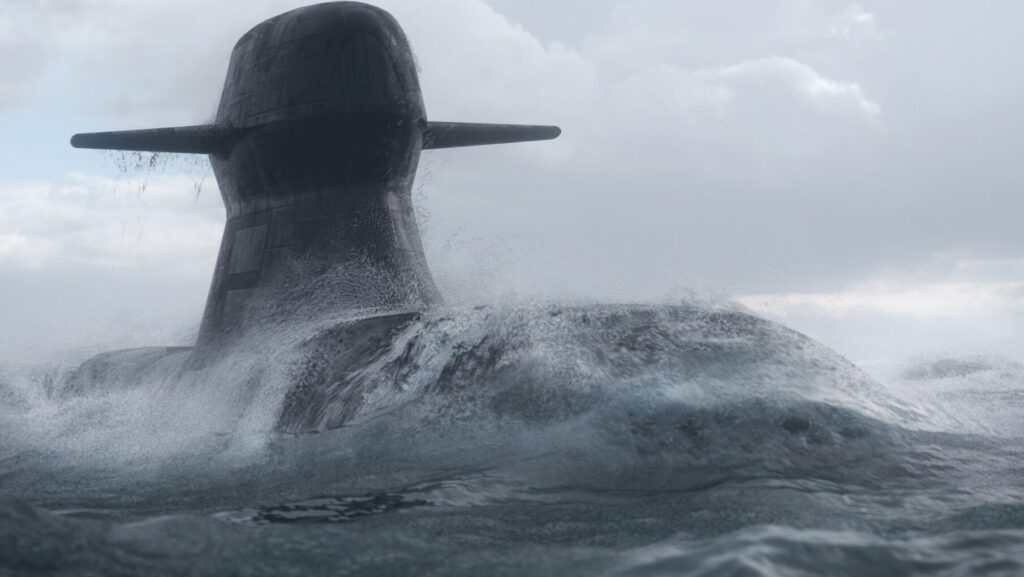
STOCKHOLM — The Polish government has officially chosen the Swedish offer of Saab’s next-generation A26 Blekinge-class submarines for its long-awaited Orka submarine program, in what is expected to be a 10 billion Polish zloty ($2.52 billion) investment.
The decision to acquire three submarines from Sweden marks a major step toward replacing Poland’s sole aging conventional Kilo-class diesel-electric boat that dates back to the Soviet-era. Sweden was picked over competing proposals from Germany’s ThyssenKrupp Marine Systems, Italy’s Fincantieri, France’s Naval Group, Spain’s Navantia, South Korea’s Hanwha Ocean and Saab-Kockum, according to Polish public broadcaster TVP.
However, there are a lot of unknowns at this point. Everyone involved has emphasized that no contract is signed and no order is targeted before the end of 2025, with negotiations now underway between Warsaw and Stockholm. It is also unclear whether Poland will be getting newly built A26s or if the package might include used Swedish boats.
Polish Defense Minister Władysław Kosiniak-Kamysz cast the decision as a landmark, both for his military and for Warsaw’s relations with Stockholm.
Kosiniak-Kamysz said that an intergovernmental agreement could be signed by year’s end, paving the way for submarine’s delivery in 2030 and bolstering Poland’s underwater deterrence in the Baltic region, according to TVP.
Saab welcomed Poland’s decision to select the Swedish government’s offer of A26 Blekinge-class submarines for the Orka program, emphasizing its strategic fit for Baltic Sea operations. “We are honored to have been selected and look forward to the coming negotiations with the Armaments Agency in Poland,” Saab CEO Micael Johansson stated in a press release.
RELATED: With Sweden, Baltic Sea now a ‘lake full of NATO submarines’


Meeting Zero Trust goals while maintaining information dominance
Balancing security and access to data are critical to providing users with trustworthy, reliable data for real-time decisions.
Swedish Prime Minister Ulf Kristersson also welcomed Poland’s selection of the A26 submarine, calling it “confirmation that the Swedish defense industry stands strong” and proof that “Saab has a world-leading submarine program.” in a post on X.
Poland is bordered by Russia’s Kaliningrad enclave, which hosts a major naval base equipped with submarines and surface combatants. As one of Russia’s only two naval bases in the Baltic Sea after the Cold War, Kaliningrad is a critical hub and makes the region a high-priority area for anti-submarine warfare.
The Swedish A26 Blekinge-class submarines, currently under construction by Saab Kockums for the Swedish Navy, are diesel-electric submarines fitted with Stirling air-independent propulsion. They incorporate multi-mission portals that support diver operations and the deployment or recovery of unmanned underwater vehicles, as well as systems for torpedo armament and seabed warfare.
The export design can include a modular payload section that allows for the optional integration of submarine-launched missiles, including vertical launch systems, providing a land-attack and multi-domain strike capability if selected by the operator, per company literature. However, nothing was said about that option today. .
According to a gov statement, the Swedish submarine offer includes a role for the United Kingdom, which is bringing “cutting-edge technology” to the effort. The partnership “can form a strong and decisive force in the Baltic Sea region,” the Swedish government stated in its release.
Poland’s order is a big boost to the A26 program, which has not gone smoothly to date.
Sweden ordered two A26 Blekinge-class submarines from Saab-Kockums in 2015, but the program has faced significant delays and cost increases. By 2021, the schedule had slipped to 2027–2028. Last month, Saab and the Swedish Defence Materiel Administration (FMV) announced a further renegotiation. The total cost rose to 25 billion SEK (≈$2.6 billion) — more than double the original figure for the two boats — with deliveries now set for 2031 and 2033.
However, the limited order of only two units has made development costs particularly high per submarine. Poland’s selection of the A26 for its Orka program is therefore viewed positively in Sweden, as additional hulls could help distribute fixed costs — assuming new boats are being built.