
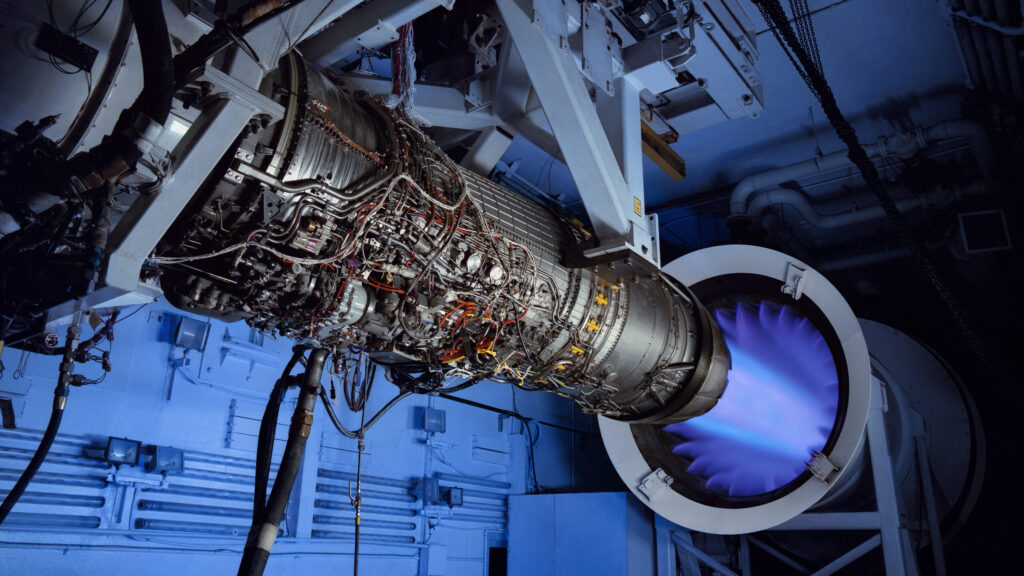
WASHINGTON — Defense tech startup Shield AI’s X-BAT drone wingman will be powered by GE’s F110 fighter engine, the two companies exclusively told Breaking Defense, giving the recently unveiled loyal wingman drone the same powerplant used in the F-15 and F-16.
Under a memorandum of understanding signed by the firms, GE will provide its F110-GE-129 powerplant and integrate a thrust vectoring nozzle critical for the X-BAT platform’s vertical takeoff-and-landing (VTOL) operations. GE will also assist Shield AI with joining the F110 with the X-BAT itself, the first partnership the engine maker has announced for a specific drone wingman platform.
The F110 “provides the performance that we need” to operate the X-BAT particularly in its vertical setup, Armor Harris, senior vice president and general manager of aircraft at Shield AI, told Breaking Defense ahead of the engine announcement. Harris identified some key distinguishing criteria for the engine, which is actively used by the US Air Force today, as sufficient thrust, a thrust vectoring nozzle and a hot production line that can be scaled up.
“We saw right away that [the X-BAT] really is a disruptive approach to putting these dilemmas in front of” potential adversaries, Steve Russell, vice president and general manager of Edison Works at GE, said in a virtual call with Harris. “So we’re really appreciative of the opportunity to work with Shield on this.”
Shield AI unveiled the X-BAT at an event in Washington on Oct. 21, asserting that the aircraft promised a forward leap for efforts like the Air Force’s Collaborative Combat Aircraft program that seek to pair drone wingmen with manned aircraft. The company is pitching the drone as a full package with its in-house Hivemind autonomy software.
Military acquisitions often compete an aircraft’s engine separately and treat it as government-furnished equipment. However, Harris said Shield AI is trying to field the X-BAT “as quickly as possible,” following the lead of more recent programs that “have the engine wrapped up with the vehicle provider” to cut down the time needed for a competition.
Harris said Shield AI has been working on the X-BAT for about the last 18 months, with GE coming aboard about six months ago to refine the aircraft’s propulsion. He added that “engine development is now beginning in earnest” to achieve a first vertical takeoff and landing demonstrator flight by the second half of next year. Production is then expected to follow in the 2029 timeframe.
GPS: Still the gold standard in global navigation
The GPS network continues to prove its unmatched reliability, and it’s only getting stronger.
The thrust vectoring nozzle is integral to the X-BAT’s VTOL concept because the nozzle helps balance the aircraft by changing the angle of its thrust, with Harris likening it to keeping an upside-down broom steady in the palm of one’s hand. The nozzle for the X-BAT is being adapted from the Axisymmetric Vectoring Exhaust Nozzle, which was developed in the 1990s and demonstrated on an F-16.
“There may be some modifications” to the nozzle to integrate it with the X-BAT vehicle, Mark Rettig, vice president and general manager of advanced programs at GE’s Edison Works, said during the call. “Integrating the nozzle and the control of the nozzle with the vehicle will be part of the first thing that the teams will be working to do. But, relative to our experience with the nozzle on the F-16, [we] don’t anticipate any challenges with being able to provide the level of control that the vehicle needs.”
Although the Air Force has still not settled on requirements for a next round of its CCA program, industry has appeared to start placing its bets, with Lockheed Martin, Shield AI and reportedly Northrop Grumman working on more exquisite drone wingman concepts. GE, for its part, has launched a partnership with Kratos to manufacture smaller engines.
“We’re doing a lot of things to bring more capability to the same cost box,” Harris said when asked why the firm selected a high-performance fighter engine that would appear to drive a higher cost for the platform. He added that Shield AI plans to “assemble and integrate the aircraft in-house” while noting more partnerships will be announced in “the next couple of months.”