Ever since President Donald Trump rode down the golden escalator at Trump Tower on June 16, 2015, to kick off his first presidential campaign, analysts have been trying to decipher whether he has a coherent foreign policy. One decade later, people are still asking the same question.
Trump’s approach in the Western Hemisphere is proving to be the exception. Remove the personality conflicts and rhetorical swipes against some Latin American leaders and what you essentially have a hybrid between the 1823 Monroe Doctrine and the 1904 Roosevelt Corollary. The goal is the same today as it was back then: preserve US dominance by preventing great power adversaries from meddling in America’s sphere of influence.
The big difference is that whereas past US administrations went through the motions of justifying their actions on the grounds of defending democracy or enhancing stability, Trump is unapologetically motivated by power. Whether a country has a questionable human rights record or shoddy democratic practices is insignificant so long as it follows Washington’s lead on the big geopolitical issues.
In short, with respect to America’s near-abroad, Trump is a classic primacist. In this view, the United States has the right and obligation to throw its weight around to keep itself on top of the pecking order. Adversaries like Cuba and Venezuela are to be slayed with sanctions and threats of military force; allies like Canada are to be pressured into submission; and partners like Brazil and Mexico are expected to cater to US demands irrespective of their own domestic politics or national security interests. Leaders who cooperate get rewarded with Oval Office visits and hefty loans; those who don’t get punished.
Such a strategy, however, is not without costs for the United States over the long-term. By incessantly wielding the stick and treating other countries as chess-pieces in Washington’s grand designs, the United States runs the risk of alienating the very regional partners it needs to maintain a favorable balance of power. The pressure tactics have more immediate negative repercussions as well, particularly on the two issues — drugs and migration — the Trump administration regards as top-tier priorities.
Trump’s Rooseveltian-like tendencies are in full bloom, most prominently in Venezuela. If there is any figure in the region who likes to thumb his nose at Washington, it is Nicolás Maduro, who has ruled the South American country since 2013 through a combination of political repression, cronyism and state-sponsored corruption. Trump has long eyed Maduro as a troublemaker who consistently undercuts the US position in Latin America by keeping Cuba afloat with sending heavily subsidized crude oil, partnering with drug trafficking organizations and courting a military relationship with Russia.
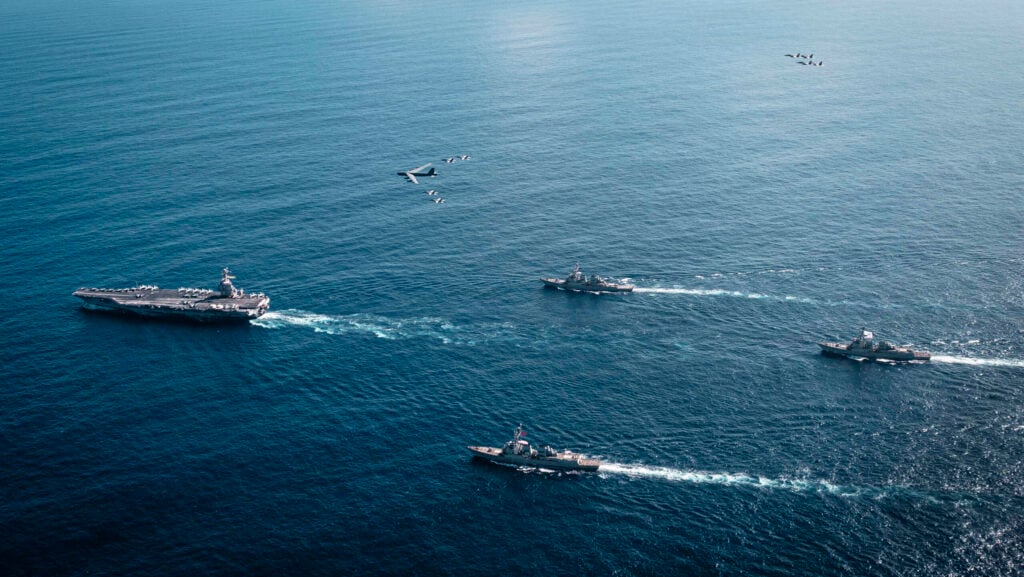
The United States has responded with an overt show of force. US B-1 and B-52 bombers have flown close to the Venezuelan coast, presumably to rattle Maduro’s inner circle into defecting from his regime. US officials are using phrases like “drug trafficker” and “cartel leader” to delegitimize Maduro and justify what could lead to a US regime change operation in Caracas. At least 20 boats allegedly carrying drugs have been destroyed in US airstrikes since early September, with more than 80 people killed. The US military now boasts the heaviest presence in the Caribbean since the 1962 Cuban Missile Crisis — including the USS Gerald Ford, which recently entered the theater. Add Trump’s flirtation with striking land targets inside Venezuela and his order for the CIA to conduct covert operations into the picture, and the message to Maduro seems clear: capitulate or face war.


From requirement-driven to market-ready: Rethinking how defense technology reaches the warfighter
As threats continue to evolve, speed will increasingly depend on what is already available when the need emerges.
Colombia, too, is under significant US coercion. Spurred by the growth of coca cultivation in the country as well as the left-wing politics of President Gustavo Petro, Colombia, traditionally the strongest US ally in South America, is increasingly being meshed in with Venezuela as a state-sponsored drug dealer. The Trump administration designated Colombia as a major illicit drug producing country, stripped Petro of his US visa and slapped sanctions on him for allegedly allowing “drug cartels to flourish.”
It would be disingenuous to say that Trump’s hardball strategy has failed to earn Washington any deliverables. Following Trump’s threats to take back the Panama Canal, Panama is now reviewing its relationship with China and withdrew from Beijing’s Belt and Road Initiative. Mexico is far more aggressive in combating the cartels on its territory than it was in the past, a notable shift powered in part by Trump’s threatened tariffs on Mexican imports. And with the exception of Nicaragua, Central America is largely cooperating with the Trump administration’s deportation policies.
The Perils Of Primacy
But short-term benefits do not necessarily turn into long-term gains for the United States, and not every country is submitting to US diktats. Therein lies the problem: The longer the Trump administration implements its primacist agenda, the more likely other countries in the region, even traditional US security partners, will start to chafe at the intrusions on their sovereignty. With a heavy-handed hegemon to the north unwilling to question its assumptions and more than happy to leverage US economic power to compel compliance, other non-hemispheric great powers like China could suddenly begin to look like viable alternatives.
In short, through its own actions, the United States risks making Beijing’s work easier than it would normally be.
This development is already occurring to some degree. In July, the Trump administration instituted a 50 percent tariff on Brazil as punishment for what it called the politically motivated prosecution of Jair Bolsonaro, a former Brazilian president and Trump ally. But if Washington was hoping Brazil would simply capitulate, it was sadly mistaken. Not only did Bolsonaro’s prosecution continue unfettered, but Brazilian President Lula de Silva used the US tariffs to bolster his domestic popularity. Moreover, to the Brazilians, Trump’s pressure tactics are merely a confirmation that its years-long foreign policy of preserving positive relationships with all the world’s major powers was the correct one. Brazil, Latin America’s largest economy, is diversifying to alternative markets and boosting trade with China as a way to limit the impact of U.S. tariffs, precisely the opposite of what the White House wanted.
Colombia’s Petro is resisting US pressure as well. On Nov. 11, Bogotá announced that all intelligence sharing in the field of counter-narcotics will be suspended until the Trump administration stops its unilateral strikes on boats in the Caribbean. (Although the Colombian defense minister later walked some of this back, the fact this declaration was made at all represents how turbulent this normally close strategic relationship has become.) Worried about being implicated in possible violations of international law, the United Kingdom, Washington’s closest intelligence partner, is also limiting the amount of information on drug trafficking it transmits to US authorities. The end result will be fewer drug interdictions, fewer criminals caught and fewer prosecutions.
China, meanwhile, is using Trump’s erraticism to strengthen its longstanding argument that the US can’t be relied on. This shouldn’t be understated: China is already the top trading partner for most of Latin America’s economies, and Chinese leaders would like nothing more than to increase Beijing’s influence in America’s self-described backyard to counteract Washington’s own forward-presence in East Asia.
Trump’s heavy-handedness to date is ironically supplementing Beijing’s work in this regard. Facing US pressure with no acceptable off-ramp, middle powers like Brazil, Mexico and Peru will likely continue courting China as a hedging strategy, not out of ideological sympathy but as a strategic imperative to lessen dependence on Washington and give themselves greater operating space.
Speak Softly And Carry A Smaller Stick
There is a lesson in all of this: Although primacy may look good on the surface, it is ultimately its own worst enemy. States don’t like getting pushed around and will, over time, choose to partner with others that hold similar threat perceptions.
Instead of utilizing the stick at every opportunity, Trump would be better served tapping into his salesman’s instincts. This means deploying the art of persuasion and offering the region’s leaders fair deals that are mutually beneficial. If Washington wants Brazil, Colombia and Argentina to limit their strategic relationship with China — eliminating it outright is a fool’s errand — then it should provide an alternative in the form of more US investment and deeper intelligence ties on matters of mutual interest. Trump would also do well to better grasp the internal politics of crucial Latin American states like Colombia, which for domestic or strategic reasons may not be able to cooperate with Washington’s literal war on drugs. A refusal to accept political facts on the ground will only cause more problems.
Above all, Trump should always keep in mind one of the baseline realities of international politics: Just because another state is unwilling to follow US demands to the letter doesn’t mean the entire relationship should be discarded. Especially when those relationships are in your own backyard.
Daniel R. DePetris is a fellow at Defense Priorities.