
Debate over the legality of recent strikes on alleged narcotics-smuggling vessels has been loud but shallow. Critics cite the UN Charter and international legal bans on the use of force and call the strikes “murder.” Defenders say the devastation of synthetic opioids and the ways the illicit profits are used are reason for a decisive response. Both sides tend to ignore the fact that the international system has been here before.
International law doesn’t evolve by treaty alone. It evolves through state practice, which is how states interpret, stretch, and sometimes break the rules when the system can’t contain new threats. The law of armed conflict, built for mid-twentieth-century wars between states, was never designed for the world of fragmented governance, global crime, and hybrid networks that blur the line between criminality and warfare.
When law meets the vacuum of state failure, practice fills the gap. When weak states, transnational crime, and global commerce collide, the rules of international law bend, and they usually bend first under US pressure.
Critics label such actions illegal or immoral, but this misses the complexity of how law evolves. Every major change in the use-of-force regime from humanitarian intervention to counterterrorism began as something unlawful. Over time, repetition and multilateral participation transformed what began as violations into accepted practice.
The real question for narcotics interdiction is not whether it violates the law today, but whether states can meet the same standards that made past deviations sustainable: clear necessity, proportionality, transparency, and restraint. If strikes on narcotics vessels are ever to gain legitimacy, they will need not only justification but proof of humanity.
To understand how narcotics interdiction fits into this broader trajectory, four examples are instructive: the 1998 US strikes against al-Qaeda, the campaign against Somali piracy from 2005 to 2008, the targeting of ISIS oil convoys in Syria and Iraq beginning in 2014, and the recent strikes against the Houthis. Together, they show how states repeatedly bend the law when encountering the gray space between crime and war — and how current US policy appears to rely on the same evolving logic, regardless of the textbook legality.
The question is not whether striking a narcotics boat is lawful under today’s strict reading of positive law — because it almost certainly isn’t — but whether states will once again evolve the law through necessity.

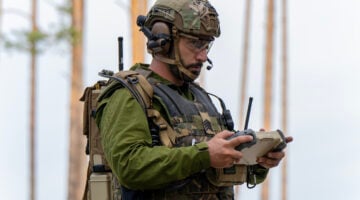
Data overload threatens decisionmakers as autonomy expands
Reducing cognitive overload on warfighters while improving “time to trust” for autonomous systems is a matter of design.
Piracy And A Major First Bend
When Somali pirates terrorized the Gulf of Aden and western Indian Ocean from 2005 to 2008, there was no legal authority to destroy pirate vessels or strike their coastal infrastructure. Pirates were criminals, not combatants. But after piracy threatened global commerce, the UN Security Council passed Resolution 1851 authorizing “all necessary measures” to repress it. The United States, NATO, the EU, China, India, and Russia all joined in direct military operations, including sinking vessels and attacking shore bases.
This was a remarkable stretch of the law. Rather than only using force against individuals actively performing piracy in the moment, the campaign broadly targeted and dismantled the pirate networks on land and sea. What began without clear basis in the UN Convention on the Law of the Sea (prohibiting the lethal targeting of pirates) evolved into an accepted practice through collective action. The lesson: when criminal networks exploit governance vacuums and threaten global order, the law adapts.
Yet this adaptation did not emerge in a vacuum. The idea that states could use military force against criminal networks was born a decade earlier in the original campaign against al-Qaeda.
Infinite Reach And The Power To Declare Conflict
The problem of criminal networks wasn’t new, and the methods deployed to fight them were the result of hard-fought experience. Global terrorism demonstrated there were few ways to combat complex criminal threats. The lesson began in 1998 when President Bill Clinton launched Operation Infinite Reach, a series of cruise missile strikes against al-Qaeda camps in Afghanistan and a suspected chemical facility in Sudan. The strikes followed the US embassy bombings in Kenya and Tanzania that killed over 200 people. But the United States was not in an armed conflict with either Afghanistan or Sudan, and the attacks lacked both Security Council authorization and a clear self-defense justification. Al-Qaeda were simply criminals, and by any legal measure of the time, the operation was unlawful.
Infinite Reach exposed the gap between the world’s legal categories and its emerging realities. Al-Qaeda was a transnational network thriving in lawless spaces, much like the smuggling networks of today. It was neither a state nor a traditional army, but its reach was global. If the US had followed international law to the letter, there were no lawful means to strike al-Qaeda before 9/11, and critics later faulted the Clinton administration for not doing enough. As with current debates on narcotics smuggling, judgments about unilateral action often turn less on doctrine than on political orientation.
After 9/11, the United States filled the gap in international law with domestic law. The 2001 Authorization for the Use of Military Force (AUMF) declared an armed conflict against those responsible for the attacks and those who harbored them. That single statute created a domestic legal foundation for unilateral global counterterrorism operations. The United States used its interpretation of international law to declare conflict with non-state actors and used force anywhere it perceived a threat. This recognition — that the entire network needed to be targeted if the threat was going to be defeated — led directly to the response to Somali piracy and a series of additional bends in international law. It is a pattern other states would follow.
The Red Line And The Houthi Precedent
Other states and US allies embraced the logic of the AUMF when confronting Somali piracy in 2008, but the pattern of bending the law did not stop there. In the years that followed, new and even more controversial justifications emerged outside the counterterrorism context. When the Assad regime used chemical weapons in Syria in 2017 and 2018, the United States launched strikes alongside allies without Security Council authorization. The strikes were not acts of self-defense; they were punitive and deterrent. Yet the international community tolerated them, and the law bent accepting deterrence and humanitarian necessity as sufficient justification.
The same pattern applied more recently in American and allied strikes on the Houthi movement in Yemen. These operations were justified as protecting freedom of navigation in the Red Sea, but that is a global commercial interest, not a national one. There was no declared armed conflict with the Houthis, no direct attack on US forces or commercial interests prior to American military involvement, and no explicit international mandate. Still, many Western and regional powers accepted the strikes as legitimate, echoing the rationale once used to fight piracy.
Each of these episodes, from Infinite Reach to Somalia, to Syria and Yemen, represents a growing willingness to bypass the rigid categories of international law. They show that when existing law cannot manage transnational threats, state practice builds its own authority.
ISIS And The Targeting Of Civilian Infrastructure
Although the campaign against ISIS unfolded several years before the strikes in Syria and Yemen, it belongs in a different category of adaptation. If those previous examples stretched the law procedurally by redefining when and why states could use force, the war against ISIS stretched it substantively, redefining what could be lawfully targeted.
In 2014, ISIS was funding its operations through oil production in captured Syrian and Iraqi fields. Civilians drove the trucks that moved the oil, and civilians refined the oil and sold it. Destroying this profit-generating network meant striking the civilian infrastructure and civilian workers, an act that, on its face, seems to violate the law of armed conflict’s protection of civilians and civilian objects. It’s a thorny problem. Money is not a military object, and unrefined oil is several steps removed from fuel for military vehicles.
The US and its coalition partners nevertheless targeted ISIS’s oil fields, refineries, and convoys under the rationale that the oil itself was a “military objective.” This expanded doctrine of “war-sustaining activities” held that resources directly financing enemy operations could be lawfully targeted. It was a controversial idea and threatened to blur the lines between civilians and combatants. But it helped to defeat ISIS and became state practice.
What often gets lost in the controversy is how carefully those strikes were conducted. Coalition forces took deliberate steps to mitigate civilian harm. Leaflets were dropped to warn drivers. Pilots made low-altitude passes to scare them away. Precision munitions were used to destroy the trucks rather than the drivers. Certainly, drivers were tragically killed, but the intent and method reflected restraint, not indifference.
From Piracy To Narcotics: The Next Legal Frontier
The analogy to narcotics interdiction should be clear. The networks moving synthetic opioids by sea or air are not states, but they threaten public safety on a scale greater than each of the previous examples. These networks operate in spaces where law enforcement is weak and where legal categories break down.
If the narcotics trade is treated as a transnational network financing armed groups, its interdiction can fit within the logic of past precedents. As with Somali pirates and the Houthi militias, a threat to global order can invite a collective response that blurs the lines between law enforcement and war. As with al-Qaeda, a criminal enterprise can become an adversary in armed conflict when governments run up against the limits of combating terrorist groups. The Syria and Houthi strikes sidestepped both Security Council and self-defense rationales to protect global interests. And the ISIS campaign expanded the definition of military objectives to include treating civilian infrastructure as legitimate military objectives, provided efforts are made to spare civilians.
This is not to say such evolution is unproblematic. Every time the law bends, accountability bends with it. The more that states claim the power to define their own adversaries and conflicts, the greater the risk that convenience, not necessity, drives their decisions. The use of force becomes a matter of policy rather than principle.
The opposite risk of clinging to an inflexible legal order in the face of global criminal networks is equally real. The world has already accepted that terrorism and piracy warranted exceptional responses. Narcotics trafficking, which kills tens of thousands annually and destabilizes entire regions, may prove to be the next domain where law follows practice rather than the other way around.
The law of armed conflict has never been static. Somali piracy, al-Qaeda, Syria, the Houthis, and ISIS’s oil convoys all show that the rules bend when states confront threats that do not fit existing categories. Sometimes the bending comes with UN authorization, and sometimes it comes through unilateral declaration. What unites these cases is the same pattern: novel threats emerge, states act first, and law catches up later.
The narcotics-boat debate is only the latest manifestation of that pattern. Dismissing these strikes as “illegal” ignores decades of precedent. But embracing these strikes without question would ignore the moral and legal costs of every prior exception. The path between them, acknowledging that the law evolves through practice, but insisting that practice be humane and justified, is the only way the rules survive.
If the law bends again, it should bend the way it did against ISIS’s convoys with self-imposed precision, restraint, and a recognition that necessity and humanity are not opposites but the conditions for legitimacy itself.
Humanity, in this sense, is not a sentimental limit but an operational standard. It means distinguishing the guilty from the incidental, choosing methods that minimize suffering even when law does not compel it, and subjecting new forms of force to public explanation and review.
The legitimacy of future interdictions will depend less on the perfection of legal theory than on the care with which states wield their power. The world tolerates bends in the law only when it can see the discipline behind them.
Maj. Trent Kubasiak is a judge advocate with First Army at Rock Island Arsenal. Previously, he was chief of national security law for Eighth Army in the Republic of Korea. He deployed three times to Afghanistan and once to Kuwait. He has a JD from Marquette University School of Law, Wisconsin; an LLM from the Judge Advocate General’s Legal Center and School, Virginia; and an MBA from Capella University.
The views expressed in this article are his own and do not represent the official position of the Department of Defense.