STOCKHOLM — Sweden’s Defence Minister Pål Jonson said Wednesday that Canada’s “strong avionics sector” and skilled workforce make it the perfect partner to help Saab rapidly expand Gripen production — capacity urgently needed to supply Ukraine with the 100–150 Gripen fighters it seeks.
In a Canadian public broadcaster interview, Jonson made clear that Sweden cannot ramp up production alone if a Western coalition green-lights a major Gripen transfer to Ukraine. Hence, Sweden is on the hunt for another industrial partner to handle the potential jump in production.
“We are looking for increased production,” Jonson said. “To produce 100 to 150 additional Gripen fighters on top of what we’re doing right now in Sweden — and with Brazil, Colombia, and others already in the queue — might be challenging to do it all in Sweden. That’s why I am talking about partnership.”
Jonson highlighted the existing Saab–Bombardier partnership on the GlobalEye AEW&C program as proof the two countries can successfully coproduce advanced aircraft.
“If we can reach an agreement to provide Ukraine with the Gripen-E as the backbone of their air-defence system, then the components of all of this align very broadly,” Jonson noted, pointing to Canada’s strong Ukrainian diaspora and Ottawa’s role in Kyiv’s military support.
Jonson’s comments sit against the backdrop of Canadian Prime Minister Mark Carney’s decision to reexamine Canada’s troubled F-35 procurement in light of the escalating US trade war under President Donald Trump.
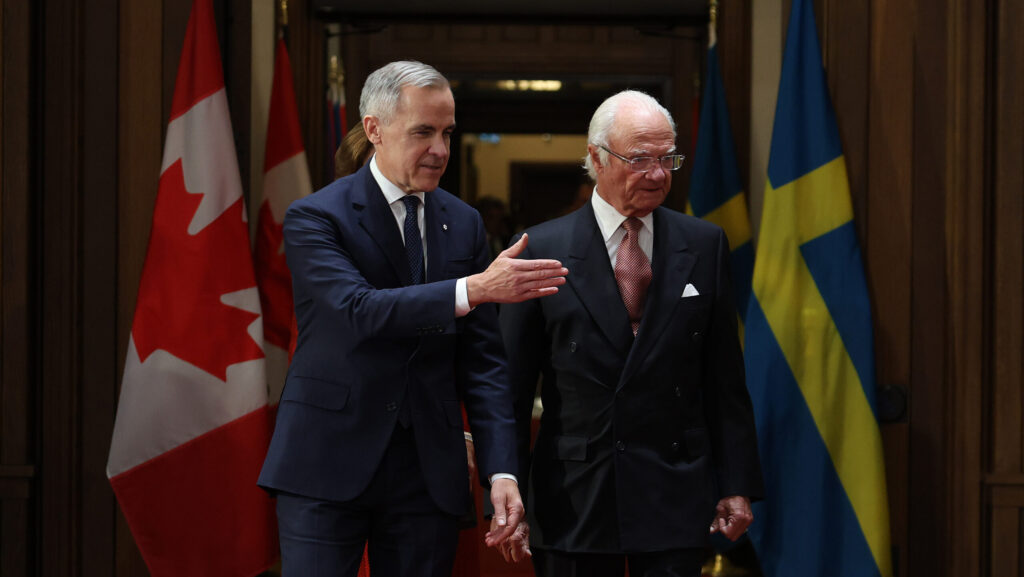
A high-level delegation — led by the Swedish king and queen, alongside Deputy Prime Minister Ebba Busch — traveled to Canada this week to promote the Gripen as a viable alternative to the Lockheed Martin-produced F-35, while also pushing for coproduction deals and potential Canadian sales of the Saab GlobalEye AEW&C aircraft and the Saab-Kockums A26 fifth-generation submarine currently built for the Swedish Navy.


Undersea superiority: ASELSAN’s integrated approach to naval defense
As global navies adapt to evolving underwater threats, ASELSAN’s integrated sonar, countermeasure, and sonobuoy solutions offer a scalable, future-ready approach.
Saab and the Swedish government are offering as many as 10,000 new jobs in Canada, potential production-line expansion in partnership with companies such as Bombardier, and full technology transfer — incentives Canada’s Industry Minister Mélanie Joly described as “very interesting.”
“Of course, we’re very much interested in the offer by Saab on the Gripen and the creation of jobs in Canada and working together regarding Ukraine,” Joly told Busch Wednesday at a joint business event. “We need to have more details … but we’ll continue the conversations for sure.”
However, the clock is ticking fast on Canada’s fighter jet replacement. The last major overhaul of the current CF-18 fleet only extends their safe operational life. With the first Canadian F-35s scheduled to arrive 2028 and full operational capability of F-35s in 2032-2034, the margin for further delays or a protracted new competition is razor-thin.
Saab is slowly expanding the Gripen’s global footprint. In August, Thailand signed a $550 million deal for four jets. Last week, Colombia officially joined neighbor Brazil as a Gripen operator. Brazil already has 36 on order and hosts a domestic final-assembly line; it remains unclear whether Colombia’s 17 aircraft will also be built there. Talks with Peru continue.
And perhaps most notably, last month Ukraine and Sweden signed a letter of intent for Kyiv to potentially acquire 100–150 Saab Gripen E fighter jets.
Addressing the perennial Canadian concern about operating a “mixed fleet” alongside the F-35, Jonson pointed to a successful Nordic air-power integration.
“In the Nordic cooperation, Finland, Denmark, and Norway are using the F-35; we’re using Gripens, but we still have a common Nordic air-power concept and we work very, very closely together,” he said. “From a strategic perspective, it actually creates more dilemmas for Russia because they have to diversify their air defense systems.” He also stressed that Gripen is fully compatible with NATO’s data communication links 16 and 22.