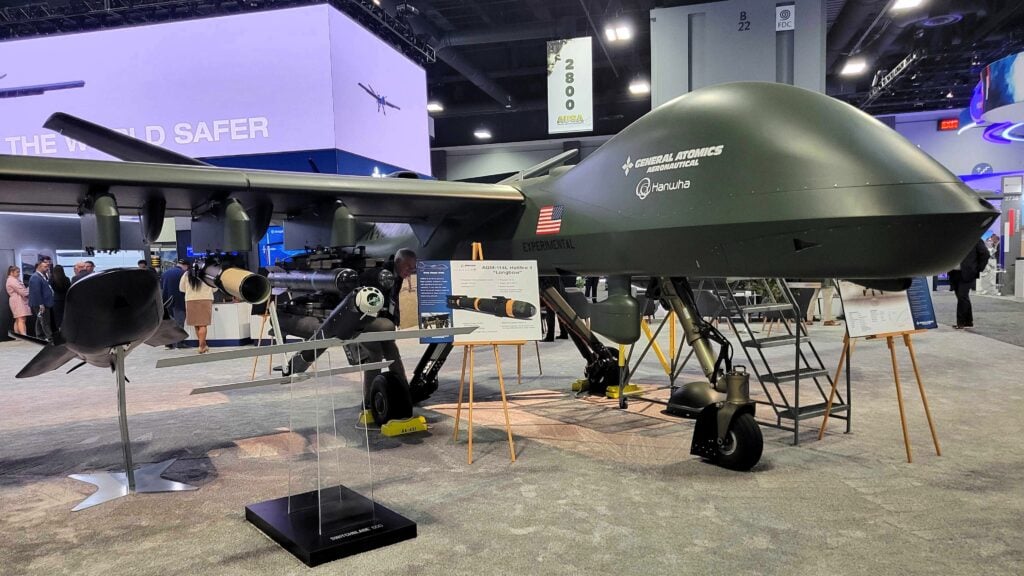
WASHINGTON — The Army is kicking off its search for a replacement for the Gray Eagle large drone, with a new request for information to industry for short/vertical takeoff and landing (S/VTOL) unmanned options.
The RFI posted Friday came in the form of a “challenge” in which service leaders are looking for systems that don’t require a runway, in the Group 4 or above category — with each airframe weighing at least 1,320 pounds.
“In alignment with the Army’s Continuous Transformation, there is a pressing need for reducing runway dependency, allowing critical weapon systems to meet the challenges of an evolving battlefield. Division formations require an organic, runway-independent Uncrewed Aircraft System (UAS) that offers increased Size, Weight, Power, and Cost (SWaP-C), modularity, and interoperability,” the RFI reads.
The service added that it’s looking for a “long-endurance, multi-mission payload system” that can be deployed in large-scale combat operations.
As part of the Army’s Transformation Initiative announced earlier this year, service leaders opted to halt future buys of the General Atomics-made Grey Eagle in part due to concerns that the sensors are outdated, Col. Nick Ryan, director of the Army Capability Manager for Unmanned Aircraft Systems, previously told Breaking Defense. Ryan said at the time that the Army’s plan was to keep the newer Gray Eagle drones in its inventory and upgrade them, while phasing out older versions around the 2028 timeframe.
To fill the gap left by fewer Gray Eagles, the Army is looking for Group 4 or larger S/VTOL that have characteristics and capabilities that include but are not limited to:
- Advanced sensors with atmospheric sensing and electro-optical infrared capabilities
- Autonomous operations that include collision avoidance and sensor and computing dependency
- Mission software architecture that includes survivability systems and electronic countermeasures with an open systems architecture
- Cybersecurity Maturity Model Certification (CMMC) Level 2
- Components that are classified as Government Furnished Equipment, defined as property that is possessed or acquired by the government, which is furnished to the contractor for performance of a contract


Winning the cognitive domain — A methodology built for democratic constraints
The challenge for Western democratic institutions is not a lack of capability — it is a structural one.
Though not included in Friday’s RFI, Breaking Defense reported earlier this month that the service plans to ask industry to incorporate at least some of its those large drones with high-energy lasers.
While it’s unclear at this point which defense firms plan to throw their hats in the ring to compete to see their larger drone offerings adopted by the Army, General Atomics, for example, could look to reclaim the contract with its Mojave demonstrator, GA spokesperson C. Mark Brinkley told Breaking Defense earlier this month.
Those interested in participating in the S/VTOL challenge must respond to the RFI by Jan. 8, the Army said. The RFI did not include information about its plans for conducting the challenge.