UPDATED 12/4/2025 at 1:30 p.m. ET to reflect new information from BAE clarifying that the ATR capability will be used on both the Bradley and AMPVs at two upcoming Army exercises.
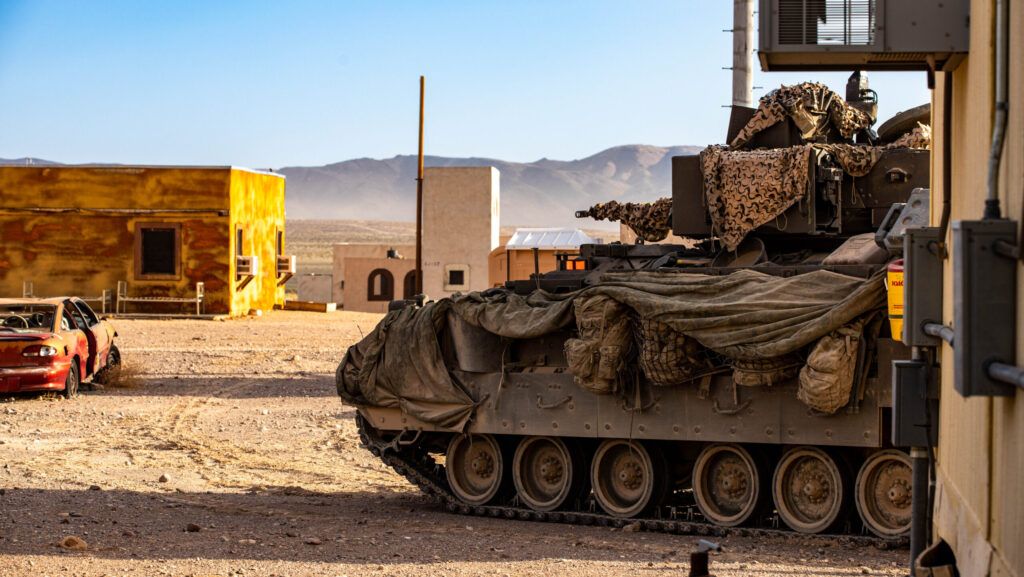
I/ITSEC 2025 — BAE Systems will show off its newest artificial intelligence-enabled target recognition capability attached to Bradley Fighting Vehicles and Armored Multi-Purpose Vehicles (AMPVs) for the first time in the coming months, the company told Breaking Defense.
“When you’re testing target recognition, soldiers with [human machine integration] and soldiers without it, that human machine teaming aspect always wins,” BAE CTO of intelligence solutions Don Widener said. “When you have a soldier with that added capability, it makes them way more effective.”
BAE uses its Virtual Battlespace 4 (VBS4) simulation engine to create synthetic training data that informs the target recognition model, which the company is calling ATR, for aided target recognition. The model is then deployed directly onto the Bradleys, Widener told Breaking Defense on the sidelines of the I/ITSEC conference here in Orlando. The end goal is for soldiers in the vehicles to be able to use the ATR to detect all kinds of ground threats.
The introduction of BAE’s ATR on the Bradley vehicle will occur at next month’s Army III-CORP event at Fort Hood and its integration with the AMPV will occur at the Army’s next Transformation in Contact (TiC) exercise, which begins next month.
The introduction of BAE’s ATR into next month’s TiC exercise comes after the Army has been experimenting with other AI-aided target recognition tools during the 4th Infantry Division’s Ivy Sting series of experiments, as Breaking Defense previously reported. During the exercise, which is one of the service’s prototype experiments for its Next Generation Command and Control program (NGC2), the target recognition was able to identify one target. But the service hopes to be able to have the AI differentiate between several targets, Maj. Gen. Patrick Ellis, commander of 4th ID, previously told Breaking Defense.
RELATED: ‘That’s a tank’: Army introduces AI-aided target recognition to Next Gen C2 prototype
Widener noted that he’s hopeful the ATR will demonstrate this capability during the exercises, and that the capability will ultimately be part of the NGC2 program.
He added that the significance of adding such a capability to a ground vehicle is the ability to use AI-targeted recognition with a “horizontal view.” Previously, especially during the US’s Global War on Terror, operators used platforms like drones for AI-targeted recognition for a “predator’s-eye-view” of threats such as vehicles and people, but by integrating such capability into a ground vehicle, soldiers are able to see threats from the ground, Widener explained.
“The unique aspect of BAE Systems is we’re focused on the horizontal view. So for the last decade, the Army and Air Force and other other [Defense Department] organizations have been focused on the vertical view of the ground, so think of satellite images and things like that,” Widener said.
“The Bradley has been very effective in Ukraine. So they [the Army] were like, ‘Hey, we want to add target recognition to ground systems, but all of our training data from the predator view was looking down, we need to retrain the models looking horizontally.’’’
While the ATR is not currently on contract for the Army, the Bradley and the VBSR4 are part of current programs within the service.