
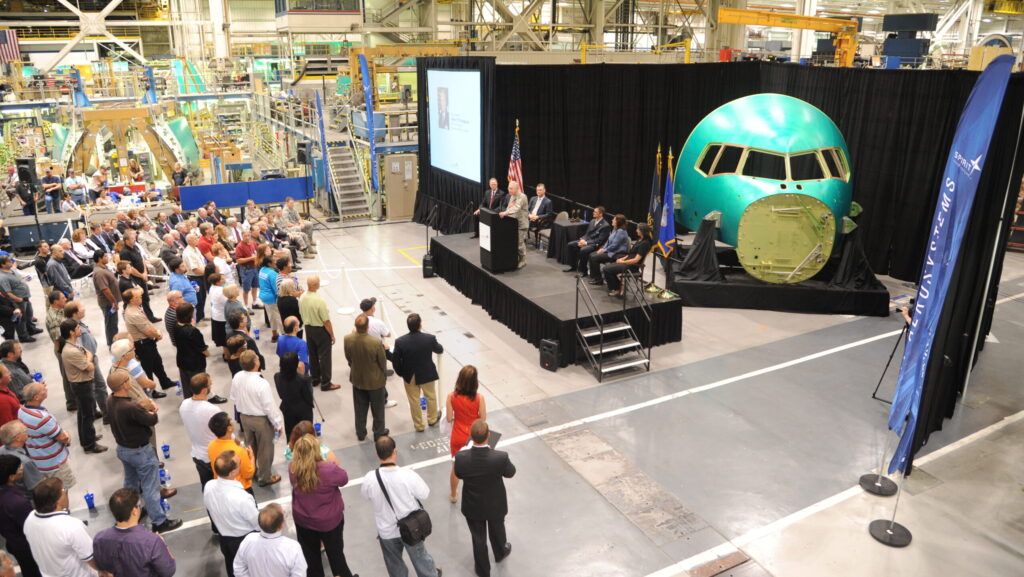
WASHINGTON — Boeing has completed its $4.7 billion acquisition of Spirit AeroSystems, reabsorbing a critical supplier of airplane structures for commercial jets as well as defense aircraft such as the KC-46 and B-21.
The acquisition, which was approved by the Federal Trade Commission on Dec. 3, allows Boeing to acquire all of Spirit’s Boeing-related operations, including fuselage construction for the ubiquitous Boeing 737 and other commercial jets that are the basis for military planes like the P-8A Poseidon maritime aircraft.
Going forward, Spirit Defense will function as a “non-integrated” subsidiary under Boeing’s existing defense unit, “aligning for financial reporting and select enterprise functional and site support, but maintaining independent governance and operations,” Boeing said in a news release. The move allows it to act as an independent supplier to Boeing’s competitors in the defense aerospace world such as Northrop Grumman, which uses Spirit-made aerostructures for the B-21 bomber.
“This is a pivotal moment in Boeing’s history and future success as we begin to integrate Spirit AeroSystems’ commercial and aftermarket operations and establish Spirit Defense,” said Boeing CEO Kelly Ortberg. “As we welcome our new teammates and bring our two companies together, our focus is on maintaining stability so we can continue delivering high quality airplanes, differentiated services, and advanced defense capabilities for our customers and the industry.”
Spirit, which was spun off from Boeing in 2005, makes major sections of the fuselage of every Boeing jetliner, but in recent years made a concerted effort to diversify beyond its former parent company. During its time as an independent company, Spirit grew its defense sector to include work on the B-21 bomber built by Northrop Grumman and V-280 rotorcraft produced by Bell. However Bell made the decision to part ways with Spirit after the Boeing acquisition was announced.
As a result of the acquisition, Boeing said it will add approximately 15,000 employees across five sites: Wichita, Kansas; Dallas, Texas; Tulsa, Okla.; Belfast, Northern Ireland and Prestwick, Scotland.
As a condition for its approval of the deal, the FTC ordered Boeing to divest all of the business Spirit previously did with the plane maker’s main rival, Airbus, which will absorb those entities. It also requires Boeing to divest Spirit’s aerostructures business in Malaysia — which supplies parts to both Boeing and Airbus — to Composites Technology Research Malaysia.

Meeting Zero Trust goals while maintaining information dominance
Balancing security and access to data are critical to providing users with trustworthy, reliable data for real-time decisions.
Sen. Jerry Moran, R-Kansas, a member of the Senate Appropriations defense subcommittee who previously questioned how the Boeing acquisition would affect Spirit’s defense business, ultimately praised the acquisition in a statement today.
“Boeing’s acquisition of Spirit AeroSystems will help build bridges between Seattle and Wichita and bring new opportunities to the Air Capital of the World,” he said. “ I welcome Boeing back to Wichita and look forward to working with them to build a lasting relationship with the community and its workforce, as well as current and future suppliers, to continue building on the growth we have seen in recent years.”