WASHINGTON — In keeping with tradition, lawmakers’ compromise fiscal 2026 defense policy bill released late Sunday tweaks several key Pentagon programs, with provisions aimed at aerospace like Air Force tankers and Army helicopters.
The FY26 National Defense Authorization Act, if passed into law, would boost the Pentagon’s topline by $8 billion above what the Trump administration requested. While the NDAA holds significant sway over programmatic outcomes, funding will be formally decided by the budget process run by congressional appropriators.
The final topline will “depend on what the appropriators work out,” Rep. Adam Smith, D-Wash., told Breaking Defense at the Reagan National Defense Forum over the weekend. “Mostly we like to follow their money, but since they didn’t put a number out there, we can’t move our bill forward with having a number.”
For now, here are some key NDAA provisions:
Up In The Air (And Space)
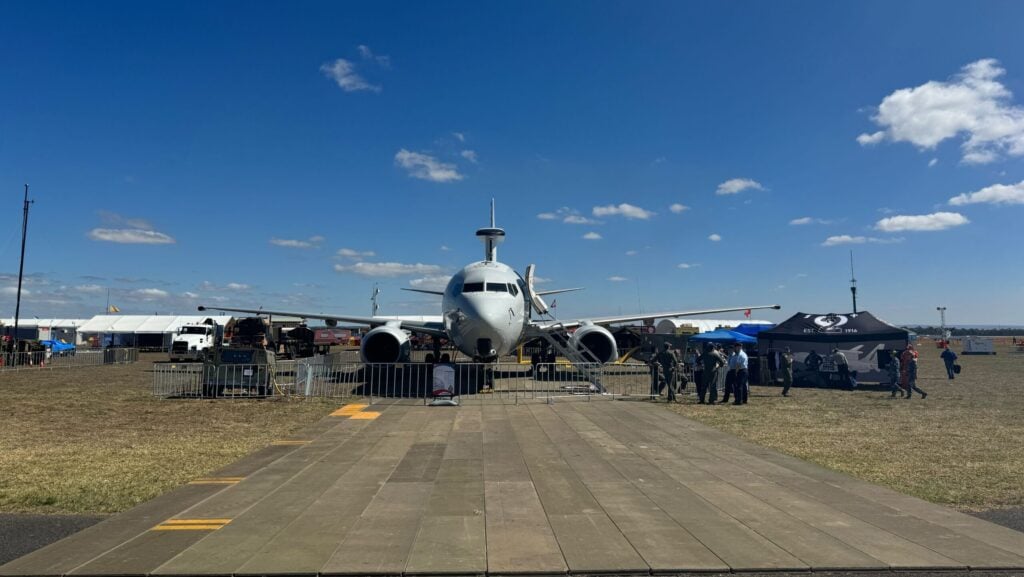
A top item that has garnered significant congressional pushback this year is the Air Force’s nascent E-7 Wedgetail program, which has faced the axe under the Trump administration. Along with provisions aimed at preventing the Wedgetail’s termination, in the NDAA lawmakers would also authorize a total of $846.7 million to continue the radar plane’s development and procurement, according to a funding table included in the proposed legislation.
The Air Force’s C-40 program, which seeks to add new jets for VIP transport and has previously faced skepticism from lawmakers, would get $250 million authorized for one plane. The agreement would further direct a Pentagon-wide analysis of alternatives, with a deadline of April 2026, for recapitalizing the executive airlift fleets of each of the military services.


Meeting Zero Trust goals while maintaining information dominance
Balancing security and access to data are critical to providing users with trustworthy, reliable data for real-time decisions.
Several of the bill’s provisions are aimed at the Air Force’s air refueling inventory, with a big change in the service’s minimum number of tankers: By October 2028 the Air Force would be required to keep at least 502 tankers in inventory, up from a current requirement of 466. Despite previously greenlighting the divestment of the KC-10 Extender, lawmakers would require the Air Force to preserve retired aircraft in storage.
The bill would additionally slow some of the Air Force’s planned retirements, including by stopping the full divestment of the service’s A-10 fleet in FY26. The legislation would prevent the Air Force from retiring any F-15Es in FY26 as well.
And though the bill doesn’t add any F-35 Joint Strike Fighters, it does include an extra $250 million boost to spare parts procurement for F-35As and $125 million each for F-35Bs and Cs. It also trims over $300 million collectively between Air Force, Marine Corps and Navy accounts for development of the jet’s Block 4 upgrade, citing delays.
Shifting to space, the bill directs the Air Force Secretary to coordinate with the DoD undersecretary for intelligence and security to study the “feasibility and advisability of establishing a program of record for tactical surveillance, reconnaissance, and tracking capabilities” (TacSRT) by July 31, 2026 — and granting such a program a nod of approval if the study is in favor. The congressional move to codify the Space Force’s pilot program for buying commercial remote sensing data follows a hard-fought agreement between the service and the National Geospatial-Intelligence Agency (NGA) inked in May.
At the same time, lawmakers would require the chairman of the Joint Chiefs of Staff to submit an annual report for the next five years detailing all the requests made to NGA for space-based remote sensing products that includes how many were fulfilled, as well as how many were rejected and why. The first such report would be due in February.
Over At The Army
The bill gives the largest service, the Army, new multiyear procurement authority to buy Black Hawk UH-60s beginning in the fiscal year 2027. This comes after the Army’s Transformation Initiative has spurred cuts to its aviation portfolio as well as prioritized the Future Long-Range Assault Aircraft (FLRAA) program.
Earlier this year Army Secretary Dan Driscoll and Chief of Staff Gen. Randy George sidestepped lawmakers’ questions related to the future of the Black Hawk. The duo instead focused on their priorities to accelerate the production of FLRAA — which is set, in part, to replace the Black Hawk.
However, months later the Program Acquisition Executive of Maneuver Air, Maj. Gen. Clair Gill, told reporters at AUSA that “fundamentally, we’re not getting rid of Black Hawk anytime soon. We’re all going to be off this earth, and Black Hawk is still going to be flying.” He added that it’s not a matter of if Black Hawks will be a part of future fleets, but more the question of how many will fly.
Further, Gill said at the time that when it comes to the Black Hawks, the service is primarily focused on the modernization of the fleet. It appears Gill’s wish came true, as the compromise NDAA authorizes an additional $100 million for Black Hawk modernization.
The bill also gave authorization to initiate early production of the FLRAA, stating that “[t]he Secretary of the Army may enter into contracts, in advance of full-rate production, for the procurement of future long-range assault aircraft as part of an accelerated low-rate early production effort for such aircraft.”
The bill also calls for Driscoll to brief Congress no later than 180 days after the enactment of the NDAA on the implementation plan and timeline for the early production effort for FLRAA, the status of industrial base readiness and supply chain coordination for early production, and estimated long-term cost savings and operational benefits “expected to be derived from such early production effort.”
Theresa Hitchens contributed reporting.