
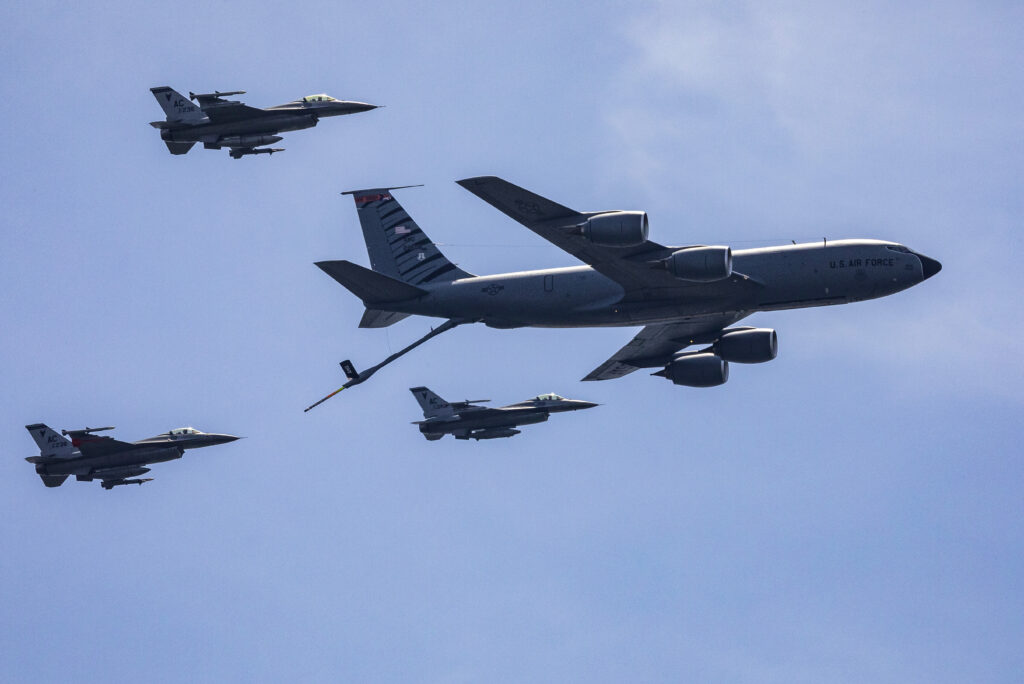
High Value Airborne Assets (HVAA) such as tankers and cargo aircraft fill critical roles in maintaining air dominance, moving materiel to where it needs to be and monitoring airspace for adversaries.
Traditionally, these aircraft operated in relative safety, far from the area of engagement. But advancements in surface-to-air and air-to-air missiles and electronic warfare attacks are putting HVAAs at risk, driving the need for new defensive capabilities to keep critical assets safe.
Breaking Defense spoke with Jared Belinsky, product line director, Integrated Survivability Solutions, and Avetis Ioannisyan, program director, Strategic Air, BAE Systems, about the challenges of protecting HVAAs in contested environments.
Breaking Defense: How do High Value Airborne Assets differ from other aircraft in the fleet? What roles do they fill?
Belinsky: Within the US Air Force, the conversation starts with the tankers. The KC-46 and the KC-135 mission is aerial refueling to provide the Air Force with additional range endurance for their combat aircraft. These are larger platforms traditionally flown in less contested or non-contested environments, and fighter jets and other Air Force aircraft rely on them to be able to perform missions overseas. They didn’t always need to have protection considerations in the same way assets flying in contested environments would.

In addition to the tankers, there’s also the cargo aircraft: the C-5, C-130, and C-17. Their primary mission is cargo and transport. They’re used to move materiel around – vehicles, ground troops, supplies. All for the deployment of inter-theater logistics and mobility.
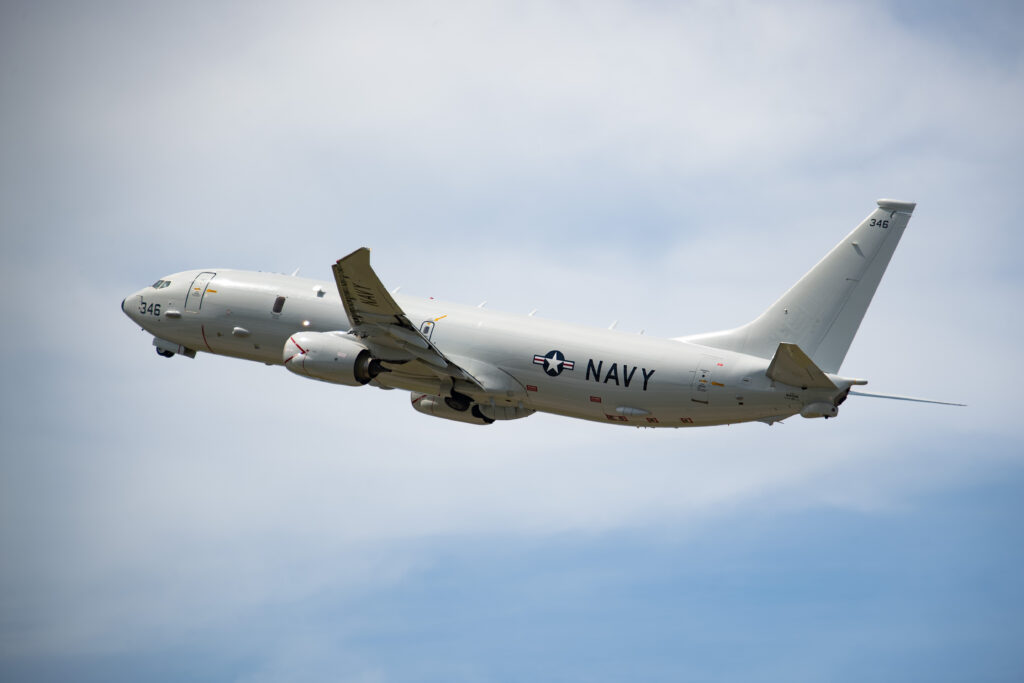
Within the Navy the P-8 provides maritime patrol and reconnaissance, which are critical to their mission.
Are the tankers and cargo planes flying into more dangerous and contested environments than they were in the past? Has the threat escalated to their domains today?
Belinsky: The short answer is yes for our peer and near-peer threats. We still need to perform aerial refueling missions. We still have cargo and transport missions and we still have the maritime patrol and reconnaissance missions. What we’re seeing in the highly contested threat environments is that China and Russia are proliferating long-range weaponry that is reaching farther than ever before.
In doing so, they’re creating contested airspace where we used to enjoy freedom of maneuverability. As that happens, our tankers and our cargo aircraft are going to be pushed farther and farther away from their area of responsibility or they’re going to need some version of protection, either electromagnetic or kinetic, so that they are enabled to fly in those contested spaces.
Ioannisyan: When we talk about power projection around the globe, fighters like the F-22, F-35, F-18 come to mind. What people forget is that these large, High Value Airborne Assets like tankers or cargo airplanes are the key critical enablers in that power projection mode, because without them, the tactical fighters wouldn’t be able to be at the right time at the right place.

These support aircraft are large, relatively slow and sometimes have significant electromagnetic signatures. What challenges do those characteristics create when it comes to protecting HVAAs?
Ioannisyan: These are very large platforms, they have limited maneuverability, and that creates additional challenges in contested environments. That can leave these aircraft exposed to long-range threats that we’ve seen countries like China advance in the last 5 to 10 years. Most of these HVAA platforms are based on their commercial variants that have been in service for decades, and they were not designed to have a low radar cross signature. They naturally have a large electromagnetic signature, which makes them highly visible in the battlespace.
Belinsky: They can also be slower and less maneuverable than fighter jets, so their ability to take evasive maneuvers is limited. Coupled together, the CONOPS around HVAAs need to be revisited.
These aircraft still need to be able to perform their tasks, so are there limitations to what you can do to upgrade their defensive capabilities?
Belinsky: There are limitations there, especially if we continue to use commercially derived High Value Airborne Assets. That’s where sensors and countermeasures and other effects in the battle space will need to be brought forward in order to help secure the mission HVAAs are tasked to accomplish.
What kind of attacks specifically are we talking about? Is it all electronic attacks? Is it attacks against GPS? Kinetic attacks?
Ioannisyan: It’s all of the above. Our adversaries have come a long way, both in the electromagnetic environment and their kinetic projection of their power. In the past, your tankers and support aircraft have had the luxury of staying outside of the weapon engagement zone.
Those weapons have matured and grown in range, capabilities, and targeting. The seekers on them tend to be multimodal and layered. These HVAA platforms are now being pushed farther out from where they’ve doctrinally enjoyed being during the last engagement.
What kinds of sensors and countermeasures are necessary to defend against these attacks?
Belinsky: There’s a variety of ways that one could go about protecting the mission of our High Value Airborne Assets. When we look at the electromagnetic spectrum, RF countermeasures can be installed on our High Value Airborne Assets. Those could be installed onboard the platform, or they could be installed as expendables or towed decoys.
There are also RF countermeasure capabilities that are currently installed on the F-35, F-22, F-15, etc., creating a layered approach to electromagnetic defense. Support aircraft like the EA-37B – the Air Force’s dedicated electronic attack aircraft – could be used in the battle space to support the HVAAs by providing wide area electromagnetic protection.
Ioannisyan: As the adversary comes up with these very long-range weapon systems, air-to-air and surface-to-air, they’re also becoming smarter. They’re multimodal, which means that they can operate in multiple frequencies and/or include seekers within those weapon systems, or use third-party targeting.
When I started my career 20 years ago, there would be a threat that came online. The industry would provide the antidote for the threat in a particular band, and we’d call it done. That was the typical legacy cycle. What we’re seeing with modern threats is modality where they can switch between different bands, and so the protection of these platforms becomes much more nuanced. We have to be able to detect these threats at different bands and also provide protection across the full electromagnetic spectrum.
Surface-to-air and air-to-air missiles have been around a long time, but we’ve still been able to maintain dominance in the air. What is changing now that is making it harder to protect HVAAs?
Belinsky: From a detection standpoint, the reconnaissance capability of our adversaries is becoming more advanced, and the range at which they’re able to detect blue assets that they’re watching is being extended.
Matching that is the offensive capability of our adversaries. Whether it’s a surface-to-air missile or an air-to-air missile, their range is extending. They’re able to detect at farther ranges, they’re able to reach out and attack at a farther range, and therefore the safety zone which HVAAs are accustomed to operating within is being pushed farther and farther away from where they would prefer to operate.
How do you balance the defensive capabilities you need with considerations such as weight and power?
Ioannisyan: We always worry about weight, size and power. That is less of an issue for these platforms, just because they’re large and heavy to start with. Our capabilities in the EW arena tend to be well packaged, so weight is really not a concern. Power is also less of a concern, because there tends to be a lot of generation on these platforms.
But in practice, what we’re trying to do is protect these airplanes in a layered defense. A sensor that picks up engine plume from these missiles from far away, for example. Then there is a radar warning receiver that is coupled to the sensor, such that it can hand off tracks and confirm that there is a threat from a particular direction coming your way. That allows you to get a higher probability of detection and identification of that threat.
On the protection side, we need to run a gamut of protection capabilities, which can be onboard RF countermeasures. Another layer could be towed decoys. Other systems on the protection side may include expendables, the legacy chaff and flare dispensers. The last layer would be kinetic protection, whether it’s a missile or a swarm against the opposing missile.
Belinsky: Our adversaries are using a layered approach of multimodal sensors and threats to threaten blue forces and create contested airspace where we used to enjoy freedom of maneuverability. If we’re going to preserve our freedom of maneuverability, it’s going to require a layered multimodal defensive system, and that’s going to come from multiple platforms, multiple types of sensors and multiple types of countermeasures because that’s what our adversaries are using to challenge our freedom of operations.
Many HVAAs have been in service for a long time. How do you retrofit these platforms to have the capabilities that they need?
Ioannisyan: Let’s pick a particular platform like a KC-135. It’s a tanker. For a decoy, you’d want to put that at the back of the platform so that when a missile or threat comes the decoy gets ejected. Tankers have a boom on the back and at the bottom of the platform, so that area becomes prohibitive for that particular capability.
Pods versus inboard capability have their own pros and cons, but there are no wing stations on tanker platforms. It’s impossible to mount something on a wing station unless you take the airplane out of service, remove the wings, add wing stations and put the wings back on.
There’s hesitation on our customers’ side to make massive modifications just to facilitate a wing pod, so we try to work within the real estate of each platform. That solution space varies tremendously between individual platforms and the kind of capability that is required.