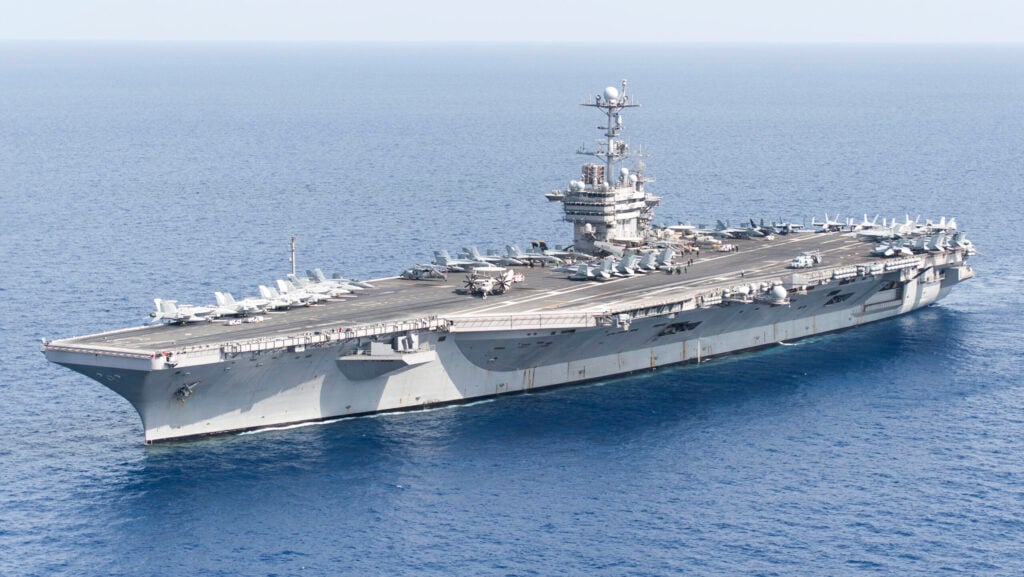
WASHINGTON — The results of four command investigations related to serious mishaps during the Harry S. Truman carrier strike group’s recent deployment point to inadequate training and poor performance by ship crews as well as their commanders, according to newly released Navy investigation reports.
The reports, which were heavily redacted for public consumption, paint a picture of strike group sailors and officers who erred in their judgment and failed to communicate properly while under exceedingly high pressure and operational tempo as the strike group was conducting operations to counter Houthi rebel attacks in and around the Red Sea.
The investigations released today cover the Dec. 22 incident involving the cruiser Gettysburg (CG-64) firing missiles at friendly F/A-18s, a Feb. 12 collision with the commercial vessel Besiktas-M, and two incidents in the spring when F/A-18s fell off the ship into the ocean. Some sailors sustained injuries from the mishaps, but there were no casualties.
A senior Navy official that spoke to reporters said the service had learned from its high-profile mistakes, including through the establishment of the Office of Warfighting Advantage which is specifically tasked with ensuring lessons from mishaps are incorporated into future training.
“I can’t tell you with full confidence that we’ve addressed every single thing that can happen. That’s why we’re inquisitive and open to understanding when something happens, and doing the new cause analysis to try to make sure that we prevent that from happening again,” the official said.
The first report, which was also the most heavily redacted, investigated a Dec. 22 incident in which the cruiser Gettysburg (CG-64) fired missiles at two friendly F/A-18s. Investigators found crew up and down the chain of command held some level of culpability in the incident for their failure to spot red flags or voice concerns, as well as their over reliance on the accuracy of the information from the ship’s technology.
But the investigation most heavily blamed Gettysburg’s commanding officer, stating his decision to engage the F/A-18s was “neither reasonable nor prudent.” Investigators found he had low situational awareness, and that the decision to engage the F/A-18s was incorrect across the “totality of information” available to the crew.


Winning the cognitive domain — A methodology built for democratic constraints
The challenge for Western democratic institutions is not a lack of capability — it is a structural one.
“A lack of integrated training opportunities between USS Gettysburg and the Carrier Strike Group, lack of forceful backup on the cruiser, and lack of cohesion across the Carrier Strike Group contributed to the misidentification, and subsequent engagement, of the friendly aircraft and near miss of another,” according to the Navy statement.
As for the F/A-18 pilots and their weapon systems officers, those individuals were not seriously harmed in the incidents. The investigation found that one crew’s decision to eject from their aircraft was justified and that while the second crew did not eject, they would have been justified if they had done so.
The report about the Harry Truman’s Feb. 12 collision with the commercial vessel Besiktas-M at a port near Egypt concluded that incident was “avoidable” and the investigating officers made direct comparisons to two incidents in 2017 when two Navy destroyers collided with other vessels, leading to the deaths of 17 sailors. Investigations into those incidents found crews had been inadequately trained and were severely overworked and regularly sleep deprived – issues the Navy said it would work to fix.
When asked about the similarities to the 2017 collisions, the senior Navy official argued the service had learned from those collisions, but added that the service is under manned, with 18,000 positions at sea not filled.
“The fleet commanders do not certify ships or squadrons or units to deploy unless they’re manned, trained and equipped to go execute that mission. That doesn’t mean we’re not going to put those sailors into challenging situations, as we did with Truman,” the official said.
Navy investigators said the aircraft carrier crew’s poor bridge resource management led to the incident and that eight sailors were in a small location close to where the impact occurred. While those sailors were not seriously harmed, the report, which was endorsed by Adm. Stuart Munsch, concluded by saying, “My team spoke with those eight sailors, and they will never forget how close they came to losing their lives. Neither should we.”
The April 28 loss of an F/A-18 into the ocean was found to be the result of a severe turn the Harry Truman made while evading enemy fire. At that moment, the crew was moving planes around the flight deck to prepare for operations. The report describes a series of complications that prevented them from following certain procedures that should have occurred after the ship announced the unexpected turn. The result was that the crew lost control of the plane and it ultimately rolled off the side of the deck.
Navy investigators blamed this at least partly on poor crew communication.
“While all actions taken were within standard operating procedures, the investigation determined that the primary cause was an aircraft brake system failure, compounded by insufficient communication between the bridge, flight deck control, and hangar bay control,” according to the statement.
“The crew’s quick thinking and resourcefulness prevented any personnel injuries or further damage,” the statement added.
The report stated the plane was worth $36 million and a dolly used to position it, which was also destroyed, was worth $61,000.
In the case of a similar May 6 loss of an F/A-18, Navy investigators found that an arresting cable snapped as the plane was attempting to return to the carrier. The report stated that sailors failed to spot a number of issues that should have been visible during pre- and post-operations inspections which led to the mishap.
For that incident, the damages totaled $60 million for the aircraft, $207,000 for repairing the cable and associated equipment as well as $47,000 for a life raft.
“The investigation found the failure was caused by a malfunctioning #4 starboard sheave damper,” according to the Navy’s statement. “Contributing factors included inadequate maintenance practices, low manning levels, limited knowledge, and insufficient training. The high operational tempo and combat conditions also contributed to a strained environment.”