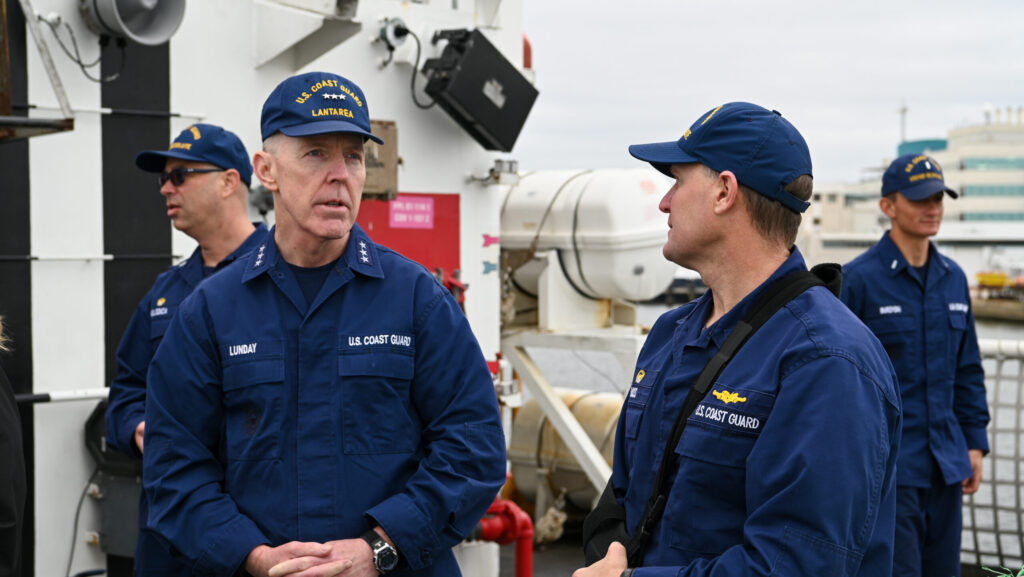
WASHINGTON — As the Coast Guard looks to “supercharge” its assets with a hefty $25 billion from the recent reconciliation spending bill, newly minted commandant Adm. Kevin Lunday said he is sizing up industry options to build additional icebreakers inside the US and sunsetting the MH-65 Dolphin helo fleet sooner than expected.
“Supercharge is exactly the right word,” the commandant told lawmakers today. “It is what is fueling the success of Force Design 2028 … [and moving] people closer to the front lines to be able to streamline and create an acquisition and contracting superhighway.”
Lunday, sworn in as the 28th USCG commandant on Jan. 15, delivered his comments before the Senate Commerce, Science and Transportation Committee’s Coast Guard, Maritime and Fisheries subcommittee, and fielded an array of questions including about the mix of light and medium icebreakers.
The USCG is eyeing 11 vessels, and so far has awarded deals for six new medium Arctic Security Cutters with two to be built in Finland, and up to four more to be built in the US. Those remaining five vessels could be a mix of the ASC and the lighter variant, but the service is looking for them to be built at home.
“We’re working on awarding additional contracts for five more that will onshore more shipbuilding into US shipyards, and strengthen America’s industrial base,” Lunday told lawmakers.
“We’ve gotten that input back [from industry] on both the light and the medium variants, and we’re analyzing that information right now as we develop an acquisition plan to move forward with acquiring the light and the medium icebreaking capability,” he said separately. “So we don’t have a specific breakdown of which of the numbers of each variant yet.”
RELATED: Why the US had to recruit help in race with Russia, China for Arctic icebreakers

Breaking Defense announces Breaking Defense Europe, a new, distinct, European edition
Breaking Defense Europe will launch May 4 with Tim Martin and Elisabeth Gosselin-Malo as co-editors.
After subcommittee chairman Sen. Dan Sullivan, R-Alaska, prodded the commandant about potential plans to home port some of those ACS in Alaska, Lunday said his team is currently working though options and up to four of those icebreakers could be bound for the Arctic state.
“We’re going to have to assign the people very soon, and we’re going to have to make decisions in consultation with the Department [of Homeland Security] and then in communication with Congress on what those home basing decisions will be and that will happen in 2026,” the commandant explained.
Last year President Donald Trump called for the Coast Guard to acquire up to 40 icebreaking vessels in total as part of a longterm modernization push, including what the Coast Guard says will be a handful of heavy Polar Security Cutters.
Growing the Coast Guard’s icebreaker fleet was one of several modernization topics lawmakers discussed with the admiral today. Up in the air, the committee also asked for service plans to modernize its helo fleet, in part, by buying MH-60 Jayhawk aircraft from Sikorsky.
Lunday said the service is still deciding what to do with its older MH-65 Dolphin helicopters made by Airbus, but right now it looks like those aircraft will stop flying before the initially envisioned 2037 date.
“The Dolphin is much harder to maintain. The original equipment manufacturer doesn’t supply parts, so we’re phasing those out … but we think the sunset is going to come much faster, given the obsolescence,” he told subcommittee members.