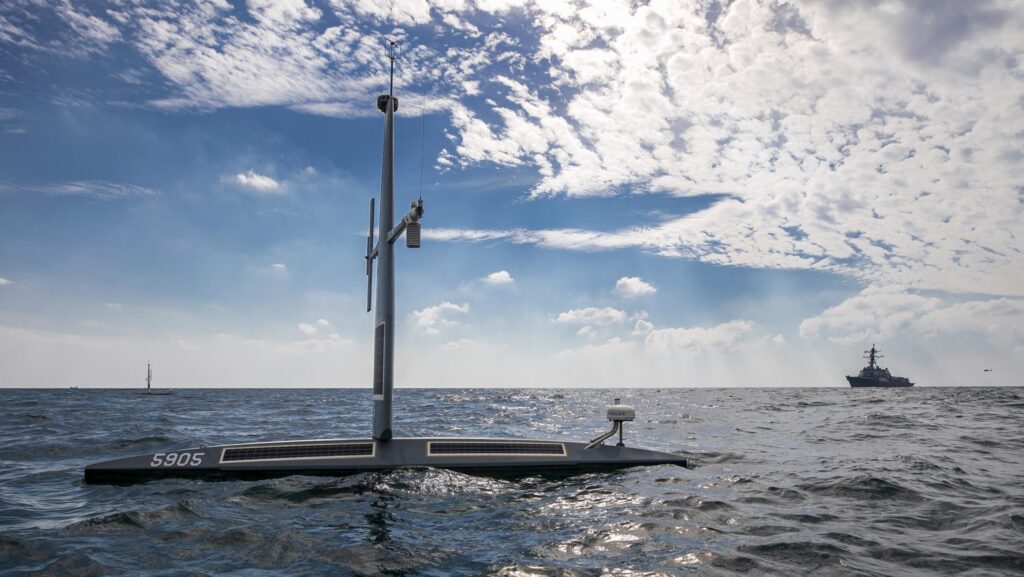
WASHINGTON — The Navy is considering establishing a robotic autonomous systems (RAS) commander to oversee unmanned capabilities amid a larger push to integrate unmanned vessels into the rest of the fleet, Chief of Naval Operations Adm. Daryl Caudle said.
Caudle unveiled plans to employ a hedge force strategy that seeks to capitalize on unmanned systems and create a range of tailored options combining various systems in his new “Fighting Instructions” framework. Included in these plans are directions for the Navy to figure out how to fully embrace RAS in its command structure.
“This RAS commander, if you will, knows how to command and control these packages of unmanned capabilities to achieve the mission outcomes that the strike group commander may want,” Caudle told reporters Feb. 10 at the WEST 2026 conference in San Diego. “Where my head is, and we’re not there yet, a RAS warfighting commander — it’s almost a joint task force commander just for these systems alone.”
The details of what the RAS commander role looks like are still being fleshed out, Caudle said, as he tackles an “unmanned dilemma” of how to organize RAS capabilities. While RAS is now arranged by domain, like undersea, aviation and cyber, a RAS commander could coordinate across the domains, he said.
“I can easily see a robotic and autonomous system commander, you know, as a first instantiation on the strike group staff,” Caudle said. “Now I’ve got a strike commander, I got an integrated air missile defense I’ve got a sea combat commander, I got an information warfare commander, and then, because of these capabilities, are certainly going to be across the main to advise that striker commander, best I can see a RAS commander too.”
Caudle’s “Fighting Instructions” also call on the Navy to outline how fleet commanders and the joint force will integrate RAS capabilities into “service decisions like strategic laydown, dispersal, and global force management.” While a standard, pre-existing model is currently employed to address needs like anti-submarine warfare demands, that’s not the case for RAS capabilities right now, the framework said.
“It’s a challenge making an ensemble of these types of capabilities in a meaningful way that combatant commanders and Navy component commanders can ask for it in a way that solves one of their key operational problems,” Caudle told reporters. “We don’t want this just to be a gadget, okay?”


Biodefense is force protection: Ready today, prepared for tomorrow
A decorated combat aviator and biotech CEO advocates preparing for novel viral threats before the next crisis.
Meanwhile, Caudle said that he wasn’t ready to publish an unmanned strategy just yet, adding that he needs to understand what the command structure to employ these forces would look like.
“We’re in this discovery phase of how we actually just now assemble command and control of these forces through the administrative chain of command so we can actually fill, maintain, sustain and train sailors to actually bring these kind of capabilities to bear,” Caudle said. “We’re in a nascent journey of how I build ensembles together to solve key operational problems.”