WASHINGTON — The Pentagon’s Defense Advanced Research Projects Agency (DARPA) is funding startup Diffraqtion to develop what the company said in an announcement today is “a first-of-its-kind quantum camera” capable of providing near-real time imagery at “up to” 20 times faster than that enabled by current optical surveillance cameras.
Johannes Galatsanos, Diffraqtion co-founder and CEO, told Breaking Defense on Monday that work under the the two-year, $1.5 million DARPA Direct-to-Phase II Small Business Innovation Research grant began last April and will end in 2027, following “on sky” demonstrations of the camera on ground-based telescopes owned by the Air Force Research Laboratory in Hawaii and the University of California Observatories Lick Observatory in Santa Cruz, Calif.
Further, he said, the company is working with the Space Force’s Space Domain Awareness Tools, Applications and Processing Lab in Colorado Springs, Colo. The lab is working to figure out “the best use cases and the timeline of use cases.”
Galatsanos, a graduate of Massachusetts Institute of Technology (MIT) and Oxford University who has a background in artificial intelligence, quantum tech and entrepreneurship, claimed that the quantum cameras can be fitted to satellites and ground-based telescopes for space surveillance. They also can be optimized for satellites and drones used for missile defense and terrestrial observation, he said, making them potentially of interest to the Defense Department’s Golden Dome initiative.
“This camera is very good because it is very fast and can look at very small things,” Galatsanos said.
He added that it also is capable of providing high-resolution imaging during daylight — something that is very difficult, if not impossible, for most current optical telescopes.
“When you have an asset in space you want to keep persistent custody, so you want tracking especially during daytime,” he said. “The biggest thing that we provide is to enable persistent custody and change detection also during daytime.”

Building logistics networks for contested environments
Explore how software, edge AI and resilient connectivity can strengthen military logistics in contested environments. Join Breaking Defense on Oct. 21 and earn 1 CPE credit.
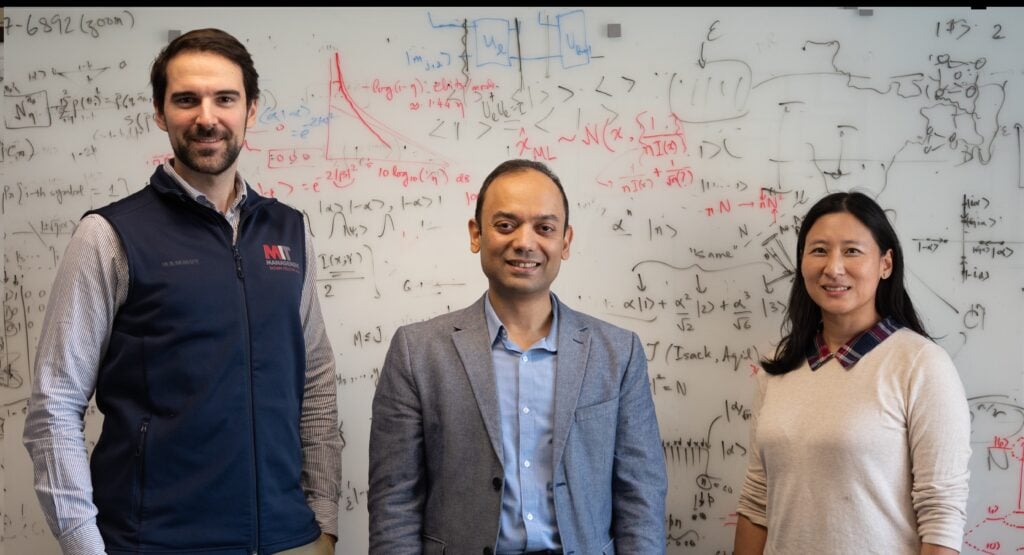
The novel quantum imaging technology is based on the previous research, funded by DARPA and NASA, of Saikat Guha, a quantum sensing scientist at the University of Maryland (UMD) and one of the firm’s three co-founders. The third founder is Christine Wang, chief technical officer and former director of optics and photonics research at Riverside Research.
“NASA was looking for aliens through exoplanet detection and looking for signatures of life on exoplanets. And DARPA was interested in space domain awareness, so looking at more objects very far away”, Galatsanos said.
At the very basic level, he explained, the camera’s lens processes images through a series of “programmable light plates” based on quantum algorithms into images and analytical products, such as a count of aircraft on the ground or showing the difference between nuclear warheads and decoys fired by an adversary.
Galatsanos noted that following the DARPA demonstration, Diffraqtion hopes to launch its first space domain awareness satellite, called Galileo-1 (after both the scientist and the firm’s canine mascot), in 2028. A second satellite, for Earth observation and Golden Dome missions, is planned for launch in 2029.
While Diffraqtion, headquartered in Somerville, Mass., is only a year out of stealth and still in the pre-seed funding stage, the MIT-UMD spinout has already attracted attention, and accompanying investment, from the venture capital world. For example, it won Europe’s annual SLUSH 100 award for technology innovators of €1 million ($1.17 million) in November 2025, and in August 2025 a $100,000 space innovation award from US accelerator TechConnect.
According to the company’s announcement, it so far has raised a total of $4.2 million in early investment.