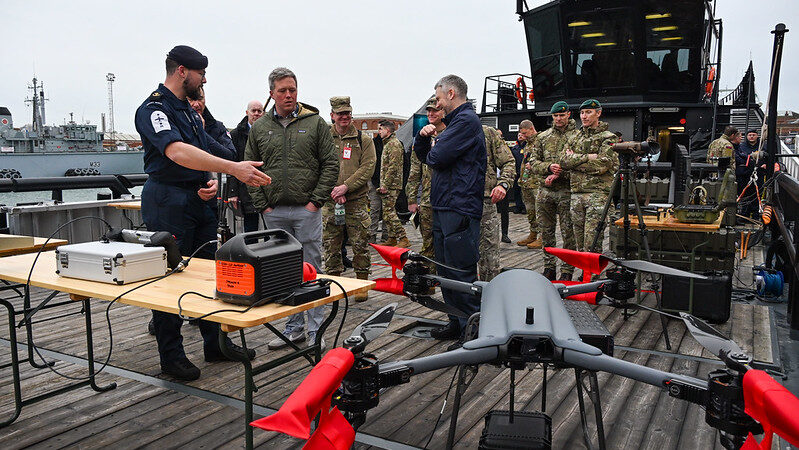
WASHINGTON — The US Army recently signed an agreement with the United Kingdom establishing ground rules for sharing intelligence on drone and counter-drone operations, the first of several team-ups that Army Secretary Dan Driscoll said he’s seeking with allies and partners.
Driscoll said he and Brig. Gen. Matthew Ross, the director of the Army’s Joint Interagency Task Force 401, traveled to the UK last month where the two allied nations worked together to establish the intelligence-sharing partnership.
“We signed a document with them that basically said, ‘Hey, we’re going to work on this together. We’re going to figure out how [….], like what are the rules for sharing information?’ Because drones can penetrate airspace so quickly and they’re so hard to predict. It’s not like a missile where you can predict a trajectory and act on it, you have to be able to exchange information,” Driscoll said during a town hall which took place at Fort Drum in New York, home of the service’s 10th Mountain Division, on Monday. Video of the event was published online today.
Driscoll added that the US is “going to try to expand that to a couple of other countries” so the service can ideally build and buy the same tools as its partners. He said the “end state” of such an arrangement would make the US and its allies “stronger” in a future conflict where they would have to fight together.
“We have a lot of the same software as our allies around the world. So when you train with them, when you travel, when you are deployed abroad, and when one day, if you have to fight with them … hopefully dealing with counter-drone and the threat of drones today has made us a lot stronger for that fight,” Driscoll said.
While Driscoll did not reveal what other nations would see a future drone intel arrangement with the Army, the service has been taking part in drone and counter-drone exercises and competitions with other partner nations in recent months. As Breaking Defense reported in November, the Army and vendors from the US and allied nations hosted a competition, dubbed Flytrap 4.5, to counter simulated threats from Group 1-3 (small- to medium-sized) drones operating in NATO airspace.
At the same time, other American soldiers from the 10th Army Air and Missile Defense Command joined their Polish and Romanian counterparts to train together for 10 days, learning how to operate the American-made Merops counter-drone platform, which has been used in Ukraine for just short of two years.

Breaking the Pentagon’s new bottleneck of time
As threats evolve, the winning model ties digital engineering to manufacturing capacity and a reindustrialized supply chain.
Further, last February India and the US established an alliance for autonomous systems, called the Autonomous Systems Industry Alliance, with the aim of “scaling industry partnerships and production in the Indo-Pacific,” a joint memo read. The alliance included a plan for Anduril and the Mahindra Group to work on autonomous projects together including to co-develop and co-produce “advanced AI-enabled” counter UAS capabilities.
Task Force 401 Picks First Replicator 2 c-UAS Systems
Driscoll’s relevation about the teaming agreement came as Task Force 401 announced its first counter-drone purchase under the second phase of the high-profile Replicator acqusition program. The Pentagon said the task force is procuring “two advanced DroneHunter F700 systems, which are expected to be delivered by April.”
The DroneHunter F700, made by Fortem Technologies, is a six-rotor unmanned aerial system that fires nets to capture other drones mid-air, according to the company’s website. “Once the F700 is within range of the target, escape is highly improbable,” the company maintains. “Statistically, only 15% of target drones evade the first shot… and a second shot is usually ready to follow.”
In the Pentagon’s announcement, Ross said, “We have just one measure of effectiveness: to deliver state-of-the-art counter-UAS capabilities to our warfighters both at home and abroad. This purchase of the DroneHunter system is a key first step in accomplishing our Replicator 2 mission.”