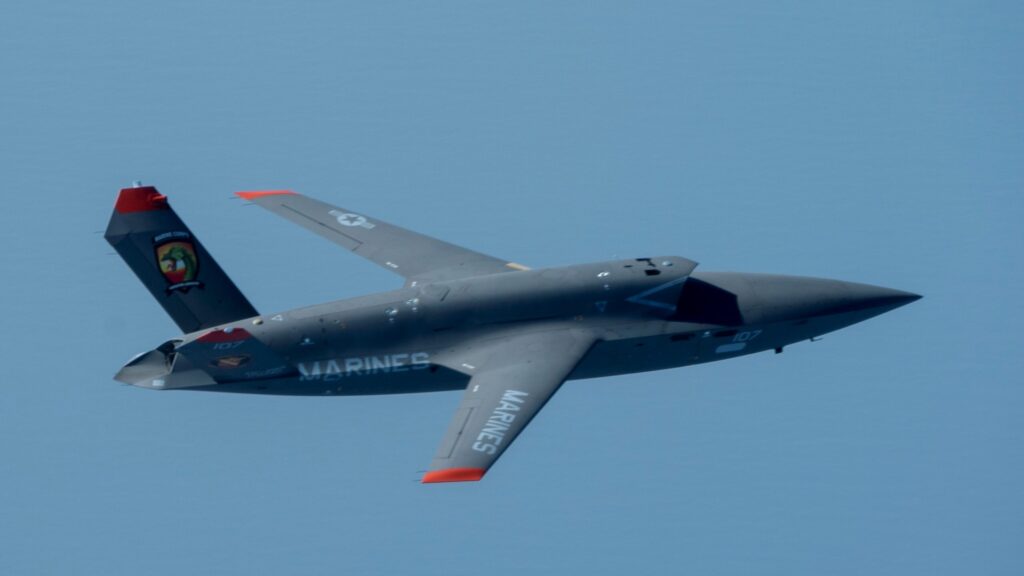
WASHINGTON — The US Marine Corps has selected a team of Northrop Grumman and Kratos to deliver the service’s first batch of drone wingmen, the companies announced today.
Under the Marine Air-Ground Task Force Uncrewed Expeditionary Tactical Aircraft (MUX TACAIR) program, Northrop will serve as the prime contractor, integrating mission equipment onto Kratos’s unmanned XQ-58 Valkyrie. Northrop will also supply the company’s Prism open architecture software for autonomy, according to a press release.
The award, the sole one for the MUX TACAIR effort, is an Other Transaction Agreement, which comes with an initial value of $231.5 million, Krys Moen, vice president of advanced mission capabilities at Northrop Grumman, said in response to questions from Breaking Defense. “The OTA covers development with an initial period of performance of 24 months,” Moen added, who said that program milestones are not releasable.
Steve Fendley, president of Kratos’s unmanned systems division, added in the release that “[t]he integration of the Kratos Valkyrie aircraft system configured with the world’s best multifunction mission systems from Northrop Grumman results in a high-capability CCA at a price point that enables the uncrewed systems to be deployed in mass with crewed aircraft.”
The teaming arrangement between Northrop and Kratos — where Northrop is serving as a systems integrator for a platform manufactured by Kratos — is somewhat unusual. Moen told Breaking Defense that the necessary “collaborative integration” led to a joint decision to pitch the Marine Corps on the concept with Northrop serving as the lead, which “provided the best approach for MUX TACAIR.”
Northrop “is still in the process of negotiating and awarding subcontractors, including commercial entities,” Moen said.
Like similar efforts underway with the Air Force and Navy, the MUX TACAIR program aims to produce Collaborative Combat Aircraft drones that can pair with manned jets in battle, providing a force multiplier for missions like surveillance, electronic warfare and kinetic attack. Officials say the drone wingmen will provide “affordable mass” that can offset challenges with shrinking numbers of platforms like fighters.

Meeting Zero Trust goals while maintaining information dominance
Balancing security and access to data are critical to providing users with trustworthy, reliable data for real-time decisions.
Budget documents released last year show a request of $58 million for MUX TACAIR program in fiscal 2026, which will fund the delivery of a “prototype air vehicle with fully integrated mission systems” to demo tasks like takeoff and landing and command and control. The budget documents say the MUX TACAIR will proceed as a rapid prototyping program, which permits quicker fielding of mature systems so long as they can be declared operational within a five-year timeframe.
MUX TACAIR will develop drones with a “spiral approach” for fielding new capabilities, according to the documents, suggesting new features will be iteratively introduced on platforms. The documents list this stage of MUX TACAIR as the first “increment,” adopting nomenclature similar to the Air Force that suggests successive increments will follow. The press release says the MUX TACAIR contract was “competitively awarded,” and budget documents discuss awarding as many as three OTAs for a previous stage of the program, but it’s not clear what other companies may have bid.