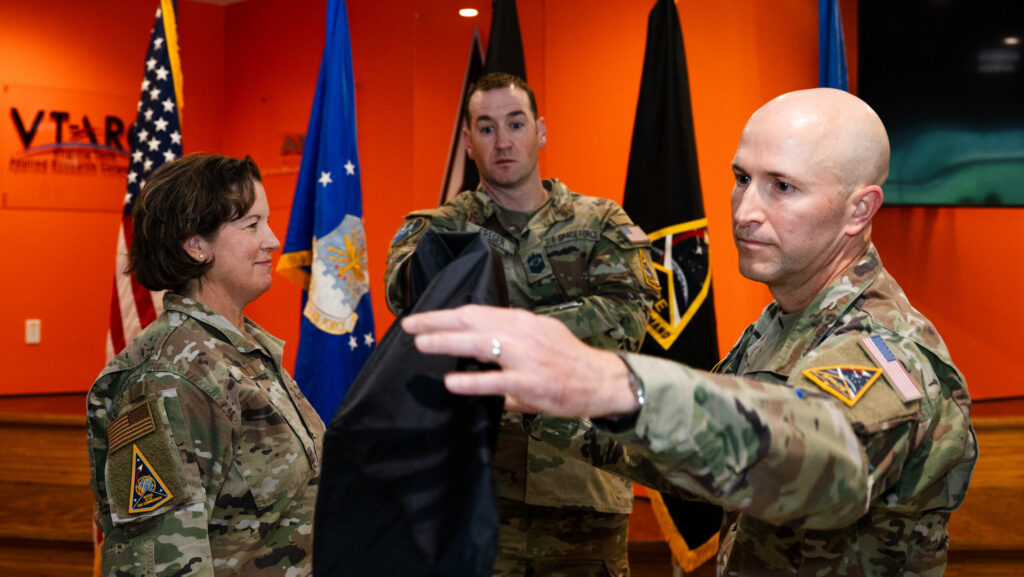
WASHINGTON — The Space Force is planning to issue a new contract this summer to create a pool of qualified vendors to help fill Guardian needs for hands-on training in electronic, cyber and orbital warfare — with the latter to eventually involve dedicated satellites on orbit, according to service officials leading the effort.
Col. Corey Klopstein, program executive officer for Operational Test and Training Infrastructure (OTTI) at Space Systems Command, said that work on an acquisition strategy for development of the OTTI program’s “physical/live environment(s)” line of effort is expected to wrap up “in this calendar year.”
The development of physical/live training capabilities and ranges is one major sub-efforts being pursued by the OTTI program, along with the creation of a digital environment for virtual training, and a basic layer of infrastructure such as modelling and simulation tools and secure facilities.
Speaking to reporters on the margins of the Space Mobility Conference in Orlando, Fla., on Jan. 23, he explained that a “gap analysis” of physical/live training needs was completed by by staff at SSC’s new(is) System Delta 81 in December. System Delta 81 is responsible for delivering capabilities to Space Training and Readiness Command (STARCOM), with Klopstein double-hatted as commander.
The resulting acquisition strategy is nearly completed, he told the Space Mobility audience in a presentation the same day on OTTI plans, and the next step is an indefinite delivery/indefinite quantity (ID/IQ) contract expected to be released this summer.
The idea of using an ID/IQ approach is to establish a pool of qualified vendors who can fulfill specific requirements over a period of time.
Klopstein’s shop on Dec. 17 issued a “special notice” providing industry with a series of documents, all stamped as controlled unclassified information so thus not publicly available, detailing its overarching OTTI architecture. The documents are designed “to provide industry with awareness and facilitate informed planning for future opportunities,” the announcement said.

Why Bigger Fences Aren’t Enough in the Age of Drones
Traditional thinking about how to protect facilities must adapt to new threats such as drones or downstream attacks.
Lt. Col. Curtis Babbie, head of physical test and training at System Delta 81, also spoke at Space Mobility, saying that the OTTI program is not just looking at buying software and hardware, but also considering whether using commercial services for some training activities might be an option.
One of the questions explored by the gap analysis was, “‘What do we need to do organically versus commercially?’ So, we’re starting to look at potential commercial services,” he said.
Klopstein chimed in: “So, we’re open to ideas on how you could bring commercial assets as a service for us to leverage for either test or training for our Guardians.”
On-Orbit Training Range: Blue Force, Aggressor and Sensor Satellites
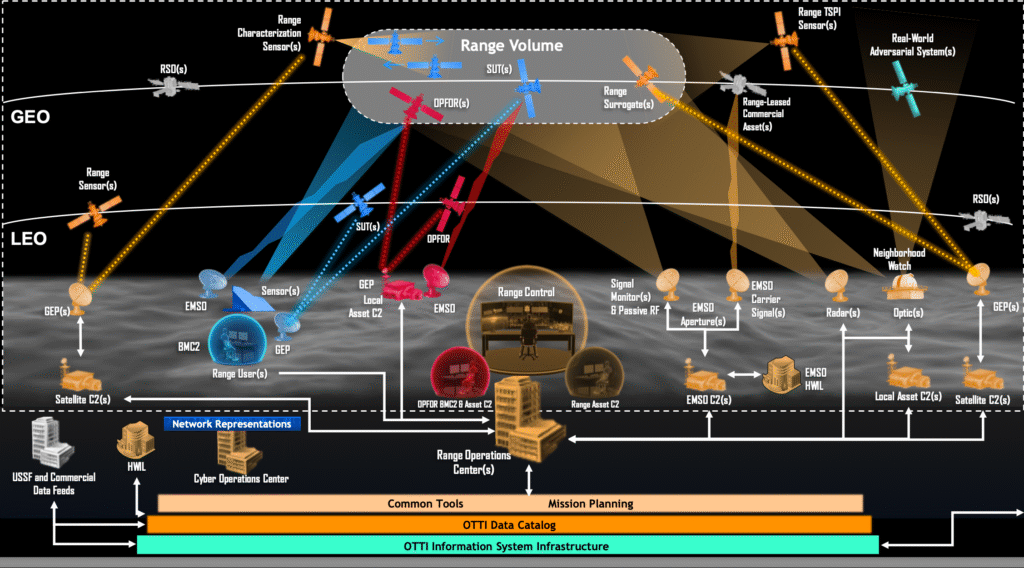
While the Space Force is working to improve training capacity across the electronic, cyber and orbital warfare mission areas, senior Space Force officials are putting a high priority in the establishment of a new ‘orbital training range‘ to enable Guardians not just learn to operate satellites on a day-to-day basis, but also to practice defensive and offensive space warfighting tactics.
Gen. Stephen Whiting, commander of US Space Command, told reporters Wednesday that while space operations are “ideally suited” for synthetic training, live training is also “vital” and should include the use of refuelable satellites that can be used for training but repurposed if needed for real-world missions.
“It’s really a mix of all three. You need some dedicated live training assets. You need synthetic simulations: simulators to train in. And then you want capability moving forward that is refuelable and and can be repaired, so that you can go train with that too, and then you can refuel and repair it for when you need it for operation,” he said.
At Space Mobility, Klopstein explained to reporters that live training includes the “traditional type of assets that you would think of when you think of building a space system: on-orbit assets, space and ground sensors, and a ground system to be able to control those things.”
In addition, he said, the OTTI program is “building out hardware-in-the-loop facilities on the ground that are specific to testing, whether that’s payloads or certain aspects of systems.”
Breaking Defense Video