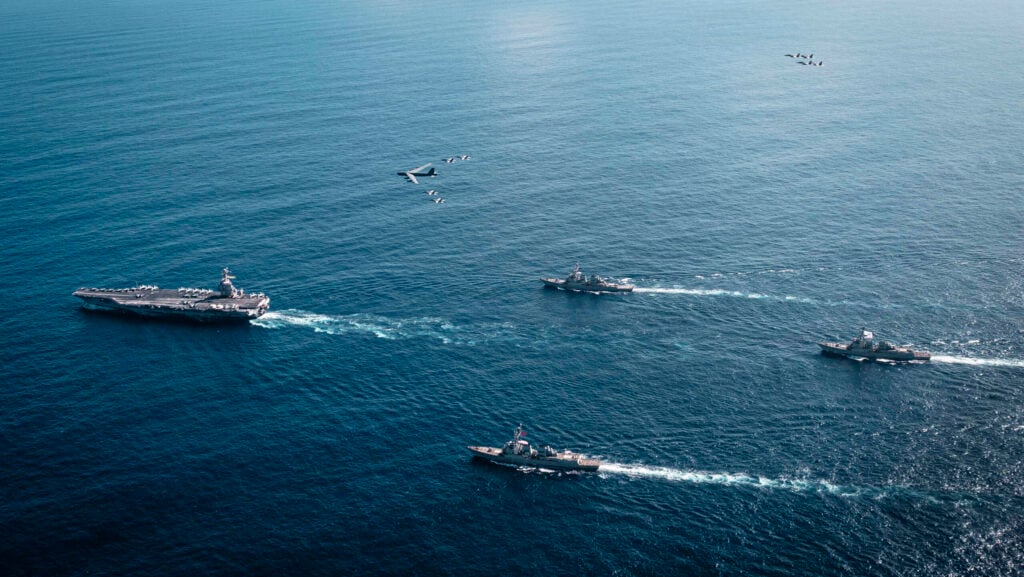
For the first time since the Second World War, the United States faces a peer naval rival able to challenge American control of the seas and global trade.
The Chinese Communist Party has spent a generation building a fleet that can contest sea control and turn industrial scale into military power. Its rapid naval buildup, combined with dominance in commercial shipbuilding, is shifting the balance of power at sea and eroding US advantages.
At the same time, regional authoritarians like Iran and extremists create a constant global demand for naval forces. The Navy is asked to do more with less, patrolling an ever-wider map with a fleet that is smaller, older, and increasingly brittle. Readiness problems and maintenance backlogs now threaten America’s ability to respond when crises erupt.
This moment demands a fundamental rethink of US maritime strategy, the fleets that support it, and the industrial base that underwrites military power. That is why Congress created the National Commission on the Future of the Navy. The bipartisan panel is charged with helping the United States Navy and Marine Corps compete, deter, and win with modern tools and concepts against sophisticated adversaries.
This has been a long time coming. While we were announced in 2022, it wasn’t until 2024 when members were named and late 2025 when funding was approved. There’s a lot of ground to make up, so we’re aiming to work fast — and we want to hear from stakeholders across the country.
The commission will be holding public hearings in 2026, culminating in a submission of its recommendations in early 2027. These are likely to cover everything from how America builds and buys ships consistent with efforts like “Re-Industrialize 2.0” and the Maritime Action Plan, to more subtle changes in policy and law that support new ideas like the recently announced hedge strategy.
In partnership with the executive branch, the commission will focus on three core problems.


Undersea superiority: ASELSAN’s integrated approach to naval defense
As global navies adapt to evolving underwater threats, ASELSAN’s integrated sonar, countermeasure, and sonobuoy solutions offer a scalable, future-ready approach.
First, it will test emerging ideas such as a hybrid fleet and expanded use of unmanned systems against how the Navy actually fights and what realistic budgets will allow. A distributed fleet that combines manned platforms with unmanned surface and undersea vehicles can expand sensing, complicate enemy targeting, and cover a wider area.
Second, the commission will examine recurring shipbuilding and maintenance failures that have turned too many plans into paper fleets. Shipyards struggle to deliver on time and on budget, while schedules slip, costs rise, and the nation pays for ships that never reach the fleet. The recent cancelation of the Orca unmanned undersea vehicle and Constellation-class frigate are harbingers of how good intentions can still leave the fleet short.
Third, the commission will confront the constant global demand for naval forces that makes rebuilding the fleet even harder. From operations in the Red Sea to recent deployments in the Caribbean, American leaders turn to the Navy because it can project power from the sea while limiting the political risks of large ground deployments. That demand strains the force and compounds problems in shipbuilding and maintenance.
Responsibility for this predicament extends beyond the Pentagon. Legacy policies and laws have produced perverse incentives across the defense industrial base and federal bureaucracy. Paper cuts are sinking ships. The commission will therefore make recommendations not only to the Navy but also to Congress, the White House, and industry. The United States cannot afford to concede the high seas to an authoritarian rival, even if voices in both parties argue for turning inward.
To develop practical options, the commission will undertake an ambitious research and outreach agenda. Members and senior staff will meet with senior political and military leaders, junior officers and new recruits, and defense firms large and small. They will cast a wide net to understand how different constituencies define the problem and where they see opportunities for change. The commission will also solicit ideas directly from the fleet through professional military education institutions, shared staff, and essay contests so sailors and marines have a voice in shaping the force they will fight.
This outreach will drive a streamlined research effort that starts with a simple question: a navy for what? The commission will use prior studies and new analysis to build a set of threat and budget informed planning scenarios grounded in fiscal realities. It will then assess how different fleet structures, including mixes of manned and unmanned ships and aircraft and Marine Corps formations, perform across those scenarios while a parallel effort examines whether the American maritime industrial base can actually build and sustain the fleet.
The result will be a menu of strategic choices, force structure recommendations, and reforms on how America buys, builds, and operates its gray-hulled fleet. The commission will share options with the Department of the Navy, Congress, and the White House, then deliver a final report that can inform hearings and a broader public debate about the nation’s role at sea.
Sir Walter Raleigh once wrote, “Whosoever commands the sea commands the trade. Whosoever commands the trade of the world commands the riches of the world, and consequently the world itself.” For Washington, which depends on open seas, stable markets, and credible deterrence, the task is clear.
The United States needs a Navy that can secure its sea lines of communication and safeguard its trade in the face of emboldened adversaries. To make that happen, we need your feedback. Send us your ideas about how to unleash a new era of seapower.
Mackenzie Eaglen is the Co-Chair of the National Commission on the Future of the Navy and a senior fellow at the American Enterprise Institute.
Filemon Vela is the Co-Chair of the National Commission on the Future of the Navy and former Congressmen from Texas.
Benjamin Jensen is the Executive Director of the National Commission on the Future of the Navy and a senior fellow at the Center for Strategic and International Studies.