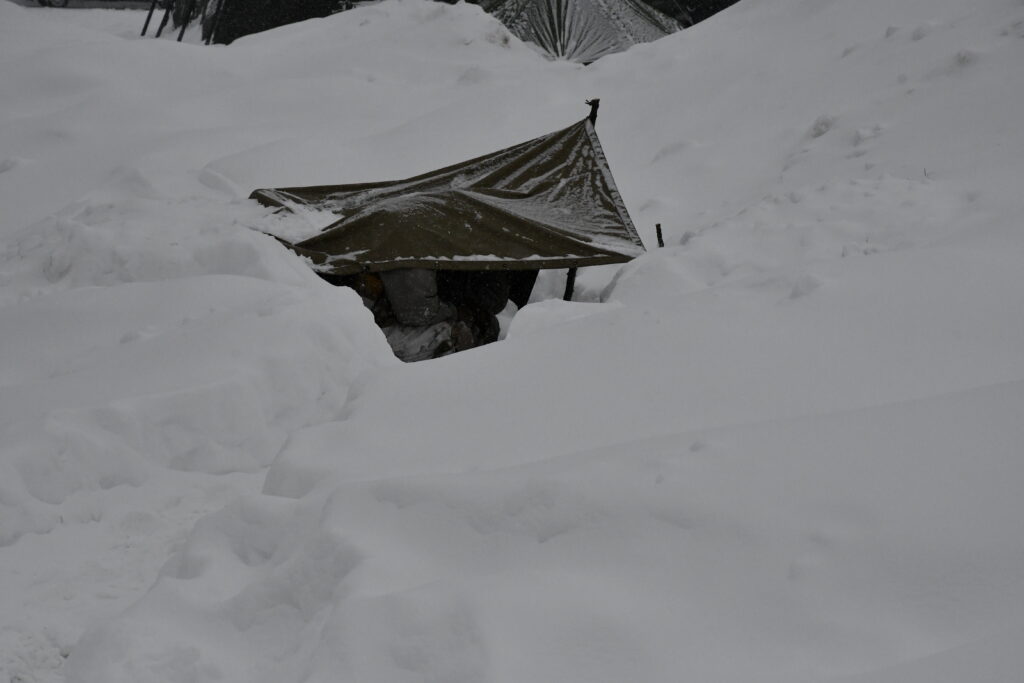
YUKON TRAINING AREA, Alaska — About 30 miles southeast of Fairbanks, soldiers from the 2nd Infantry Brigade Combat Team, 11th Airborne Division periodically bob their heads in and out of their six-foot deep hole in the snow, covered by only a camouflage tarp as they kept watch for their “enemy:” the 1st Infantry Brigade.
The soldiers usually try to move as little as possible in such positions to conserve body heat in temperatures that average around negative 20 to 40 degrees with wind chills much colder here this time of year, but today the soldiers seem restless. It is an abnormally warm day at a balmy 18 degrees.
“Securing Alaska, and the Arctic, is a prime example of how the Army will defend our homeland,” Gen. Randy George, chief of staff of the Army, told Breaking Defense in a thankfully heated conference room. “We must be prepared to operate in any environment and terrain — the Arctic is no exception.”
During this exercise, Joint Pacific Multinational Readiness Center (JPMRC) Rotation 26-02, soldiers in the 1st IBCT are attempting to track down and defeat those in the 2nd IBCT to emulate what a mutli-domain battle would look like in the Arctic. After two decades fighting in the Middle East, the US military is putting new emphasis on the potential for a freezing fight in the north as the Arctic’s strategic value grows and the Pentagon reorients to homeland defense.

Building the stand-off and stand-in weapons needed for the fight
Threats have changed the range, seeking and attack capabilities necessary to ensure effectiveness.
No Tablets For Frostbitten Fingers
JPRMC 26-02 is the fifth exercise of its kind that the division has taken part in since it was reestablished in 2022, Gen. John Cogbill, commanding general of the 11th, told reporters here in Alaska. The 11th is also deployed to the Indo-Pacific theater, he added.
The number one problem the 11th is currently facing is how to maintain smooth logistics and sustainment operations in such austere conditions, Cogbill said. He explained that “everything takes longer in the Arctic.” The terrain and conditions limit the amount of space for equipment like field artillery and also botch plans for attacks and counter-attacks.
It doesn’t help that everything breaks at negative 40 degrees, he added.
Even exposing a finger to use a tablet or mobile device in such frigid air can cause frostbite, as it did with one soldier here, Col. Chris Brawley, commander of the 1st Brigade IBCT, said.
The Army has now given the soldiers the option to use styluses when using such devices, but even that can be a difficult task considering the thick mittens soldiers usually wear.
The tablets themselves and similar devices are also at risk. Brawley said tablets often crack around negative 40 and the battery life drains rapidly in the cold, so the division has been experimenting with chargers that have built-in heating packs. So far, they’ve been working well, he said, but this still doesn’t prevent the screens from cracking.
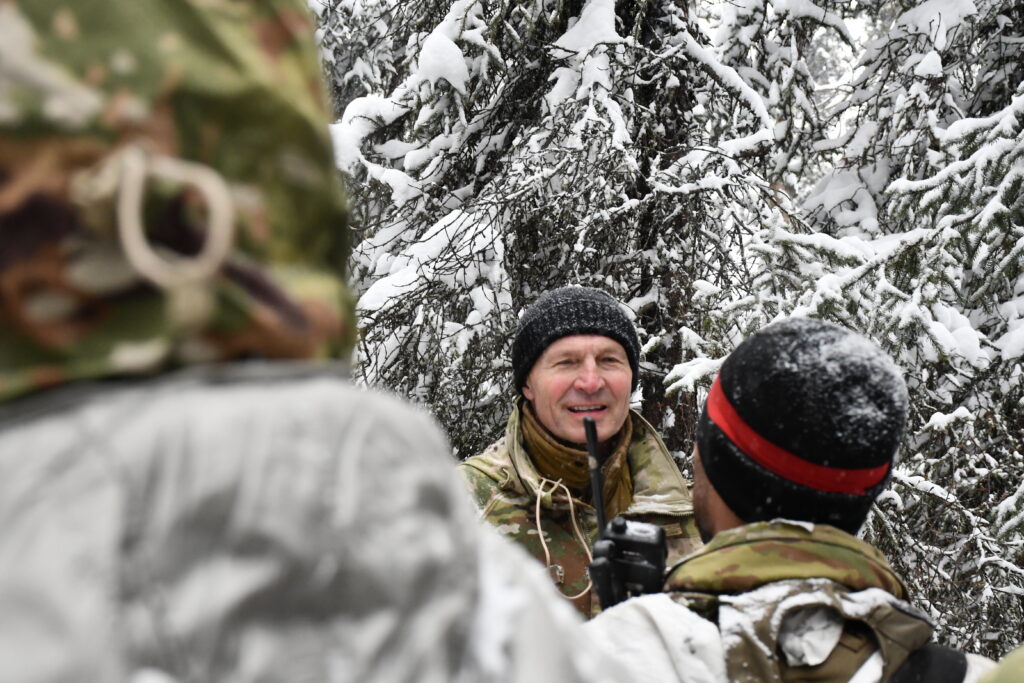
Drones also face the same issue with draining batteries, with many devices only able to fly for 10 minutes or less at full throttle once temperatures hit below negative 20 degrees. Like with the tablets, soldiers are experimenting with battery chargers with built-in heating packs and insulated batteries. Those have been working, Brawley said, but they need them at a larger scale.
The material drones are made out of also plays a pivotal role in how well they can perform in the Arctic. For example, Brawley said carbon fiber does well in cold environments, but other materials such as Styrofoam do not. Further, the harsh winds and heavy snowfall, coupled with complicated tree lines make it difficult to navigate, he added.
The division has been experimenting with different types of drones, and one EW technician told reporters that they have had success with the Vector AI drone from Quantum Systems, which the technician said can fly for up to three hours in negative 20 to 30 degrees.
Still, the weather is always an issue. Soldiers have yet to find a small drone that can consistently fly in more than light rain or “dry snow,” the technician said.
‘We Had A Beautiful Plan … And Then …’
On the topic of botched plans, Brawley said the environment “really slow[s] down our ability to get the maneuver units into the right spots.” Problems, appropriately, seem to snowball.
“We had this, like, beautiful plan […] and we had it all mapped down, and then a unit gets there, and it’s up to my neck in snow,” Brawley told reporters. “So we’re going to need a bulldozer to get it out. Now, I gotta figure out how to get the bulldozer in there. In the meantime, that unit has to go somewhere, so they are displaced to another spot. Well, that was the place where I planned to put my artillery. So it becomes a space problem for us, and how you’re what you’re sequencing into the fight at the right moment, at the right time.”
Brawley said working out the kinks takes time, but in the meantime he’s learned that the division could have better utilized their engineers more effectively during this exercise.
On the bright side, he said the division’s growing number of the Cold Weather All-Terrain Vehicles (CATV) have helped tremendously in allowing soldiers to get from point A to point B more seamlessly. They’re also warm.
Another officer told reporters the 11th could use its own sustainment brigade. Col. Reggie Harper, deputy commanding officer for support within the 11th, said George recently made a decision to “provide resources” for such a sustainment brigade, though the timing is to be determined on when the brigade will stand up.
Nonetheless it is a “huge, huge win for the division,” Harper said, as it will bring in O-6s with up to 20 years of experience into the division to help solve the tough logistic and sustainment challenges it faces.
Staying Warm But Undetected, And Fed
Solving the logistical challenges that comes with cold weather operations is only half the task, however, as the fighting force won’t be much good if the soldiers themselves aren’t in fighting form and motivated.
“We essentially have to dangle two carrots in front of the soldiers at any moment: The soldiers have to know when they’re gonna get warm and they have to know when they’re gonna have their next hot meal,” Brawley said. “Essentially, if they have those two things, they will fight forever.”
Part of staying warm calls for soldiers to stake out and sleep in Arctic 10-person tents, which weigh about 300 pounds and include a 70-year-old system that pumps diesel fuel through a stove keeping the tent warm.
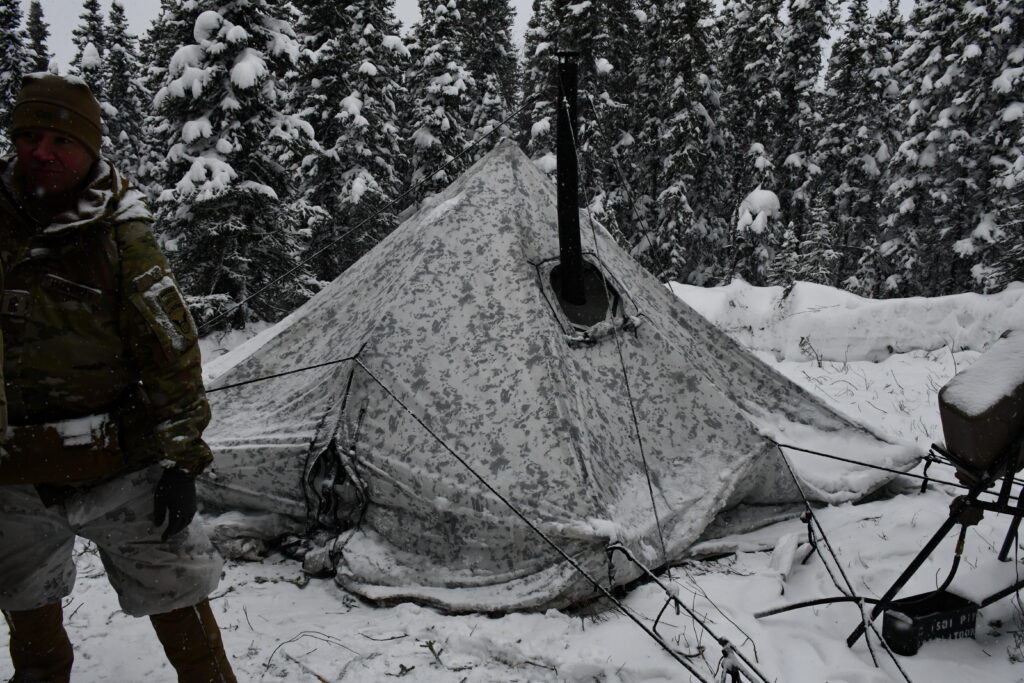
The modern problem is the tents also emit a significant heat signature, which could easily give away the soldiers’ location to enemy spotters or drones. The same is true for tactical command posts where soldiers carry out their command and control and electronic warfare operations.
To solve this problem, the Army has fielded large tarp-like mesh nets that are camouflaged into the environment and hide the thermal and EW signatures.
Command Sgt. Maj. of the 1st Brigade, Jeremiah Waggoner, did point out one problem with the nets though: Often soldiers still have to use their Starshield terminals inside their command posts, and to get a good signal they need a mostly unobstructed line of sight to satellites overhead. So, soldiers tend to just cut holes in the nets. That, Waggoner said, is better than nothing when it comes to what the enemy may see on their sensors.
“It’s not going to be able to, like completely vanish, but if I look like a company command node, and I’m actually a brigade command node, that goes down the targeting list. So you know, every little bit helps, and these have helped out tremendously, even if the StarShield’s a little bit exposed or giving something off, it’s not emitting this giant bubble,” he said.
All in all, though the 11th still must evaluate how to solve a slew of problems, it has been able to transform at a “rapid” pace in the four years since it was reestablished, Cogbill said.
“It’s just a great example of rapid transformation, like transforming at the speed of war,” he said. “We’re not just up here in Alaska to show we can do things in the cold, but we have operational plans in the INDOPACOM, we have homeland defense rapid response force requirements. So all of these things translate to these soldiers. Meaning you have a mission, you matter. You’re not only the Army’s only Arctic division, but you’re worldwide deployable.”
“So all that, I think, builds to a culture that makes people want to come here, and it makes them want to stay here. Once they get here, they don’t want to leave,” he added.
As for the 2nd IBCT huddle in that deep ditch in the snow, soldiers there braced for a long day and night. The 1st ICBT could “attack” at any moment, and all the while the 2nd would be battling perhaps a more dangerous foe: the cold.