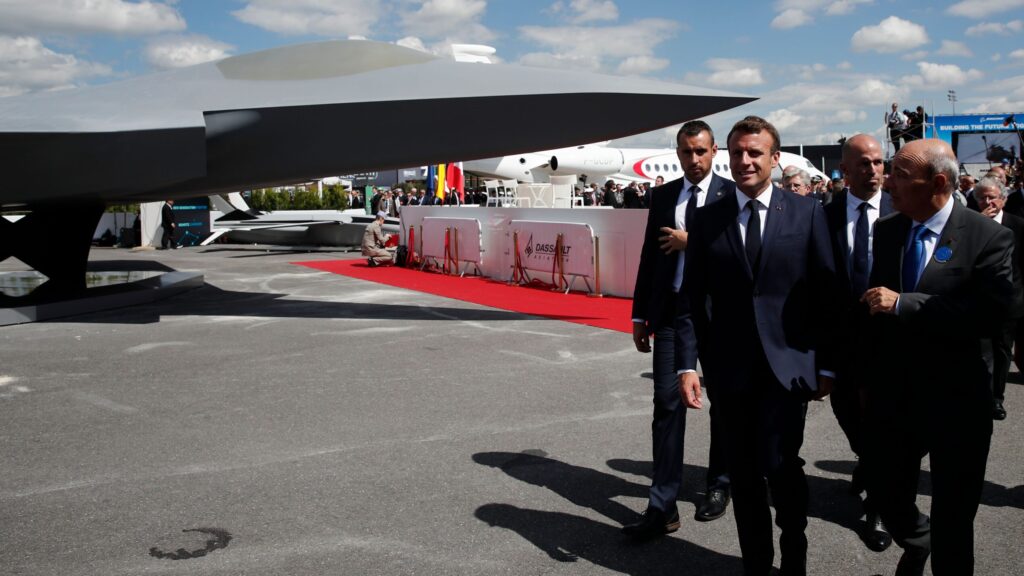
BELFAST — Europe’s Future Combat Air System (FCAS) program has felt like it’s been on life support for months now. But comments from German Chancellor Friedrich Merz this morning may represent the unofficial pulling of the plug on the effort to produce a sixth-gen fighter for France, Germany and Spain, with one European defense minister stating flatly that the comments mean FCAS is “dead.”
During an interview with German politics podcast Machtwechsel, Merz said “The French need, in the next generation of fighter jets, an aircraft capable of carrying nuclear weapons and operating from an aircraft carrier,” before adding “That’s not what we currently need in the German military,” strongly hinting that Berlin is soon to walkaway from the New Generation Fighter (NGF) aspect of FCAS, if not the entire deal altogether.
The stance that Germany and France now share fundamentally different program requirements for the jet is a new political approach, but one that simply builds on a long-running industrial dispute between Germany’s Airbus and France’s Dassault over NGF leadership.
Citing Merz’s comments, Belgian defense minister Theo Francken — whose country has been an official observer in the program to potentially join in the future — said on X “SCAF is dead,” using the French acronym for the jet.
“There will be no Franco-German sixth-generation fighter jet,” Francken wrote. “Belgium was an observer in the program. We will reassess our position.”
The sixth-generation fighter effort sits at the very core of FCAS, accompanied by new weapons, drone wingmen and a “combat cloud” communications network. Spain, led industrially by Airbus, is a third national partner involved in the multibillion dollar project, but has largely taken a backseat to Paris and Berlin when it comes to the politics of the program.
Merz’s comments are likely to raise eyebrows in Paris, which has tried to play down any differences of opinion among decision makers in recent weeks. France’s Elysee Presidential Office had not responded to a request for comment at press time.
Calls for program restructuring under a two aircraft approach, set out by Germany’s largest industrial trade union and a prominent aerospace lobby, were intensified on the sidelines of the Munich Security Conference last week.
With NGF facing collapse, an industry source said at the politically charged event that reshaping FCAS to focus on shareable technologies is still feasible — but two distinct fighter jets, one potentially developed by Germany and Spain, the other by France, forms the likeliest basis of new long-term industry planning.


Streamcaster Nexus: Empowering the connected soldier at the tactical edge
On today’s battlefield, mobility isn’t optional - it’s mission-critical.
However, there is plenty of skepticism that Europe can really handle three next-gen fighter projects, when the British-Japanese-Italian GCAP is factored in. Among those skeptics is Francken, the Belgian defense minister., perhaps a sign that feasibility of development will factor into where Belgium looks for its next-gen fighter.
‘Let It Go Without A Funeral’
Over the last year, there have been signs the FCAS program was falling apart, but no one seemed quite ready to declare it’s over. But following reports over the last two weeks plus Merz’s statement today, analysts are more willing now to say the program is effectively toast.
“My sense is that it’s been clear for a year or two that FCAS is dead, it just won’t lie down, because it’s a political project,” said Paul Taylor, senior visiting fellow in defence and security at the Belgian-based European Policy Centre think tank.
But akin to a “very slow motion strip tease,” Merz’s latest assessment is another way of saying “this thing is dead,” he told Breaking Defense. “It’s very hard to bury a Franco-German political project, and you probably need other Franco-German projects to kind of supersede it, so that you can quietly….let it go without a funeral.”
Paul Lever, the former British ambassador to Germany, agreed, saying “My guess would be, Merz is preparing the ground to cancel the project. And of course, the project has been foundering for some time, partly because the Germans are saying they can’t work with Dassault. Dassault wants a share of the work that is grossly disproportionate, and [CEO Eric Trappier] is unwilling to pass on secret information about the engineering aspects. Financially, it’s all getting a bit of a disaster.”
Taylor noted that despite collaboration on a common fighter jet ending, there could be other items that FCAS partners “try and keep alive,” including the combat cloud.
Taylor also said that Dassault holds the option of upgrading the Rafale fighter jet, as that program has gained substantial export market share. It has been widely reported that French President Emmanuel Macron will finalize a sale with India for 114 of the combat jets, as part of his ongoing visit to the Asia-Pacific country.
In the analyst’s view, Germany must first work out what kind of next generation fighter it wants before potentially embarking on moving ahead alone or considering working with a partner nation to make new investments “affordable.”