WASHINGTON — Senior Army aviation leaders are aiming to have the Improved Turbine Engine Program (ITEP) reach its full qualification rating in the next couple years, signaling the program is moving along despite previous delays and a near cancellation as part of the Army Transformation Initiative (ATI).
“So projected dates last year we were looking out in the late 20s. Now we’re thinking sometime in [20]28 probably for full qualification. Of course, funding dependent,” Brig. Gen. David Phillips, deputy of Program Acquisition Executive for Maneuver Air told Breaking Defense.
The original plan was to have two ITEP prototypes delivered for the now cancelled Future Attack Reconnaissance Aircraft program in 2022, according to a Congressional report. The maker of the engine, General Electric Aerospace, said they delivered the engines in 2023 for FARA. But since the plan changed to only incorporate the ITEP in UH-60 Black Hawks and AH-64 Apache aircraft, the timeline for the service to fully field the ITEP was further delayed. The Army also announced it would sunset the program last year in line with the ATI.
Congress, however, pushed back against that decision and handed the service $175 million in fiscal 2026 funding and $63 million in reconciliation money. It’s still unknown when the Army will began fielding the engines, and a spokesperson for PAE Maneuver Air told Breaking Defense that timeline depends on when full qualification — which entails around 6,500 hours of testing — will be completed.
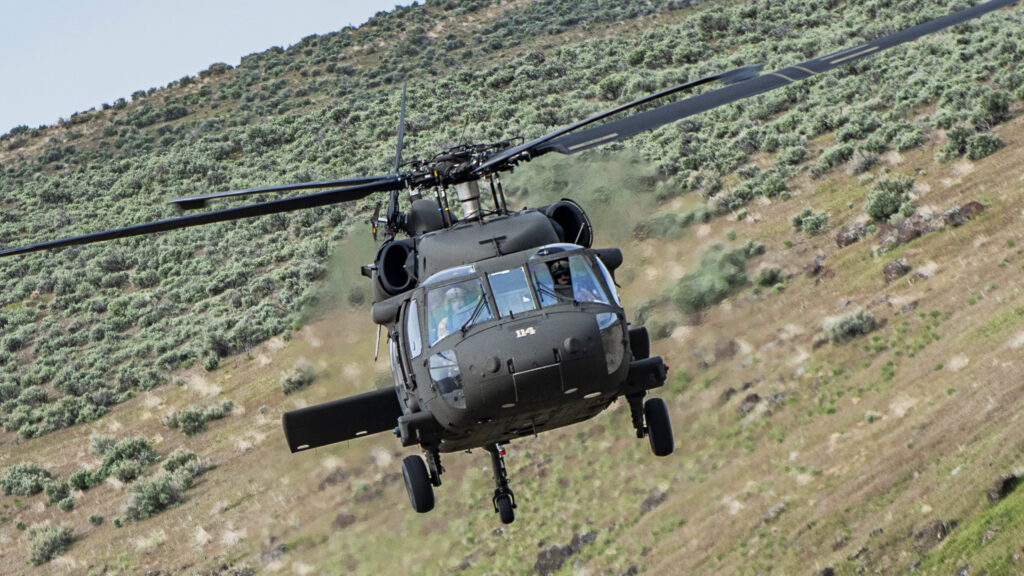
“The opportunity there that we talked about before was, if we received the reconciliation funding, if Congress supported that, then we would absolutely continue the testing that we started last year,” Phillips said in a recent interview. He added that the service completed its first flight test last May with a Black Hawk, and since then his team has added about 30 hours of flight testing including in different altitudes.
“So we’ve continued those efforts, and fortunately, Congress supported the program with another add in the 26 budget. So that’s going to continue on with those efforts through [20]26 into probably early 2027, and then we’re really looking at opportunities to be able to pull the qualification for the entirety of the engine left,” he added.
In 2019 General Electric was awarded the contract to develop the engine designed to provide a 50 percent increase in horsepower and a 25 percent improved fuel efficiency rate. A spokesperson from GE Aerospace said in a statement to Breaking Defense that the company is continuing to deliver T109 engines for ITEP, and they are “in lockstep” with the Army and “have have worked closely with senior leadership to accelerate engine testing in support of the program.”

Breaking Defense announces Breaking Defense Europe, a new, distinct, European edition
Breaking Defense Europe will launch May 4 with Tim Martin and Elisabeth Gosselin-Malo as co-editors.
Further, as the Army has pointed out, both Black Hawks and Apaches have added components to their systems over the years, increasing the weight of the aircraft. To allow the helicopters to have long ranges, a lighter engine is needed.
To meet full qualification, the ITEP has to undergo 1,500 hours of ground testing and “close to” 5,000 hours of testing for “full engine qualification,” according to the service. The Army did not disclose how many hours the engine has undergone thus far.
UPDATED: 3/31/2026 at 8:40 p.m. ET to clarify that the Army originally planned to have ITEP prototypes ready for the now cancelled FARA program in 2022 and to correct 2026 fiscal budget numbers. The update also adds a statement from GE Aerospace.