GLOBAL FORCE 2026 — The defense budget for fiscal 2027 will include consolidated budget lines for the Army’s command and control programs, the service’s undersecretary Michael Obadal, said today.
Budget consolidation allows for agile, or flexible, funding giving the services more control over money that is not tied to one specific requirement, ultimately allowing them to be more adaptive on the battlefield. In the FY26 budget, Congress granted the Army permission to consolidate 13 lines related to electronic warfare, counter unmanned aerial systems and drones, allowing program executives to exercise more control over these pots of money.
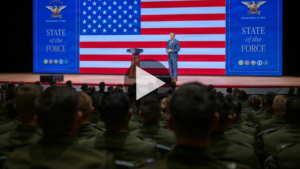
“This allows program executives the ability to shift from stagnant or obsolete efforts to emerging needs and compelling industry solutions,” Obadal said during his keynote address here in Huntsville, Ala. “In close coordination with Congress, we plan to expand this into the Army C2 portfolio, allowing the rapid movement of resources to support needs and opportunities in the application, data, network and transport layers.”
Obadal did not specify which C2 capabilities would be consolidated, however, during a Technical Exchange Meeting earlier this year he told an audience that he “anticipates” that in the FY27 budget, the line items related to the service’s Next Generation Command and Control (NGC2) initiative will be consolidated by 35 percent.
Further, Obadal told reporters during a media roundtable today that the Army is currently in talks with Congress to further expand budget consolidation authorities for the FY28 budget, though he again declined to provide any more details on what programs would see consolidation.
“In [FY]28 we’re in discussions with [Congress] about expanding budget line item consolidation into other critical and very technical parts of the Army’s budget, and that’s about as far as I’ll go, just since we’re still in discussion with them,” Obadal said during the roundtable.
Though the Army was granted budget line consolidation for drones, counter drones and EW, the service initially asked for even more agile funding in this year’s budget request. Appropriators ultimately turned down the service’s request in January, stating that there are already “sufficient authorities to restructure its internal programming and budgeting processes” within the Defense Department. Lawmakers added that enacting such agile funding practices is “unlikely to improve program execution.”
The 13 line items approved in FY26 represent just one percent of the service’s budget, Army Secretary Dan Driscoll previously said during a media roundtable in September. By not consolidating a larger portion of the budget, Obadal explained, there are roadblocks to getting capabilities into the hands of the warfighter at speed and at scale. However, today’s news signals that the Army and lawmakers have made more headway in coming to an agreement about allowing the service to further adapt budget consolidation.
“How we engage with Congress is a deliberative effort to ensure that we have the right oversight, understanding and confidence by the appropriators, and that requires consistent engagement,” Obadal said.
Further, Brent Ingraham, the Army’s chief acquisition czar, told reporters during today’s roundtable that transparency has allowed the service to come a long way in getting Congress to approve budget consolidation.
“The key word that we’ve got to make sure that we have to make sure we have with Congress is transparency as we move forward,” Ingraham said “I think we’ve been successful in sort of the [FY]26 consolidation budget line and sort of the transparency Congress was looking for with UAS, counter UAS and electronic warfare, right? We used it very effectively.”
Mark Pomerleau contributed to this report from Washington.
Breaking Defense Video