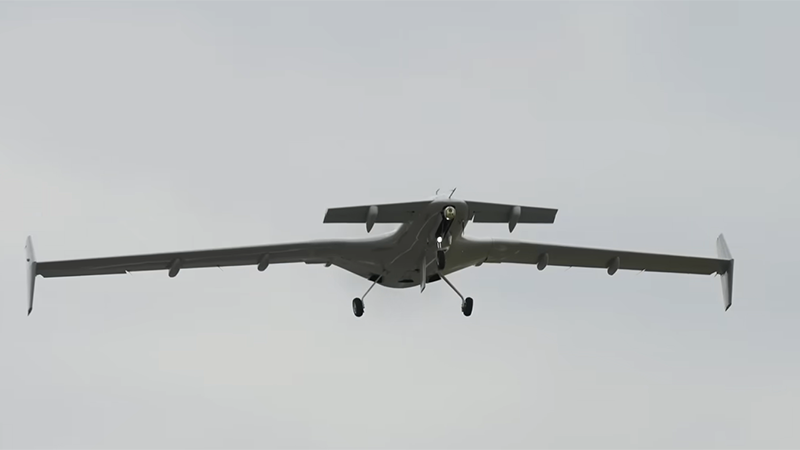
BEIRUT — Turkish drone manufacturer Baykar recently unveiled a new, AI-powered one-way attack unmanned aerial vehicle (UAV) dubbed the K2 Kamikaze UAV.
“K2 Kamikaze UAV made its debut with intelligent swarm autonomy tests,” the company said in a statement over the weekend. “The platform, featuring multi-operation capabilities and advanced AI and autonomy algorithms, successfully completed formation flight tests with 5 aircraft in varying configurations.”
The company, famous for producing mid-range drones that proved effective in the early days of the Ukraine conflict, said the K2 fits within its “cost-effective defense solutions strategy,” though it did not say how much each unit costs.
For the swarming tests, Baykar said five UAVs “successfully” conducted various formation flights during “multi-sortie tests over the Gulf of Saros over two days.”
The announcement comes as one-way attack drones have featured prominently in the conflict in the Middle East where the US and Israel are battling Iran, a war conducted almost completely through air strikes. Iran has been employing its Shahed 136, which has also been used by Russian forces in Ukraine, and the US has for the first time used its own one-way attack drone known as LUCAS, apparently based in part on Iran’s design.
Barin Kayaoglu, a Turkish defense expert, said Baykar’s latest drone is a move into a much in-demand UAV market.
“One of the criticisms against Turkish defense industries was that, after its immense success in the MALE / HALE field with Baykar TB2 and TUSAŞ/TAI Anka-2, companies didn’t make a similar rapid advance with micro / mini drones and loitering munitions (aka kamikaze drones) as seen in Ukraine,” he said.
The K2, he said, could “put those criticisms to rest.” Based on its previous products, Kayaoglu said he expects the K2 to “pack a real punch” that could attract foreign buyers especially with two ongoing major conflicts.
In his opinion, Serhat Süha Çubukçuoğlu, an expert at Trends Research & Advisory in Abu Dhabi, told Breaking Defense that K2’s swarming capability will likely increase the platform’s appeal to exports.
“Swarming is likely to increase export potential because it shifts K2 from being just another strike drone into a system-of-systems capability” he said.
Çubukçuoğlu said that many “countries cannot afford large inventories of cruise missiles or manned deep-strike aircraft, but they do want saturation capability against air defenses, logistics nodes, radars, armor concentrations, and naval targets. A swarm of lower-cost autonomous attackers is attractive for states seeking deterrence on budget.”
Baykar has been expanding in the last few years, and acquired Italian firm Piaggio Aerospace in late 2025 to expand its reach in Europe.
The Turkish firm has also established a joint venture with Italy’s defense giant Leonardo to coproduce and develop uncrewed aerial vehicles. In that deal, Italy’s Leonardo will contribute mainly with payloads and mission systems, and Baykar with its unmanned systems from Bayraktar TB2 and Akinci to the newly developed Kizilelma.