BELFAST — Europe bought 33 percent of global arms imports over the last five years, making it the largest defense importer by region on the globe, according to a report from the Stockholm International Peace Research Institute (SIPRI).
Ukraine, Poland and the United Kingdom were the three biggest European weapon system importers between 2021 and 2025, said SIPRI, with close to half of all supplies in the region, as a whole, coming from the US.
“Threat perceptions concerning Russia, compounded by uncertainties over the USA’s commitment to defending its European allies, have boosted demand for arms among European member states of the North Atlantic Treaty Organization (NATO),” added the report. “The 29 current European NATO members’ combined arms imports grew by 143 percent between 2016–20 and 2021–25.” SIPRI compares five-year stretches for this annual report in order to avoid one-off large weapon procurements skewing the trend lines.
Europe is desperate to accelerate a multibillion dollar rearmament program in the face of Russia’s war in Ukraine, a spate of drone incursions and ongoing hybrid warfare activity, alongside uncertainty surrounding US commitments to the region. President Donald Trump, whose administration is viewed with concern from much of Europe, has lashed out at Spain and the UK in recent days in the wake of a joint US-Israeli led war against Iran.
“Although European firms have ramped up arms production and the European Union’s new investment support for member states’ arms industries has led to a number of intra-EU orders, European states continued to import US arms in 2021–25, especially combat aircraft and long-range air defence systems,’ said Katarina Djokic, researcher with SIPRI’s arms transfers program, per a press release. “At the same time, the largest European suppliers continued to send most of their arms exports outside Europe.”
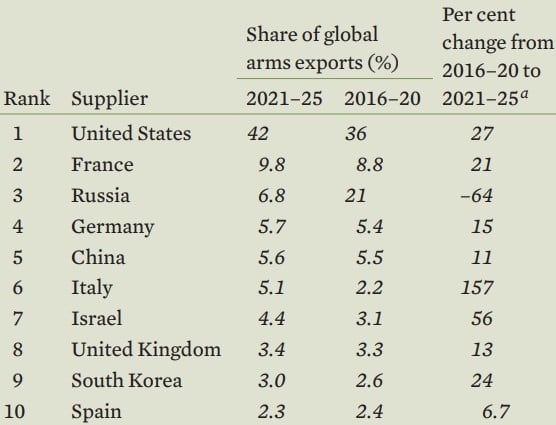
Despite deteriorating relations with Europe, Washington strengthened its position as the world’s leading arms exporter, supplying 42 percent of all international defense equipment over the last five years. The figure equates to a six percent increase compared with 2016-2020.
“For the first time in two decades, the largest share of US arms exports went to Europe (38 percent) rather than the Middle East (33 percent),” SIPRI noted. “Nevertheless, the top single recipient of US arms was Saudi Arabia,” accounting for a 12 percent share.
France was the world’s second biggest arms exporter, enjoying close to a 10 percent share of the market. Paris-based export sales jumped by more than a fifth across the two five-year windows assessed by SIPRI. Figures indicate that close to 80 percent of French produced defense goods were sold to non-European countries. Key to that trend were the trio of India, Egypt and Greece, France’s top three largest export nations. Together the group accounted for 45 percent of all French supplies.
Elsewhere from a European perspective, Germany moved to the new position of the world’s fourth largest arms exporter during the last five years, after displacing China. Just under a quarter of exports from Berlin went to Kyiv as military aid.
In a similar vein, Italian weapons exports benefited from a seismic jump of 157 percent across the different five year periods, with Rome jumping four places to become the sixth largest exporter globally.
Likely demonstrating buyer hesitancy and low confidence amid severe equipment and personnel losses in Ukraine, Russian weapon exports fell 64 percent, the only country among the world’s top 10 exporters to experience such a downturn.