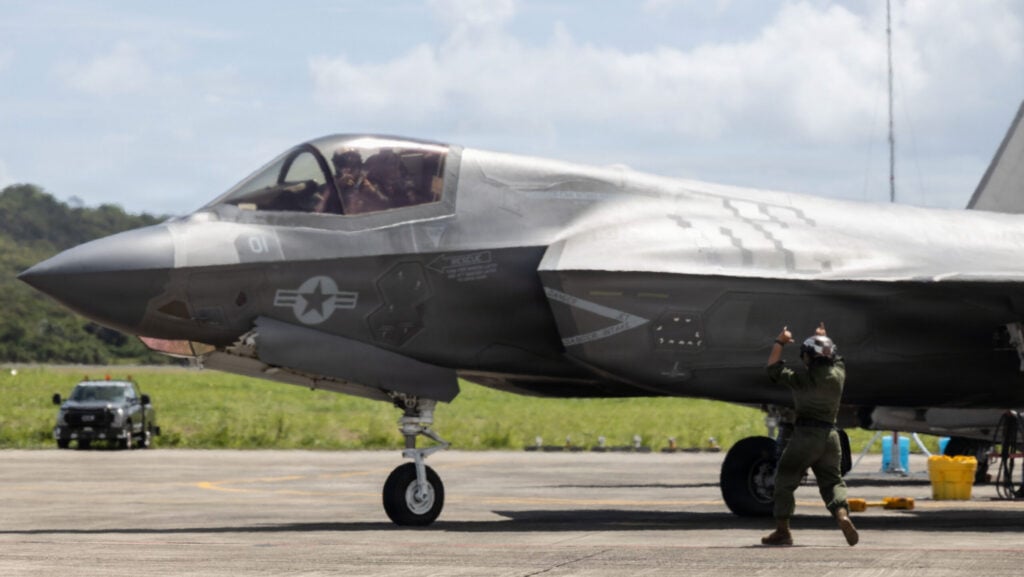
WASHINGTON — Starting this fall, all new F-35 Joint Strike Fighters delivered to the American military will come without radars, an issue that could stretch into the future and restrict the jets from participating in combat operations, Breaking Defense has learned.
In the best case, a new, redesigned radar could be ready as soon as next year, meaning only a handful of jets may be impacted. But if delays for the sensor stretch on, over a hundred jets may be delivered with a ballast where the new radar is supposed to be.
Any aircraft delivered without a radar are expected to remain airworthy, but will have to be reserved for training and cannot be used in combat, two sources familiar with the situation, who spoke on the condition of anonymity, told Breaking Defense.
“They can still take delivery of the jet. They can still use it as a flyable asset, [but] obviously not a combat-coded asset. So they can still do limited training with it,” one of the sources told Breaking Defense.
At issue is an upgraded radar called the APG-85. It’s a different size than the current APG-81, so planes meant to carry it have a redesigned bulkhead. The Pentagon attempted to time the radar’s entry into an ongoing production batch of jets dubbed Lot 17, but delays with the radar mean those planes will be ready before the APG-85. Due to the different bulkhead, the APG-81 radar can’t be wedged into the spot for the APG-85.
Rep. Rob Wittman, chairman of the House Armed Services tactical air and land forces subcommittee, confirmed that new aircraft would be delivered with ballasts in the place of a radar to ensure the jet is flyable.
“We also have an issue with the new radars, the APG-85 radars, and making sure that they’re on the new aircraft,” he said in an interview with Breaking Defense at the McAleese and Associates conference this week. “Right now, they’re going to be produced with ballasts, which too, creates an aircraft that’s not going to be combat-coded anytime soon.”


From backlogs to breakthroughs: Why the defense industrial base is turning to agentic AI
Agentic AI helps defense manufacturers speed up production, cut complexity and improve decision-making across global supply chains.
Within months, the US Marine Corps is expected to accept new F-35Bs, the jump-jet variant of the stealth fighter, without a radar. Then later this year, the US Air Force and Navy are expected to follow suit with their respective F-35A and F-35C variants, the sources said. (The Marine Corps also operates a small number of F-35Cs.)
A spokesperson for F-35 manufacturer Lockheed Martin said in a statement to Breaking Defense that while the APG-85 is government furnished equipment outside the scope of the company’s production and sustainment contracts, “we stand ready to support the government and the radar supplier throughout their deliveries of the new advanced radar the services require.
“The delivery and installation of the new advanced radars is determined by the government. Lockheed Martin is delivering aircraft in the configuration defined by our contract,” the spokesperson added. Lockheed referred further questions to the F-35 Joint Program Office (JPO).
After publication of this report, a JPO spokesperson said in a statement to Breaking Defense that US F-35s are being “built to accommodate” the APG-85, and that “[i]nitial fielding for some F-35 aircraft is planned for Lot 17,” which would align with expected Marine Corps deliveries that will feature the new bulkhead but no APG-85 radar.
“The Program in coordination with the Services deliberately undertook a highly concurrent development and production program for advanced capabilities. This decision was made with full understanding of the risk of having production aircraft ready ahead of the capabilities,” the spokesperson continued. “The program has plans to accelerate APG-85 production capacity to deliver radars that meet capability, stability, and maintainability requirements needed to meet emerging threats. F-35s with APG-85 radars, actual modernization plans, capabilities, and schedules remain classified to maintain program security.”
While there has been reporting that F-35As are already being delivered without radars, the Air Force has said its jets are currently delivering with the existing APG-81. The impact on the F-35B and F-35C fleets has not been previously reported.
The issue won’t impact foreign buyers of the F-35 since the APG-85 has not been cleared for export, the two sources said. Foreign customers are expected to receive jets with the incumbent APG-81 as a result.
A New Bulkhead, Fit For Two
Both the APG-81 and APG-85 are manufactured by Northrop Grumman and handed over to the government, which then gives them to Lockheed for installation. Northrop referred a request for comment to the JPO.
As Breaking Defense previously reported, the F-35 program is trying to mitigate radar delays with a new bulkhead that could accommodate either the APG-81 or APG-85 systems. But the bulkhead will likely not be ready until Lot 20, whose deliveries begin in 2028, leaving no option in the meantime but to accept aircraft without the radar.
Sources said the Marine Corps ordered their Lot 17 jets — whose manufacturing planning typically starts years in advance — with a newer bulkhead design to accommodate the APG-85. Sources added that the US Air Force and US Navy will switch over their bulkhead design in Lot 18, which begins production this fall. Until then, the two services’ aircraft in Lot 17 will deliver with the APG-81. Once Lot 18 hits, they’ll be faced with the same problem as the Marines.
The sources added that the new radar could be ready perhaps as soon as sometime in Lot 18, meaning impacts could be fairly limited. But if delays stretch on, aircraft produced over roughly the next two years will be unusable for combat operations until the new radar arrives, at which point aircraft would need to be retrofitted with the sensor — a process whose time and costs are currently unknown.
One source said the radar issue facing the program — already notorious for delays and cost overruns — represents yet another example of poor planning.
“The bulkhead conversation should’ve been had years ago,” the source said.
Wittman characterized long certification times as the primary driver for APG-85 delays, telling Breaking Defense that the APG-81 could be certified in three days but that the newer radar takes “much, much longer.”
“To Northrop’s credit, they have truncated that somewhat, but it’s still a matter of getting the radar certified to put on the aircraft. And the challenge is, they’re not doing that at the pace necessary for the aircraft coming off the line,” he said. “With the new radar, there’s only so much that you can do to compress the time frame, just because of the rigor necessary in certifying a new radar system, a radar system that’s much more capable, which the aircraft needs.”
While Wittman said he’s confident that the issue will eventually be resolved, in the interim, the US military will be left with “lots of aircraft out there, but not ones that are ready to go to the fight.”
Each negotiated lot of F-35s come with different quantities and pricing. The Pentagon and Lockheed Martin finalized a deal for F-35 Lots 15-17 in December 2022, with the parties reaching final terms in Sept. 2025 for Lots 18-19. The original contract option for Lot 17 included up to 126 aircraft, with Lots 18 and 19 each numbering 148 jets. Both figures include F-35s for international buyers.
The Lot 18 contract was originally awarded in December 2024 as an undefinitized deal for 145 jets, and the Pentagon said at the time in a contract announcement that Lot 18 covered 83 US military aircraft. The finalized breakdown for Lot 18 was not immediately clear. A September Pentagon contract announcement said that Lot 19 included 69 US military jets, with the remainder for foreign customers.
The Marine Corps did not deny that the service would soon accept F-35 jets without radars, and instead stressed the significance of Block 4 capabilities — including the new radar.
“The Department of War deliberately undertook a highly concurrent development and production program for Block 4 capabilities (Technical Refresh 3 (TR-3), APG-85, etc.) and the largest fighter aircraft production line in the world,” a Marine Corps spokesperson said in a statement to Breaking Defense.
The statement echoed the JPO’s contention that the production decision had been made with “full understanding” of the risks involved, but said the services’ “decision ensured that production aircraft could accept Block 4 capabilities, rather than continuing to build Block 3 F-35s that would require extensive retrofit for Block 4 capabilities, thereby saving multiple years of retrofit hardware installation.”
The Marine Corps pointed Breaking Defense to the F-35 JPO for additional questions. The Navy in February provided a statement to Breaking Defense, attributed to a Joint Program Office spokesperson, that emphasized the plans for initial fielding for some aircraft in Lot 17 but declined to provide further detail, citing operational security reasons. The service did not respond to follow-up questions from Breaking Defense this week.
The Air Force, for its part, confirmed its F-35s are delivering with the APG-81 radar but declined to comment on future jets.
“USAF F-35A lot 17 aircraft are delivering with APG-81 radars. The Air Force is working with the F-35 Lightning II Joint Program Office to deliver F-35s with APG-85 radars, and actual modernization plans, capabilities, and schedules remain classified to maintain program security,” an Air Force spokesperson said in a statement to Breaking Defense.
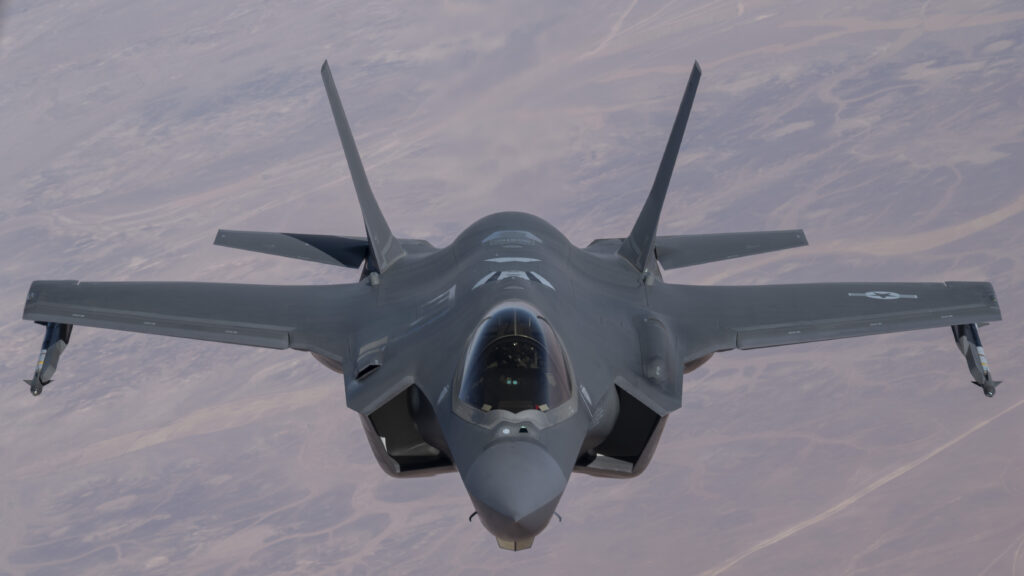
Warfighting Impact
For the time being, the radar issue in some ways has limited impact on the combat-coded F-35 fleet. Since July 2024 and following a year-long freeze first reported by Breaking Defense, new F-35s delivered by Lockheed have been reserved for training due to delays with a modernized software suite known as Technology Refresh 3. It’s not clear when the Pentagon intends to certify that software as combat capable. (F-35s currently in operations in places like Iran are older jets that fly with TR-2 software.)
Stacie Pettyjohn, director of the defense program at the Center for a New American Security, told Breaking Defense the more powerful APG-85 is planned to offer several upgrades like enhanced, longer range detection and offensive electronic attack to counter advancements chiefly made by China.
“F-35s have performed really well in the Middle East and in Venezuela, wherever they’ve been deployed against lesser adversaries,” Pettyjohn said in an interview. But when it comes to countries like China that have built “truly integrated air and missile defenses, sophisticated air forces with significant air-to-air capacity, that would be a really stressful test, and they need to continue to advance the capabilities that were initially put into the F-35 to remain relevant against adversaries that are advancing more quickly than we are.”
An aircraft without a radar would be “very near-sighted,” Pettyjohn said.
The F-35 has other sensors that could provide some situational awareness, and can leverage off-board systems like ground-based radars and receive that information via datalinks, but doing so would come with some latency and the risk of an enemy jamming communications channels. She added that radar-less aircraft could be used for learning how to fly the jet, but that training under those circumstances “is likely less relevant to the most demanding and critical missions for priority scenarios.”
Having to retrofit a large amount of F-35s with the radar at a later date “would be a huge blow, I think, to the tactical aircraft fleet, which is shrinking right now,” she said. Should US military services receive aircraft that wouldn’t be combat-ready until they get a radar, “then we’re starting to see where the numbers are going to belie the real capability that is available at any moment in time.”
UPDATED 3/19/26 at 5:00 ET with comment from the Joint Program Office.