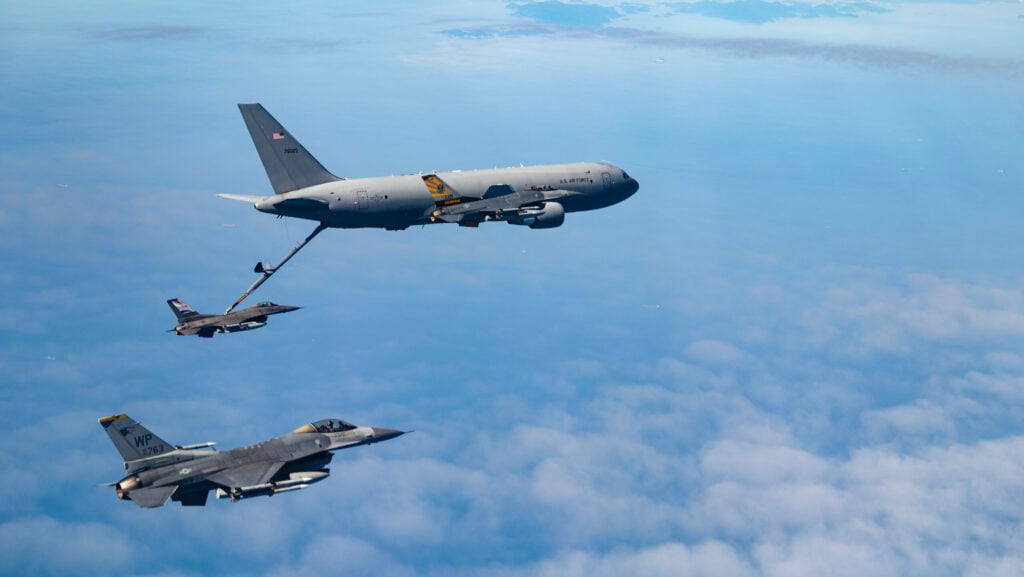
WASHINGTON — As US armed forces grind through combat in Iran, some officials have raised concerns about America’s munitions stockpile. But experts warn that a perhaps less obvious constraint could emerge: logistics.
The armed forces’ capacity for airlift and aerial refueling — predominantly provided by the Air Force — is hardly a new concern, most recently exemplified by strikes in the summer of 2025 aimed at Iran’s nuclear facilities.
“Tankers and airlift are a big gap,” Maj. Claire Randolph, the chief of weapons and tactics at Air Forces Central, told an audience at an event hosted by the Mitchell Institute in January. “If I were writing our request list, our shopping list for procuring things, probably the first 100 things on there would be tankers.
“I think because it’s not sexy, it’s not a weapon, and it’s not a fighter and it’s not a bomber, the tankers are often really left out of this conversation,” she added. “So I’m very concerned about our MCO [major combat operations] readiness,” especially when considering tanker campaigning and airlift.
And now, large-scale combat operations in Iran, dubbed Operation Epic Fury, could place fresh strain on the Air Force’s mobility fleets, composed largely of aircraft like the decades-old C-17 Globemaster or the Eisenhower-era KC-135 Stratotanker.
Stacie Pettyjohn, director of the defense program at the Center for a New American Security, told Breaking Defense, “Tankers stand out as the most likely limiting factor. If Iran continues launching missiles and drones at bases in the Gulf, USAF fighters may be forced to fly extended sorties from Jordan, Israel, or even southern Europe — missions that consume substantially more fuel and demand far more tanker support per sortie. At the same time, the airlift fleet would face mounting pressure to resupply dispersed operating locations with munitions, spare parts, and other materiel on a continuous basis.”
Pettyjohn added that when counting support for the Israeli Air Force — which operates a relatively small air refueling fleet — the “combined tempo” imposing greater demand on American air refueling assets “could be the straw that breaks the tanker fleet’s back.”
Tim Walton, a senior fellow at the Hudson Institute, told Breaking Defense that “Operation Epic Fury has demonstrated the importance of aerial refueling in enabling the US military to rapidly deploy to the region and execute large-scale attacks on short notice. It also shows that long-range, high-capacity aerial refueling aircraft are needed even when US forces have access to friendly, nearby airfields in Europe and the Middle East.”
Walton noted that “[a]erial refueling capacity has historically been a major constraint on the tempo of operations, and it’s likely the case today,” adding that “the availability of tanker crews could reduce sortie rates” amid a continued military campaign.
Previous research has established there are 119 task-ready tanker crews available for “sustained operations,” Walton said, a number that could be surged to 169 crews “for a limited period of time” during peacetime-level operations. As many as 865 crews could be available when fully mobilized for wartime, Walton added, drawing from a 2021 air refueling study he co-authored.
Similarly, daily operations consist of around 119 aircraft, which could be surged to 169 if required. Overall, 368 tankers could be available in wartime. Based on open source information, he highlighted that the US has deployed over 100 aerial refueling aircraft — consisting of the KC-135 and newer KC-46 Pegasus — for current operations against Iran.
To illustrate his point, Walton included the following graph from the 2021 report, which notes the total number of air refueling and tankers crews available.
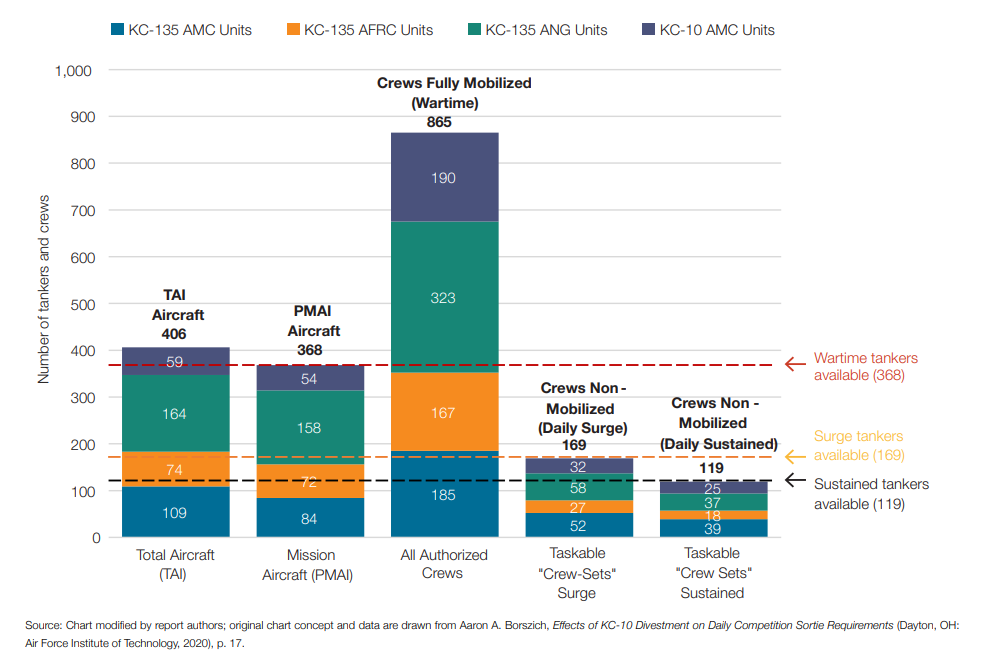
Walton noted that high utilization rates stress not only airframes, but personnel as well. “To generate more crews over a sustained basis, the Air Force would need to mobilize the Air Force Reserve Component and Air National Guard units,” he added, underscoring that about 56 percent of tanker units belong to either the reserves or National Guard.
It seems some of those forces have already been activated. In a press briefing Monday morning discussing Operation Epic Fury, Air Force Gen. Dan Caine, the chairman of the joint chiefs of staff, said Guard and Reserve mobility forces have “stepped right out of their civilian jobs to deploy and to protect the region.” (Caine did not share specifically how many Guard and Reserve forces have been activated.)
Calling them the “unsung heroes of warfare,” Caine went on to praise logisticians and sustainment forces “who quietly work every day behind the scenes to project and sustain America’s combat power.”
The Pentagon referred back to the press briefing when asked how the US military was mitigating mobility fleet limitations.
Sustaining The Fight
Some of the Air Force’s mobility aircraft actually enjoy higher mission-capable rates compared to other platforms, though it’s a bit of a mixed bag. The C-17, for example, boasts mission-capable rates around 75 percent, according to the most recent data for 2024 reported by Air and Space Forces Magazine. Meanwhile the service’s tankers hover in the 60-70 percent range. The C-5 Galaxy, the US military’s largest airlifter, suffers from capability rates under 50 percent — a fact not lost on the interim commander of the Air Force’s Air Mobility Command.
Lt. Gen. Rebecca Sonkiss told reporters on Feb. 24 at the recent AFA conference that the C-5 is a “critical tool,” but “doesn’t perform to the level we’d like it to, and we spent a lot of money trying to make that happen.”
Pressing for quickly recapitalizing the mobility fleet, the general still acknowledged that the C-5 and C-17 will have to operate for decades longer. (The C-5 and C-17 are what’s known as “strategic” airlifters, whereas “tactical” airlift is typically fulfilled by smaller platforms like the C-130.)
Pettyjohn emphasized that strains on mobility forces “would not materialize immediately,” but that “the longer and more demanding the operation, the more likely tanker availability and airlift throughput become binding constraints on the overall campaign.” It is unclear how long Epic Fury will continue, though President Donald Trump today said, “We’re already substantially ahead of our time projections, but whatever the time is, it’s okay.”
Tankers are critical for extending time on station and can move some shipments themselves, but cargo aircraft — who rely on tankers as well — help sustain a wide range of operations by quickly moving supplies between locations, especially relative to moving goods by sea.
“While sealift can move the bulk of US equipment, it can take weeks for a ship to traverse an ocean at 25 knots — while aircraft can deliver cargo within a day. Moreover, a cargo ship will need to [pull in to] port and offload its cargo, which must then be moved by either land or air to the final destination. So, your urgent needs and time-critical supplies to feed the fight rely on airlift — not sealift,” Heather Penney, the director of studies and research at the Mitchell Institute, told Breaking Defense.
“Airlift proved essential in rapidly setting the theater,” Walton said. “Sealift will be needed to sustain protracted operations at scale, delivering bulk fuel, large capacities of munitions, other consumables, and other forces.”
Extended operations could also exacerbate an underlying problem: weapons system sustainment. After years of complaints of raiding sustainment accounts to pay for other priorities, Air Force leadership is currently trying to boost the flow of funds and spare parts, which experts said will become a more pressing need in the wake of Epic Fury.
Penney said that “aircraft forward deployed will be prioritized for spare parts,” while other platforms “not in a combat zone will likely take a readiness hit” as they become de-prioritized for sustainment. Walton, for his part, predicted that Epic Fury “will likely aggravate existing gaps in Weapon System Sustainment parts and further pressure the Air Force” to boost funding for readiness accounts.
“This is why the current focus on readiness is so important — we need to stop robbing from one part of the inventory to sustain another,” Penney said.