WASHINGTON — As the breadth of US military strikes against Iran expand, so have concerns about US munition magazine depth. Now lawmakers and officials from the Trump administration are considering new supplemental defense funding that could pour money into replacing spent missiles.
“There are more details to be determined, of course,” Speaker of the House Mike Johnson said Monday, revealing discussions with Trump officials on the issue. “It depends on how long the operation goes and what the need is.”
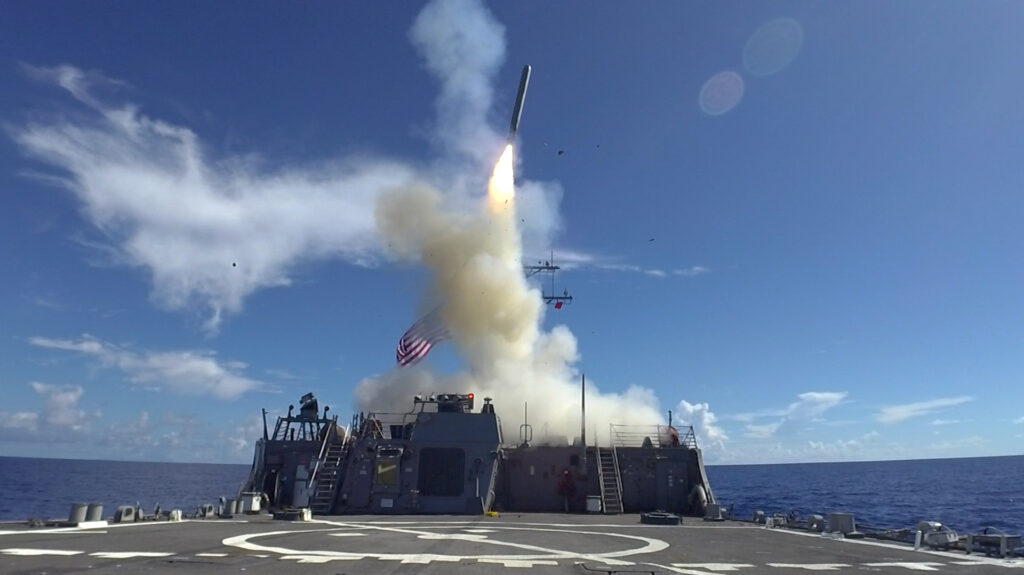
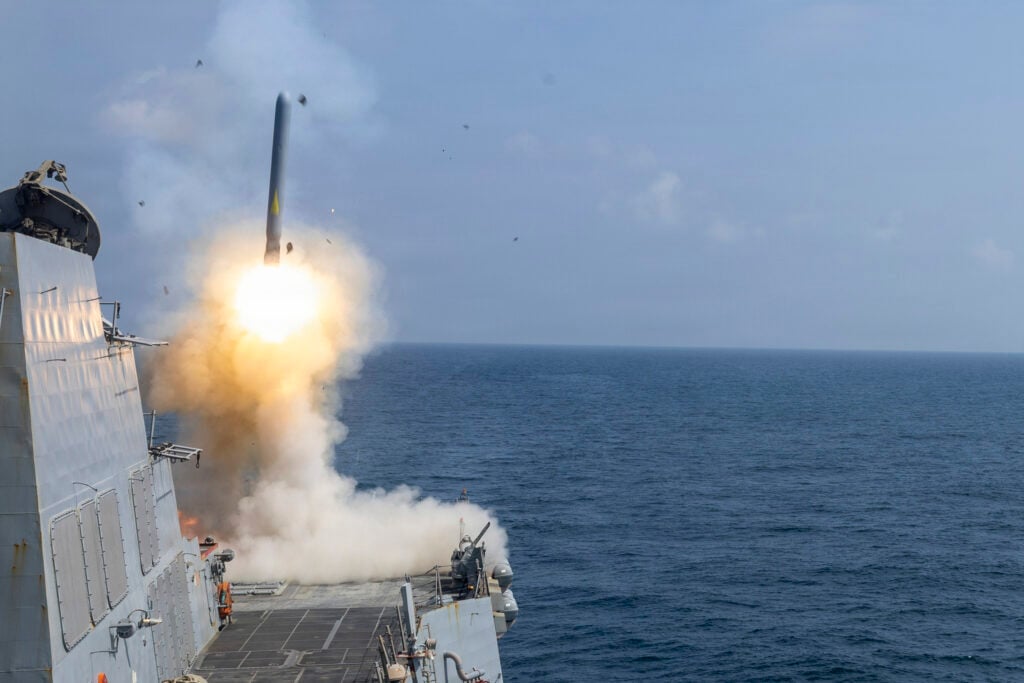
So far in the opening days of what President Donald Trump has said could be a weeks-long campaign, the US has struck more than 1,700 targets in Iran using a variety of munitions including Tomahawk land attack missiles, according to US Central Command. US forces have also responded to Iranian attacks, using Patriot interceptors and Terminal High Altitude Area Defense (THAAD) anti-ballistic missile systems to knock out incoming threats.
But each missile fired is costly and can take years to replace, potentially creating what some analysts see as a longer-term vulnerability for the US.
“The number of interceptors fired this weekend was probably quite considerable. We can’t afford to continue doing this, and the only way to preclude that is some sort of decisive political or military resolution,” Tom Karako, a senior fellow with the Defense and Security Department at the Center for Strategic and International Studies, told Breaking Defense.
“As concerning as that is, the expenditure of long range weapons should also give us pause,” Karako said, noting that every Tomahawk used against Iran is one less that could be employed in a conflict with China.
Worries that the US could be depleting its offensive and defensive arsenal appear to have reached Trump, who sought to reassure his social media followers about the status of US munition stockpiles. Trump claimed in a post on Truth Social on Monday evening that US munitions stockpiles have “never been higher or better” and that the US has a “virtually unlimited supply” of weapons.
Resourcing Questions Take Center Stage
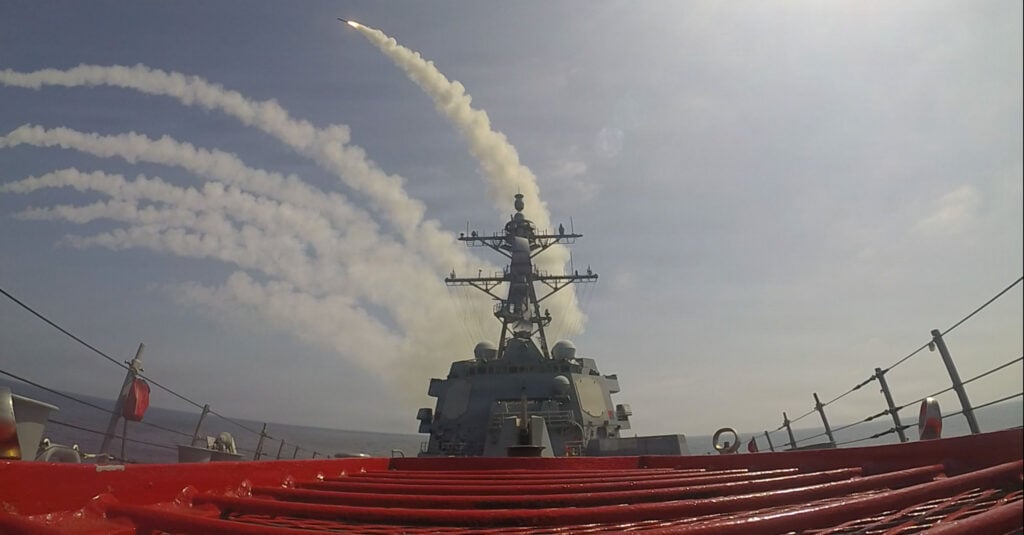
Prior to Epic Fury, military leaders had expressed desire to increase the production on munitions like the Tomahawk and the Long Range Anti-Ship Missile, following operations in the Red Sea against the Houthis that took a toll on stockpiles. In May 2025, Vice Chief of Naval Operations Adm. Jim Kilby told lawmakers that the Navy is seeking to expedite munitions replacements in the event of a future conflict with China.
The next month, the Navy employed Tomahawk missiles during Operation Midnight Hammer targeting Iranian nuclear facilities. Those strikes were relatively limited compared to the ongoing US operation.
Katherine Thompson, a senior fellow in defense and foreign policy studies at the Cato Institute, said that employment of munitions in campaigns like Operation Epic Fury could “limit optionality” for the US if a conflict emerged in another theater — absent a plan for an accelerated replenishment timeline.
“The United States is only equipped to support a one-war planning construct,” Thompson said.
“The resourcing question for Tomahawks as well as other critical munitions like Patriot and THAAD will be front and center as this campaign continues,” Thompson said. “Limits on these resources will ultimately depend on firing rates, potential pull-in of additional resources from other theaters, and whether or not this campaign does in fact extend for weeks and/or months.”
However the US manuevers its missiles, Karako said starting the work of producing more is a top priority.
“To replenish what we used this week and ramp up production rates dramatically, it will almost certainly require some kind of supplemental,” he said. “The politics on the Hill right now aren’t especially amenable to that, but it needs to be done.”
Risk Mitigations On The Table
Bryan Clark, a retired submariner and fellow at the Hudson Institute, said that the US could fire off at least 100 Tomahawk missiles as part of Operation Epic Fury, given the massive build up of Navy warships in the region. However, he said, the bigger problem is running through air defense missiles.
“SM-2, SM-3, and SM-6 missiles are in short supply and the US is not building them fast enough to catch up,” Clark said. “If another conflict occurred, the US might have to change its shot doctrine to use fewer weapons per engagement.”
The munitions inventory itself isn’t the only factor — the “core issue is risk management,” according to Jud Crane, former deputy assistant secretary of defense for force readiness. Crane said that modifying shot doctrine is one of the risk mitigations on the table that CENTCOM could consider, if necessary, to preserve munitions. CENTCOM could also potentially substitute alternate munitions and systems, or use different platforms for air defenses.
“While those mitigations can relieve inventory stress, they introduce additional risk — which is ultimately borne by service members,” Crane said Sunday.
“The Department has been improving its projections of munitions inventories over time and weighing production against competing demands, including potential needs in other conflicts, as part of the process in setting Total Munitions Requirements,” Crane said. “While the Secretary can reallocate more munitions from reserve inventory or other theaters, that just shifts risk to the future as inventories take even longer to recover. Ultimately, it’s the White House and NSC that determine whether the risk to strategic readiness is acceptable.”
Efforts are underway to improve munition production. For example, the Pentagon and Lockheed Martin signed an agreement in January to bolster production of THAAD interceptors from 96 each year to 400 annually. Likewise, the Pentagon and RTX inked several agreements in February to boost production capacity and delivery of munitions, including the Tomahawk to more than 1,000 a year, and the SM-6 to more than 500 a year.
RTX declined to provide comment to Breaking Defense on current annual production levels, but has previously indicated that these agreements could amount to four times the current annual production rate.
While this framework is positive, it is not the same as contracts, according to Karako.
“The current prospect for ramping munitions is a bit less sanguine than meets the eye,” Karako said.
Valerie Insinna and Aaron Mehta contributed to this report.