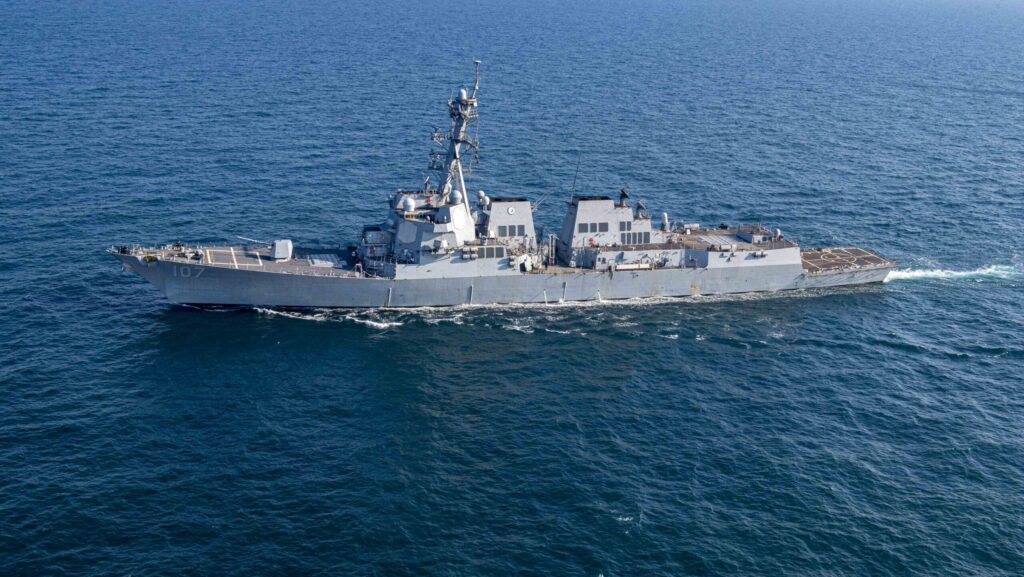
WASHINGTON — US Navy ships could start accompanying tankers transiting the Strait of Hormuz in an attempt to safeguard maritime trade in the region, according to President Donald Trump.
“If necessary, the United States Navy will begin escorting tankers through the Strait of Hormuz, as soon as possible,” Trump said in a Truth Social post today. “No matter what, the United States will ensure the FREE FLOW of ENERGY to the WORLD. The United States’ ECONOMIC and MILITARY MIGHT is the GREATEST ON EARTH — More actions to come.”
Trump’s comments came as he announced that the US would offer “political risk insurance and guarantees” on Truth Social for all shipping lines, amid concerns about rising oil prices following Operation Epic Fury. Further, the comments come after Secretary of State Marco Rubio signaled Monday that the Trump administration would unveil initiatives seeking to counter rising oil costs.
Trump did not provide any details about which ships the Navy could send to escort the tankers, nor did he provide clarity on when this could happen. The Navy referred Breaking Defense to the Office of the Secretary of Defense for more details, though OSD declined to comment.
Employing Navy vessels to escort commercial ships is not unprecedented. In December 2023, then-Secretary of Defense Lloyd Austin established a multinational task force called Operation Prosperity Guardian to help protect civilian ships transit the Red Sea.
The task force employed US Navy vessels — primarily guided-missile destroyers — to assist countering Houthi-led attacks on commercial ships in the region. Destroyers including the Gravely, Laboon, Mason and Thomas Hudner were at the forefront of the fight combating Houthi drones and missiles, at times downing more than a dozen drones at once.
Other countries that participated in Operation Prosperity Guardian included the UK, Bahrain, Canada, France, Italy, the Netherlands, and others. For their contributions to the mission, the US Navy awarded the Royal Navy destroyer HMS Diamond a Meritorious Unit Commendation in November 2025. In total, the destroyer shot down at least nine Houthi drones and one ballistic missile.
Additionally, during the Iran-Iraq War in the 1980s, US Navy vessels escorted Kuwaiti oil tankers in the Persian Gulf as part of Operation Earnest Will.
In both of these prior instances, however, Iranian forces were not directly attacking US forces the way they are now. Should Navy vessels accompany tankers in the Strait of Hormuz, Iran could launch an attack that overwhelms US warships’ defenses, according to Bryan Clark, a retired submariner and fellow at the Hudson Institute.
“If the US mounted this kind of escort mission in the current environment, it would need to complement naval escorts with an air campaign to detect and attack any missile launchers that emerged to attack the tankers or their escorts,” Clark said in an email to Breaking Defense.
Since Operation Epic Fury kicked off on Saturday, oil prices have spiked. For example, AAA reported that the national average price of regular gas rose to $3.11 a gallon today, in comparison to roughly $2.95 the week prior.
UPDATED: 3/4/2026 at 12:15 p.m. EST. This story has been updated to include information about Operation Earnest Will and insights from analyst Bryan Clark.
Breaking Defense Video