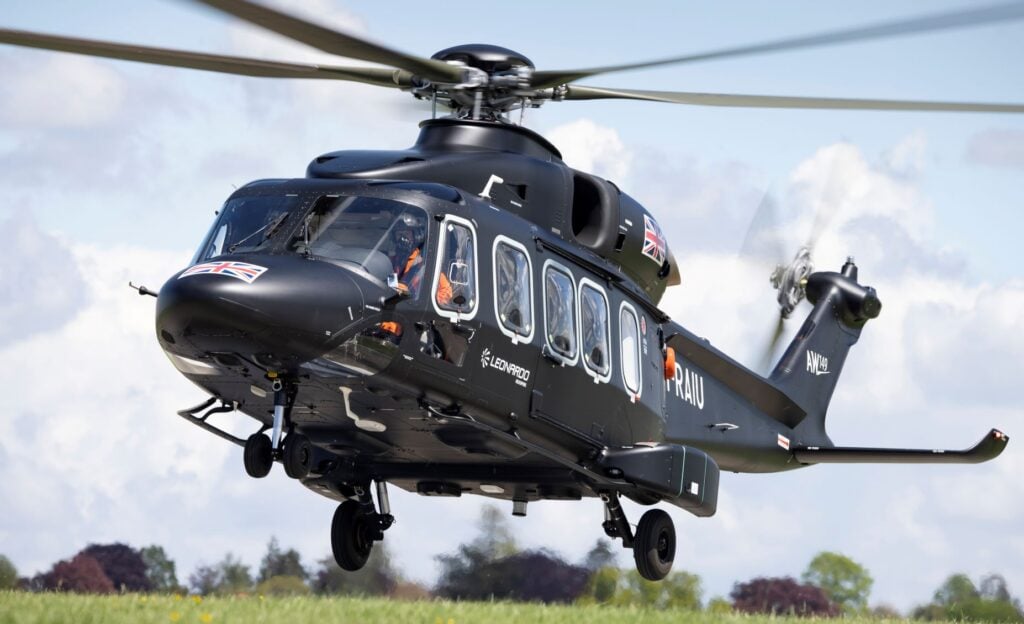
BELFAST — The UK has awarded Leonardo a £1 billion ($1.3 billion) New Medium Helicopter (NMH) contract for the production of 23 AW149 multirole rotorcraft, providing the manufacturer’s production line in Yeovil, England, with clarity over the high-profile procurement that had been in doubt for months.
Britain’s Ministry of Defence (MoD) said today in an announcement that the new helicopters could operate alongside drones “to support defence operations around the globe.” It also committed to additional investment in Leonardo’s Proteus autonomous rotary wing demonstrator, though no exact level of new funding for it, nor an AW149 delivery timescale was disclosed.
The AW149 can carry up to 16 fully equipped troops, offers a range of 545 nautical miles and is designed to carry out battlefield support, troop transport, logistics support, threat suppression, Close Air Support (CAS), Command and Control (C2), Search and Rescue (SAR), Medical Evacuation (MEDEVAC) and maritime patrol operations, according to Leonardo company literature [PDF].
The NMH program originally called for the replacement of 23 Puma HC2 helicopters and a number of smaller rotary fleets like Bell 212, Bell 412, and Airbus AS365 Dauphins. Crucially, the new AW149 fleet is desperately needed to plug a capability gap left by retirement of the Puma fleet in March 2025.
The MoD statement, which arrives a day after Leonardo’s best-and-final NMH offer expired, added that the new deal will “boost the UK Armed Forces’ battlefield kit and makes Britain Leonardo’s global centre for military helicopter production and exports — worth a potential £15 billion over the next decade.”
The MoD also said in today’s statement that the AW149 NMH program “will deliver multiple rotary wing requirements using a single aircraft-type,” adding that the platform will “undertake defence tasks that were previously delivered by three different aircraft types, streamlining our capabilities.”
In its pitch for the order, Leonardo proposed moving its AW149 export production line from Vergiate, Italy, to Yeovil, while also stressing that “an addressable market” in excess of 500 medium-class helicopters could be targeted for future export sales. International customers of the twin engine helicopter include Egypt, Poland and Thailand.

Meeting Zero Trust goals while maintaining information dominance
Balancing security and access to data are critical to providing users with trustworthy, reliable data for real-time decisions.
Leonardo is the UK’s only local defense helicopter producer, but in the lead up to NMH award it remained unclear if such a domestic capability was to be lost. The uncertainty was heightened by a dispute between the MoD and the Treasury — the UK’s finance ministry — only for Rachel Reeves, the Chancellor of the Exchequer, to intervene and approve the contract last week, according to Bloomberg. The publication said that during the dispute, the Treasury argued the helicopter program had been “deprioritized” by the MoD.
Despite a plan to award the NMH contract in 2025, the UK government had delayed the decision for inclusion in the forthcoming Defence Investment Plan (DIP), set to define British equipment priorities for the next decade. Although the plan was originally set for publication last year, the MoD has only committed to releasing the document “as soon as possible.”
Leonardo became the sole NMH bidder left in a three-way industry competition after Lockheed Martin UK and Airbus UK withdrew their interest in August 2024. The two firms that dropped out did so after citing their inability to meet customer requirements.
In 2023, Breaking Defense was the first to report that the UK had decided to slash the number of NMH aircraft due for order to between 25 and 35 units, less than an advertised upper limit of 44 platforms.
Elsewhere, the Proteus demonstrator effort sits under a four-year Rotary Wing Uncrewed Air System Technology Demonstration Programme contract, valued at £60 million. The demonstrator is in step with the Royal Navy’s Maritime Aviation Transformation strategy — a long term Fleet Air Arm evolution plan that stretches to 2040.