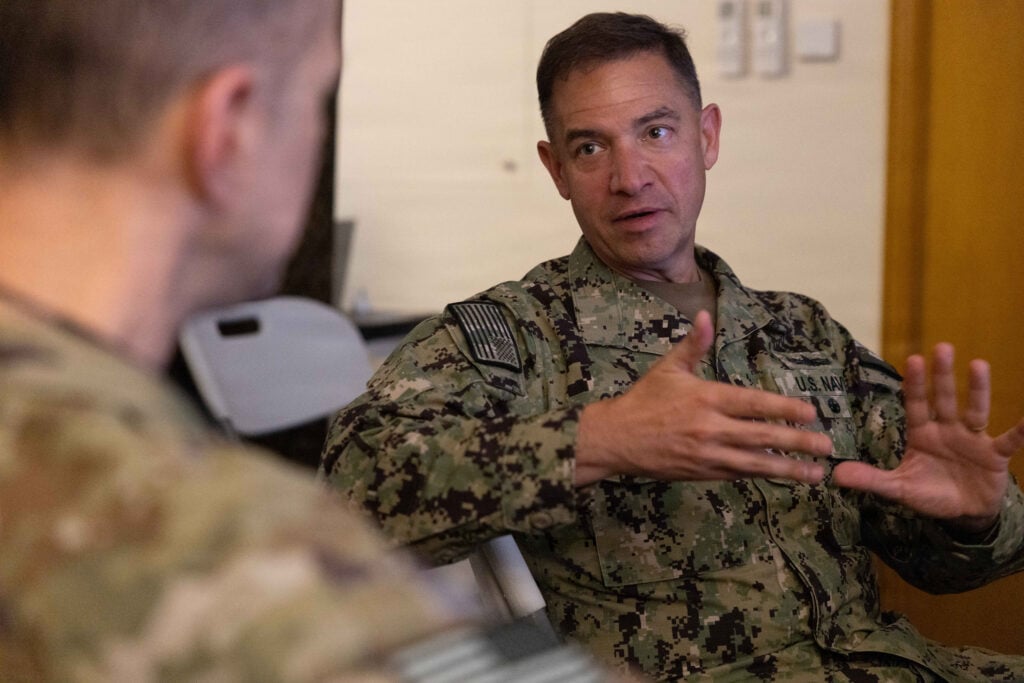
WASHINGTON — US operations during Operation Epic Fury have severely “degraded” Iran’s Navy to the point it could take a decade for Tehran to build it back up, the head of US Central Command, Adm. Brad Cooper, told lawmakers today.
Cooper also said that the operations have been successful in effectively cutting Iran off from being able to provide weapons and support to its proxy partners in the region, such as Hamas, Hezbollah and the Houthis.
“The defense industrial rates for their drones, and their missiles and their Navy were degraded by 90 percent. They have about 10 percent left,” Cooper said, although in this written testimony, he wrote the degradation was at 85 percent. “For the Navy, my military assessment would be that the Navy will not begin to rebuild for five to 10 years.”
In his written testimony, Cooper stated the US has eliminated over 90 percent of Iran’s “once-massive inventory” of over 8,000 naval mines and has conducted over 700 airstrikes on Iranian “naval mine targets.”
“In sum, Iran’s navy can no longer claim to be a maritime power, and it cannot project into the Gulf of Oman or the Indian Ocean,” he wrote. “Iran retains nuisance capability — harassment, low-end drone and rocket attacks, and residual proxy support — but it no longer possesses the means to threaten major regional operations or to deter U.S. freedom of action in the air or maritime domains.
During a joint hearing with CENTCOM and US Africa Command, Cooper told members of the Senate Armed Services Committee that the plan all along for Operation Epic Fury was to accomplish three goals: degrade Iran’s ballistic missile and the defense industrial base that supports it, degrade Iran’s drones its industrial base and degrade the Navy and its coinciding industrial base.
“In each of those categories, we met all of the achievements. Each of those systems were significantly degraded,” Cooper said.

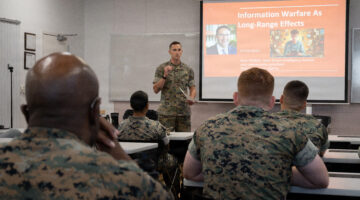
Winning the information war is as much about ideas and perception as it is about data
"Being able to tell the commander you don't need to do something is actually a pretty powerful message, as well."
Cooper wrote in his written testimony that “[a]cross more than 10,200 sorties and over 13,500 strikes, we targeted the full breadth of the regime’s ability to project power,” adding that “[m]ore than 1,450 strikes on weapons manufacturing facilities set the regime’s ability to build and stockpile ballistic missiles and long-range drones back by years.”
Cooper also testified that Iranian proxy groups have been completely cut off from Iran, stating that no resources or equipment “are flowing from Iran” to those actors.
“We also all watched Iran spend decades and billions and billions of dollars arming proxies. Today, Hamas, Hezbollah and the Houthis are all cut off from Iran’s weapons supply and support,” he said. “This result was not foreordained, nor was it brought by chance. It’s the culmination of months of careful planning built upon decades of experience.”
Cooper praised US allies in the Gulf Region for making it possible to strangle Iran’s flow of weapons and overall support to its proxies and for helping the US defend against Iranian attacks. He specifically called out the United Arab Emirates, Bahrain, Kuwait, Qatar and Saudi Arabia.
“In addition to those key allies, everything that we’ve accomplished would have been impossible without the Kingdom of Jordan, and clearly we were operating very closely with the state of Israel. I think that group in particular should be commended,” he added. “It didn’t just execute missions, they served side by side with Americans and protected Americans.”
Breaking Defense Video