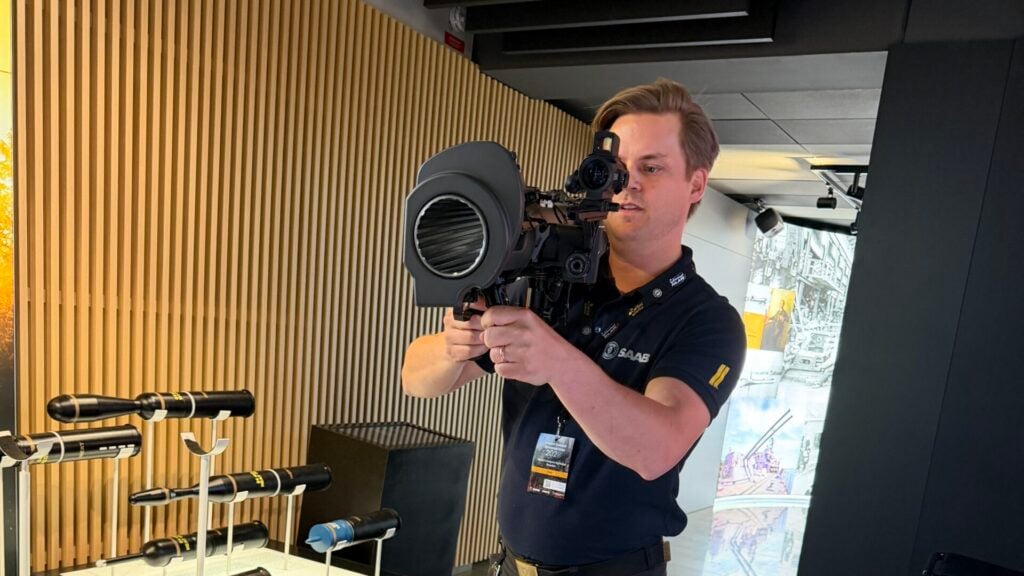
KARLSKOGA — A new tandem-warhead made by Swedish defense giant Saab for its Carl-Gustaf M4 recoilless rifle is powerful enough “to penetrate any hull of any tank available today,” a senior company official told journalists before the round was demonstrated in a live test-fire here.
Breaking Defense observed different types of ammunition for the M4 fired from various distances at different targets at the Bofors test center last week. The HEAT 758 round was fired from roughly 500 meters that struck the flank of a Russian T-80 main battle tank (MBT). The shaped-charge warhead successfully penetrated the hull just beneath the turret, near the turret ring.
Saab formally unveiled the munition, dubbed HEAT 758, today, in addition to giving new details on the global expansions in the US and India, as well as a new air defense munition.
Saab says the HEAT 758 has a range of 600 meters and can penetrate 700 mm of armor (27.6 inches), even specially designed explosive reactive armor (ERA).
Company officials stressed that ERA armour has become prevalent on modern battlefields, posing a challenge to traditional single-charge warheads. Saab says the new ammunition addresses this with a tandem warhead configuration.
A precursor charge first neutralizes the reactive armour tiles on the vehicle’s exterior, allowing the main shaped-charge warhead to penetrate the underlying armor.
An “undisclosed” customer has placed an order for the HEAT 758, with production now underway, Saab said. (Saab provided accommodation for Breaking Defense to attend the briefings and the live-fire demonstration.)

Europe’s military advantage depends on sovereign command of the ground truth
As NATO and European governments accelerate investment in space-based intelligence, decision advantage will depend on how quickly sovereign and commercial capabilities can be fused into a trusted operational picture.
Global Production Expansion
Meanwhile, to support growing demand and enhance supply-chain resilience, Saab is expanding its manufacturing footprint internationally by its new facility in Grayling, Mich., in the United States. The site spans more than 400 acres, with about 65 acres developed so far, providing room for future growth.
“We really see Grayling as providing a national asset to the US government. … We’re looking not only at how we produce our own products, but also at how we partner with other companies to help them overcome their capacity issues,” marketing and sales manager for Saab Land Systems Darrell Osteen said.
The site will produce AT4CS TW shoulder-fired weapons, which are expected to enter “full scale production and [begin] deliveries…[in] 2028,” Saab’s Head of business unit Ground Combat, Michael Höglund said.
The American factory will rely heavily on automation and robotics in “no-touch” production and currently focus on production of the tandem AT4 warhead and the ground-launched small diameter bomb (GLSDB) — the latter is built in partnership with Boeing.
Parallel efforts are advancing in India. The Carl-Gustaf system, originally developed in the 1940s in Sweden, is now used by more than 40 nations. Höglund noted: “India [is] the largest Carl-Gustaf user in the world. [The] US is the largest AT4 user in the world.”
Saab is now establishing its own new Carl-Gustaf M4 factory near New Delhi, India, with its licensed production of older Carl-Gustaf systems and ammunition, has been ongoing since the 1970s.
The dual production bases (India and the US) are intended to boost overall capacity, reduce delivery times, and better integrate Saab into the defence industrial ecosystems of its primary markets, the company said.
The company has scaled up to meet a surge in demand and has committed to roughly €500 million to investment in Saab Dynamics, mainly in Sweden, to expand capacity by at least four times compared to February 2022 across ammunition, weapons and missile-related lines. However no figures for the facilities in the US and India were presented.
Strengthening Air Defense With Bolide 2
In parallel with the Carl-Gustaf developments, Saab has launched the Bolide 2 missile to enhance the RBS 70 NG short-range air defense system (SHORAD).
The new missile features a larger warhead and improved terminal flight performance against a wide range of aerial threats, including drones. It also introduces a more modular design that facilitates future capability upgrades, Saab said.
Bolide 2 retains the combat-proven, “unjammable” laser beam-riding guidance of previous RBS 70 generations, ensuring reliability in contested electromagnetic environments, according to Saab.
“All feedback is important,” Saab’s product manager for missile systems, Paul Wooldridge said.
“We receive input from customers and other sources continuously. Development of the Bolide 2 began four to four-and-a-half years ago, well before the conflict in Ukraine, so while lessons from Ukraine have reinforced some of the core principles behind the missile, they did not directly influence this version — though they will shape the next one.”
The original Bolide missile, first launched in 2003, matches the Bolide 2 in both range (9 km or 5.6 miles) and maximum altitude (5 km). Its primary advancements are concentrated in the warhead design and supporting systems.
Bolide 2 can be fired from prior generations on RB70. Deliveries are set for next year, and Saab said it has “multiple customers” for the new missile but won’t reveal who they are.