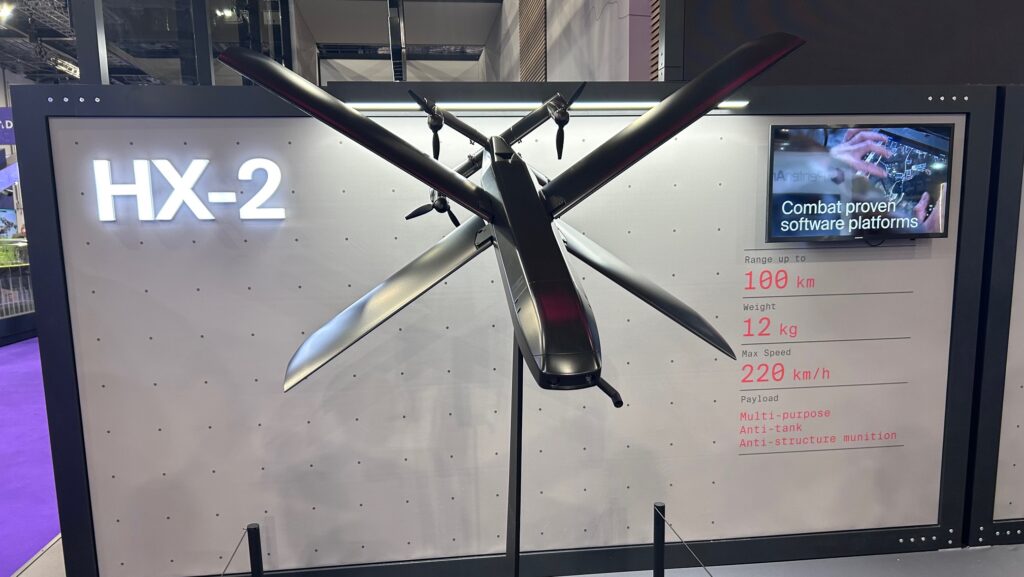
PARIS — German defense firm Helsing plans to establish its first US defense manufacturing facility and open a new drone production plant in West Virginia, the state’s governor revealed on Monday.
Helsing will initially invest $50 million to open the facility, according to a press release from the office of Gov. Patrick Morrisey. The release says the facility will start manufacturing Helsing’s HX-2 drone. Company executive Jennifer McArdle said at an event in West Virginia announcing the new facility today that the firm plans to produce as many as 2,000 drones a month, according to local media.
“Welcoming a global defense technology innovator with battlefield-deployed products like Helsing to Berkeley County is another major milestone for West Virginia,” Morrisey said in the release.
The company said the facility in Martinsburg — situated in the northeast of the state wedged between Virginia and Maryland — is planned to have initial operating capability by November and full rate production within a year.
“West Virginia stood out for its skilled workforce, speed to build, manufacturing heritage, and commitment to strengthening the U.S. industrial base,” said McArdle, Helsing’s US general manager, adding that the company was “excited to build in Appalachia.”
The HX-2 is a loitering munition powered by company software that can hit targets like armored vehicles and structures as far as 100 km (62 miles) away, according to the firm. The drone has been used in combat in Ukraine.
The German firm, founded in 2021, is headquartered in Munich and has grown rapidly with a focus on autonomous software. Helsing on Monday also announced results of a new funding round that raised $1.8 billion, growing its total valuation to $18 billion.

Europe’s military advantage depends on sovereign command of the ground truth
As NATO and European governments accelerate investment in space-based intelligence, decision advantage will depend on how quickly sovereign and commercial capabilities can be fused into a trusted operational picture.
Besides its work in autonomous software, the company is chasing other opportunities over in Europe for larger drones like Collaborative Combat Aircraft. At the Berlin Air Show in June, Helsing revealed that it was designing a kinetic attack variant of its in-development CA-1 Europa drone wingman, which is scheduled for first flight in early 2027.