
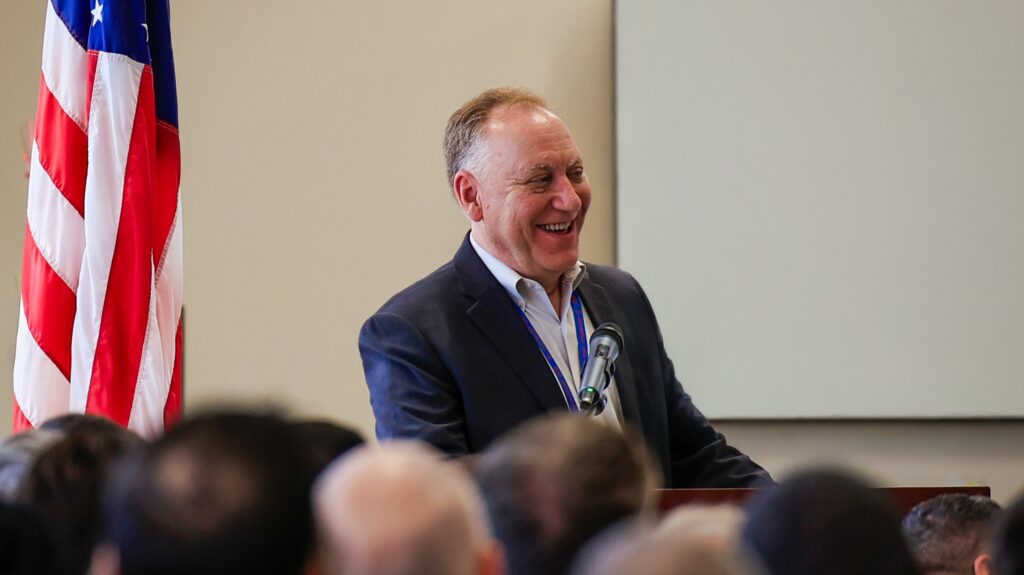
WASHINGTON — On Jan. 1 John Baylouny became the new CEO of Leonardo DRS. But it’s hardly a new company for him — Baylouny has worked at the firm for decades, and was most recently COO under previous CEO Bill Lynn.
Last month, Baylouny sat down with Breaking Defense, in which he laid out his priorities, how he sees the market shifting with new entrants, and the “almost insatiable” demand from abroad.
The following has been edited lightly for length and clarity.
BREAKING DEFENSE: You first joined what would eventually become Leonardo DRS back in 1986, so obviously you’re very familiar with the company. But having been in the CEO role for about six months now, has anything surprised you?
JOHN BAYLOUNY: Look, nothing surprised me. I think that what I found is exactly what I expected, a great team of people, all focused on the national security problems of the day, all focused on shareholder value, all focused on building the business.
I would tell you that the bigger thing that’s been surprising me is really the market changes. It’s the speed at which our customers are running. The changes in the acquisition approach is new, but very favorable. I really think that the administration is doing a good job here in creating an ability to buy what they really need.
In the past, with the PEO structure, the appropriators would appropriate line items — Okay, buy this many radios, buy this many computers, buy this many cameras — and [the PEOs] would have to buy those. And when you said to the customer, “Hey, I can combine those into one box.” They were like, “Actually, my job is to buy computers, cameras and radios. I can’t buy a combined system.” Today with the PAE structure, they actually have the ability to buy solutions, and it turns out that we were investing in that direction already.
On-demand webinar: Research security in an era of global competition
Watch experts discuss foreign influence risks, evolving DoD policy, and strategies for balancing security with scientific collaboration.
So you’re seeing real changes from the acquisition overhaul.
I am seeing some really big changes. Especially in the Army, less so in the other services. I think the Navy’s right behind it, but less so in the other services. I think the Army’s in the front, and I think they’re defining the role of the PAE.
I think they’re in the front because of necessity, because the nature of warfare is changing so quickly. And let me pick at that a little bit, because a lot of people talk about the lessons from Ukraine being drone warfare, [but] the big change in warfare is the speed of change, how quickly things are changing in the battlefield, and I think the army feels that the most.
Back to the CEO transition — okay, so there weren’t any major surprises, but what are you looking to change compared to your predecessor?
We’re not changing our direction. What we’re changing is our speed. We’ve rolled out something we call the Accelerate program, and that Accelerate program is everything that we do, but it’s how do we do it faster — not leaving anything behind, not putting quality behind, not putting customer satisfaction behind, but doing it faster. So that’s the big change we’ve rolled out.
We’ve got a lot of adaptation of that at multiple levels, kind of everything that we do, hiring, reviewing contracts, signing non-disclosure agreements, putting proposals out, developing product, manufacturing product, getting subcontracts — all those things can be done faster.
Everyone says they want to go faster, so how are you actually getting at that?
You know, it’s really a function of driving this from the folks that touch those elements, our employees. You know, it’s funny — if you have some folks that leave the business and they say what frustrates them, it’s well, you know, it took too long to make decisions, right? And you say, “Well, how would you fix that?” And they come back with really great ideas, and then you adopt those ideas, and now you’re going faster — and [that helps with retention].
Get those folks at the at the working level, folks that are actually doing the work to find ways of going faster, and if it involves changing procedures or policies, we’re doing that.
Your business is roughly one-third Army, one-third Navy and one-third everything else. Is that a mix you’re seeking to keep going forward, or do you envision that balance shifting?
I think that we’re going to continue the businesses that we’ve got, but our growth factors are more domain specific, rather than customer specific. We’re looking at growth in space, we’re looking at growth in sensing the battle space in all domains, we’re looking at missile seekers and sensing, even for one-way drones. Power propulsion, electric power is going to be ubiquitous, it’s got to be part of the plan for the Navy.
So those are our growth factors. I think over time the mix is going to change. We’re going to invite other customers into the into the mix, so, the 1/3-1/3-1/3 might change a little bit for that, [but] we’re not going to lose sight of the customers that we have. We’re going to continue to support them. I don’t see an urgency to go after and change that mix, what I see is a focus on growth of the business in the areas of the budget that are growing the fastest.
That fits in with the kind of four core topics that you guys have focused on in the last few years [advanced sensing, network computing, naval power and propulsion, and force protection]. So a similar question: Do you think you want to keep those four areas as the core, or do you think there’s room for a “fifth core,” for lack of better term?
I would tell you that those are our cores today. We’re examining the highest priority areas of the budget to establish where we’re headed. I can see some adjacencies coming, but they would be based on our core competencies, right? Our core competencies have taken decades to build; we’re embedded in a lot of programs. It takes a lot of time, a lot of energy, a lot of brilliance on our engineers to create those core competencies. So, I don’t see them leaving. We might add some capability and some capability across the spectrum.
I think legally we both get thrown in jail if we do a business interview and don’t talk about AI. So how are you approaching that for DRS?
Well, I look at it in two different vectors. One is the operational side — being able to see something, for instance, in the distance and say, hey, that looks like a tank, that’s real AI. These platforms are going to be sensing in multiple modalities, and then you come back to it and say, well, if it looks like a duck and smells like a duck, maybe it’s a duck —and maybe it is a tank, and maybe it’s about to shoot at me, so maybe I have to do something about it. That’s a real case of AI at the edge, and that’s what we’re building out in SAGEcore, and our integrated sensing portfolio.
On the other side of AI … it’s an ability to us to change the way that we do business. This goes back to that speed and that Accelerate process. How do I hire faster? How do I put requisitions out faster? How do I make sure that I’ve got compliant bids out? How do I adapt my manufacturing processes faster? AI is a way to make that happen.
Do you feel any, for lack of a better term, pressure from either DoD or the market to make a show of using AI? Because I think there’s a lot of use cases, but they’re not sexy, right? Using it to help speed up HR process is actually super important but might not move the needle with investors.
Right. Look, I think we have to resist that kind of behavior. To me, it’s kind of equated to the AS9100 approach, where you can put a plaque on the wall and say ‘I’ve got AS9100,’ but that’s not really the value. The value is, how did it make your business better? And so we really focus a lot more attention on, how can we make the business better, how can we change the way we do business, using this opportunity.
Let’s talk IRAD [independent research and development] for a second. You said previously that’s going to be a focus for the year. What are some of the areas that you’re looking specifically to funnel that IRAD towards?
It’s aligned to the areas that we’re focused on for our growth. So we’ve raised the IRAD budget to about three and a half percent of revenue. We expect to continue at that level. The focus areas are space power, counter-UAS, sensing and computing. Those areas persist. Those are the areas that we’re focusing a lot of our money on. There are some adjacencies in there, which I won’t get into, but that’s our focus.
For M&A, you have said you’re looking at technology gaps but aren’t feeling urgency to go after additions. What kind of gaps are you looking at for inorganic growth?
I would be looking for things that we currently either buy, or things that would bring us to a different level from a solutions standpoint. So, think about SAGEcore — how do we enhance SAGEcore to address the AI needs that we just discussed? How do I build out the sensing architecture that we discussed?
So, there’s a lot of different opportunities — and I’m not saying structural gaps — but how do we enhance, go to an adjacency? So technology gaps, customer gaps, like you talked about — can we get more Air Force [work]? It’s not an imperative, but could we open our solutions to those channels. Or geographic gaps as well. Can I get to a different part of the world by bringing an acquisition to the table? And we’re active here, it’s just, it’s not our focus. Our focus is organic. But we are active, looking for inorganic as well.
What’s the atmosphere for M&A like right now? Are you finding lots of options and interest?
I think that it’s more active than it has been in a while. I think that some of the smaller companies are starting to see that there’s value in combining into bigger organizations. I think that’s one element. On the other side of things, I think some of the primes are looking to focus, [and] in order to focus and speed up their manufacturing, they’ll divest some things.
There’s value in having a little bit more heft in the marketplace. Frankly, when the customers are looking for solutions, having one slice of it is very hard, but if you have a bigger slice or [are a] bigger part of the solution, it’s easier. So, I think [smaller firms] see that the value that they created with the technology that they’ve created is value enhancing for both organizations, but becomes easier to get to the market.
Does that include new entrants, the VC-backed firms?
Some of them are. Most of them, their end game is either a public offering or a divestiture or a sale. I think that at the end of the day, public offerings are difficult. Being a public company is not easy, because you have to continue to maintain your financials for quite a long time. We’ll see how some of the new ones do over time.
Leonardo DRS has prided itself as being a champion of the “mid-tier” firms. Do you feel pressure from the new entrants, or do you view them more as potential partners?
I think it’s all the above. Every company that’s out there today [is] a potential partner, potential customer, or potential competitor, and we deal at all levels with these companies you mentioned. Anduril [is] customer, partner, and competitor, right?
At the end of the day, DRS has built its core capabilities over decades. When we enter the marketplace, we enter knowing that we have core capability that that will win the day, and so we tend to try to partner with companies like that to work with them. But at the end of the day, I mean, we win most of what we go after.
Let’s talk regional growth. Europe has a lot of money flowing, but there’s seemingly a preference for European firms. Obviously you have the Leonardo connection, but how are you looking to increase share there?
You know, Europe is not unlike the US in that it needs to arm quickly. The US is acting as if speed is imperative, almost without regard to where the technology is coming from — I need it now, give it to me, [and] where it comes from is almost unimportant. The European domain is very similar. We’ve got some fractures politically, but at the end of the day, they have technology gaps that can be filled with product solutions from the US or otherwise, and they can be licensed to give them an indigenous capability. So our approach to growing in those markets is really twofold: selling products or solutions, or licensing, or a combination of the two.
A lot of countries are looking for indigenous capability, and licensing makes sense for them. Some countries are saying, “I have a gap right now, I need your products.” Some countries are approaching it as a hybrid, “I have a gap right now, and ultimately I want to have that as core capability.” Okay, let’s sell you some product license of technology on the other side. We’ll find a partner and bring that in.
Let’s move to the Middle East. Have you seen any changes in demand since the Iran war started?
Oh yeah. There’s a huge gap in capability. I mean, let’s talk about radars for a second. We lost the TPY2 in Bahrain, that’s an $800 million radar, right? I think we realize from our experience that big radars are targets, they either need to be protected, or they need to be taken out of the battlefield in favor of a proliferated set of smaller radars.
In both Ukraine and Israel, you get the air picture from thousands of radars rather than one, and if you lose a few, you don’t really lose anything. The Middle East is definitely interested in more and more air defense, more and more understanding what’s going on in the airspace. And so the demand is nearly insatiable right now.
Are you getting pinged directly by those countries saying, basically, “We’ll take anything you have available right now?”
Yeah, yes we are.
Can you meet that production demand?
I said “nearly” insatiable. [Laughs] We have expanded capacity tremendously across our business. We’re investing heavily in expansion, and the market is moving fast.
Ok then, how confident are you in expanding production when we’ve seen in the past sometimes there’s a big burst of spending, and then everyone hits pause and leaves industry holding the bag?
It’s the general trend from centralized sensing to distributed sensing. It’s the general trend from a mechanical drive to electric drive. Those trends transcend the individual budgets, or budget cycles. These are changes in markets.
We’re investing heavily in our infrared foundry to give us the ability to produce tremendous numbers of sensors for those one-way drones and missiles. We’re investing in radars, we’re investing in power propulsion. Again, these big trends are going to transcend the budgetary cycles.
Let’s round out the world tour with Asia. Given the tyranny of distance, are you hearing a different requirement set from customers there, or is it the same trends seen in Europe and the Gulf?
It’s pretty much the same trends. I mean, you’re seeing the same capabilities building up there. The technology gaps are different, but the trends are the same.
There’s a lot of uncertainty about the [US defense] budget, which features a lot of money tied into a reconciliation effort that is looking shaky. As you’re planning for the next year, how do you react to that situation?
Yeah, our plan doesn’t have any of the reconciliation elements in it. Our plan is focused on the $1.15 trillion [base budget], actually a little bit below that.
What’s more important than the top line for us, is what’s in the budget request. That budget request signals prioritization of capabilities, which align very nicely with our capabilities. So regardless of what the top line number is, our Department of War is telling us what’s important to them, and ship building, missiles, sensing, computing, counter-UAS, drones — the demand signal’s never been more clear about what they’re looking for.