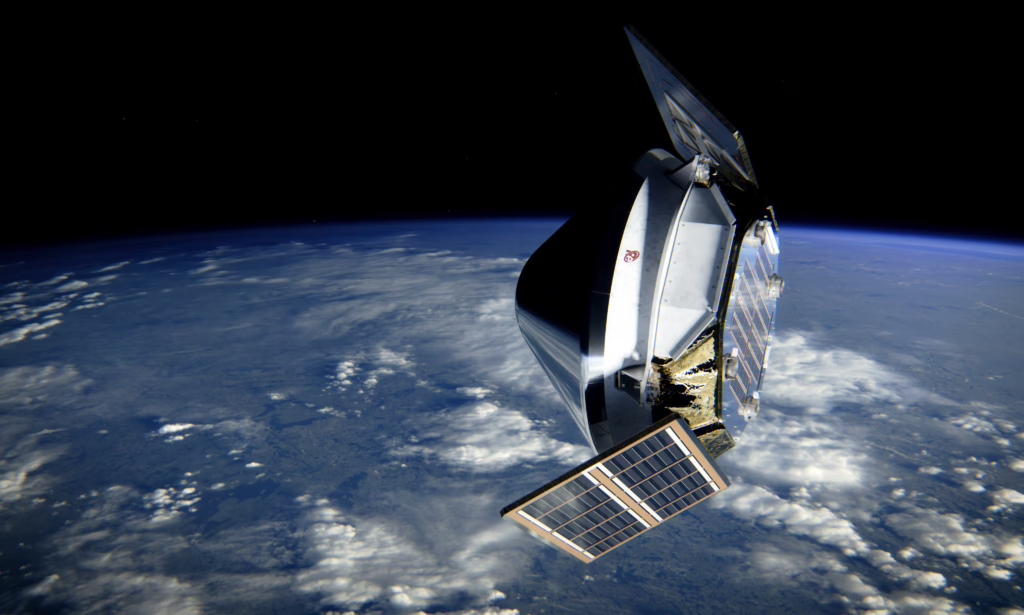
WASHINGTON — Atlanta-based startup Reditus Space today announced it has completed construction of its reusable re-entry vehicle for microgravity research, which also is being developed for Defense Department use as a hypersonics test bed — and, potentially, target vehicle.
Stef Crum, the company’s co-founder and CEO, told Breaking Defense that the spacecraft, called ENOS, can carry payloads for military testers wanting to evaluate how a specific system or technology functions in a hypersonic environment — or instead serve as a Mach 25+ target vehicle for interceptors both above and within the atmosphere.
The spacecraft is “designed to be launched and operate on-orbit like a satellite, leveraging the existing, and increasingly expanding launch-infrastructure. ENOS is capable of maintaining operations on-orbit, for days, months or years, providing operators with maximum mission flexibility. Then, ENOS can initiate its own reentry, and be recovered under parachute,” the Reditus announcement explained.
Crum said that Reditus currently is in the thick of “multiple engagements with different [DoD] entities.”
The two-year old firm, which has raised $7.85 million in seed money, last December announced it had been added to the Missile Defense Agency’s massive Scalable Homeland Innovative Enterprise Layered Defense (SHIELD) contracting pool to develop new tech and capabilities in support of the Trump administration’s Golden Dome initiative. Early this year, Reditus also nabbed a low-dollar Small Business Technology Transfer grant from the Navy to model turbulence flows and thermal dynamics for its hypersonic glide bodies.
Crum said the discussions with MDA are “particularly focused on, ‘Hey, what do the targets look like on that front.’ … So far, I’d say more [focused on] detection, but eventually kinetic engagement as well.”
For the Navy, he said, Reditus is “pushing the forefront of hypersonic modeling.”


Bombardier Defense, your trusted, mission-focused partner
A commitment to long-term operational value.
Crum said the company is also in discussions with the Air Force on using the ENOS as a “test bench,” as well as allowing the service “access to that high hypersonic environment for the maturation of their technologies and mission profiles.” This includes, he added, “shaping up a contract” with the Air Force Research Laboratory.
The ENOS vehicle weighs about 200 kilograms (about 441 pounds) and is “about the size of a small family fridge,” said Crum. The spacecraft, which looks a bit like a smaller version of the capsules used to splash down astronauts during the Apollo-era, is designed to operate in low Earth orbit at an altitude of about 450-600 kilometers (approximately 280-373 miles), he added.
For its inaugural flight, ENOS will lift off onboard a SpaceX Falcon 9 carrying microgravity research payloads for multiple commercial customers and will operate on orbit for about two months before initiating a deorbit burn and landing in the ocean.
The vehicle, which is equipped with a heat shield developed in-house by Reditus, “will reenter the atmosphere at approximately Mach 29, descending under parachute to a recovery point off the coast of Florida,” the company’s announcement said.
Breaking Defense Video