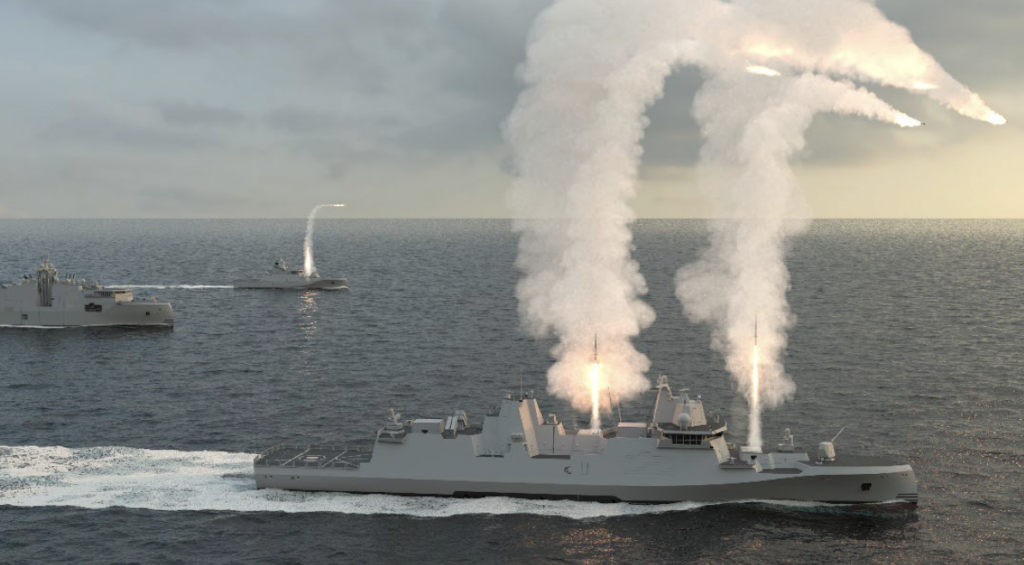
MILAN — German arms manufacturer Rheinmetall unveiled today a new guided-missile frigate, dubbed the GMF 140, intended for an undisclosed procurement tender in North America.
The 140-meter warship is designed for a variety of operations, including air and ballistic missile defense, anti-submarine warfare, and long-range strikes. Rheinmetall said in a press release that while it is targeting global markets, it intends to offer it first as part of a North American procurement program.
A Rheinmetall spokesperson declined to specify to Breaking Defense whether the project of interest is a Canadian, US or Mexican tender.
The German GMF 140 is envisioned to integrate “US-sourced primary radar options, hypersonic weapons and ballistic missiles, the AEGIS Combat System, and 64 Strike-Length Vertical Launch System cells,” the company’s announcement added. The guided-missile frigate can also be integrated with anti-ship missiles, torpedo launchers, lasers, and a 5-inch main gun, per Rheinmetall.
There is currently no known procurement program in North America for this type of system. But in April, the US Navy awarded HII’s Ingalls Shipbuilding a $283 million contract to support procuring long lead-time material, design work, and other pre-construction activities for a new frigate for the Navy.
The Navy is seeking to purchase one frigate in fiscal 2027, another in FY29, and two more in FY31, according to the service’s budget request released in April for FY27.
Last year as part of Canada’s River-class Destroyer program, the government awarded a contract to Nova Scotia-based Irving Shipbuilding for the construction of 15 guided-missile warships based on the British Type 26 frigate design.


Europe’s military advantage depends on sovereign command of the ground truth
As NATO and European governments accelerate investment in space-based intelligence, decision advantage will depend on how quickly sovereign and commercial capabilities can be fused into a trusted operational picture.
On its end, Mexico commissioned in 2020 a single ship built in country, the POLA-101, based on the Dutch Damen Shipyard’s SIGMA Frigate 10514, and no follow-on orders have been placed.
This news marks the first ship announcement since Rheinmetall’s expansion into the maritime market, following the acquisition of local shipbuilder Naval Vessels Luerssen earlier this year. Back in May, the company said it expected a “large volume” of naval orders and considerable acceleration in growth in this sector, as it outlined plans to produce “state-of-the-art navy vessels and maritime autonomous surface systems.”
Diana Stancy contributed to this report from Washington.
Breaking Defense Video