FARNBOROUGH — Throughout the week, the trilateral Global Combat Air Programme (GCAP) dominated chatter in the show halls, aircraft display areas and high-level briefings.
Since the death of the rival European Future Combat Air System (FCAS) project last month, GCAP is the only international sixth-gen fighter game in town — not including America’s unilateral F-47 project — meaning interest is sky high.
From potential new entrants to a “bridge” aircraft in the works, here’s what you need to know about GCAP, from the Breaking Defense team on the ground at the Farnborough International Airshow.
Canada Comes Into The Fold, But Anyone Else?
Undoubtedly the biggest GCAP news came with the long-awaited announcement that project partners the UK, Italy and Japan would expand to include Canada, though only as an “observer.”
Observer status does not involve any financial commitments on the part of Ottawa but allows it to hold a working understanding of the effort and could lead to discussions around joining as a full-fledged partner, which would include an industrial contribution.
“From the start of this program, the partner countries … have highlighted [an] openness to that kind of possibility, based on certain considerations, what is best for the program and of mutual benefit,” said Masami Oka, chief executive at the GCAP Agency, the organization overseeing the program on behalf of the three governments, on the eve of the Canadian announcement.
Following the virtual collapse of the Franco-German-Spanish FCAS program due to deep disagreements between industry leads Airbus and Dassault, there’s been speculation that those nations – or at least some of their industrial players – could switch to GCAP. (FCAS still lives on in pursuit of next-gen aerial tech, if not the centerpiece fighter jet.)
As far as national bodies, Leonardo CEO Lorenzo Mariani said he could easily see the benefit of, say, Germany joining, but he warned any major change would likely cause “disruption.”
Berlin would make a “strong industrial partner,” he said, but “another nation joining, another group of industries joining the program would risk [producing] some delays, while at the moment, on the contrary, we are fully committed to the 2035 [service entry] date.”
In Mariani’s estimation, France will not join GCAP, for the “same reasons” that led to the “rupture with Germany” on the defunct FCAS effort, meaning disputes over IP rights, workshare arrangements and design requirements.
German officials said after the collapse of FCAS they’re considering a range of options, including potentially playing a part in GCAP.
On the industrial side, a senior Airbus official said the defense behemoth is feeling out its own potential GCAP role, though there could be a high bar for joining.
“So your question was: Is Airbus ready to join GCAP? And my answer would be: it depends,” Michael Schoellhorn, Airbus Defence and Space CEO, told reporters in London on Tuesday, during a company briefing. “What we’re ready to do is to join something or to build something where we have a significant portion of the work and the leadership, and that’s currently being explored.”
Program Costs Still (Mostly) Under Wraps
During a GCAP panel discussion on Monday, executives shared that it is “premature” to talk about full program costs of the multinational effort, because partners are at a concept phase.
“We will have a detailed, exact figure probably at the end of the conceptual assessment phase, but we have [a] clear projection,” said Marco Zoff, CEO of Edgewing, the industrial consortium leading the project made up of BAE Systems, Italy’s Leonardo, and Japan Aircraft Industrial Enhancement Co. Ltd. (JAIEC).
He said that costs would be competitive on the basis that industrial activities are not being duplicated.
In June, the UK made a new commitment of £8.6 billion ($11.5 billion) for GCAP over four years, followed days later with the three partner nations jointly investing £4.6 billion to support the project’s concept and assessment phase. The latest round of funding follows a £686 million design and engineering contract inked in April.
Canada isn’t expected to pitch in, as its observer status does not come with a financial commitment, at least for now.
Elsewhere on other industrial matters, Zoff said that no decision has been taken on where GCAP final assembly could take place but “we have to decide in the next few months,” he explained.
“The overall architecture of GCAP is created with an underpinning map of technologies and workshare between the three countries,” he said. “We are trying to put together … the one third, one third, one third [national partner split] balance, and on the other side respecting a kind of versatility, meaning that we are leveraging the capabilities and the strengths that we have.”
Besides future decision making around workshare, the GCAP Power and Propulsion System consortium announced that it has moved “towards final approval of the all-new centre line engine demonstrator design, with continued progression of component manufacturing.”
The consortium comprises Avio Aero (Italy), IHI Corporation (Japan) and Rolls-Royce (UK).
A Wingman Reveal
GCAP is not expected to fly alone, but have a multitude of drone wingmen accompanying it.
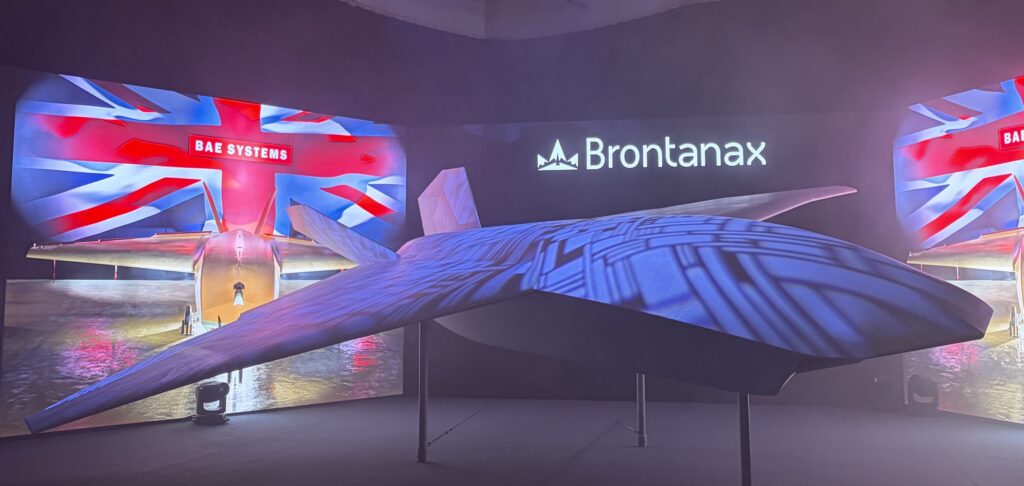
One of them could be the Brontanax, a new Combat Collaborative Aircraft (CCA) demonstrator made by BAE Systems and due to fly in 2027. The aircraft, revealed at Farnborough, is the company’s solution for the Royal Air Force’s Storm Fighter drone wingman effort.
Air Chief Marshall Harv Smyth, UK chief of the Air Staff, said that the Brontanax launch was a “historic moment” and fits within a wider RAF strategy to become “Europe’s first sixth-generation air force.”
Though designed to first team with Eurofighter Typhoon aircraft, likely as part of NATO’s exercise Steadfast Defender before the end of the year, the aircraft feeds directly into Britain’s strategy of creating a path for loyal wingmen types to be integrated into GCAP.
Building A Bridge To Sixth-Gen Capability
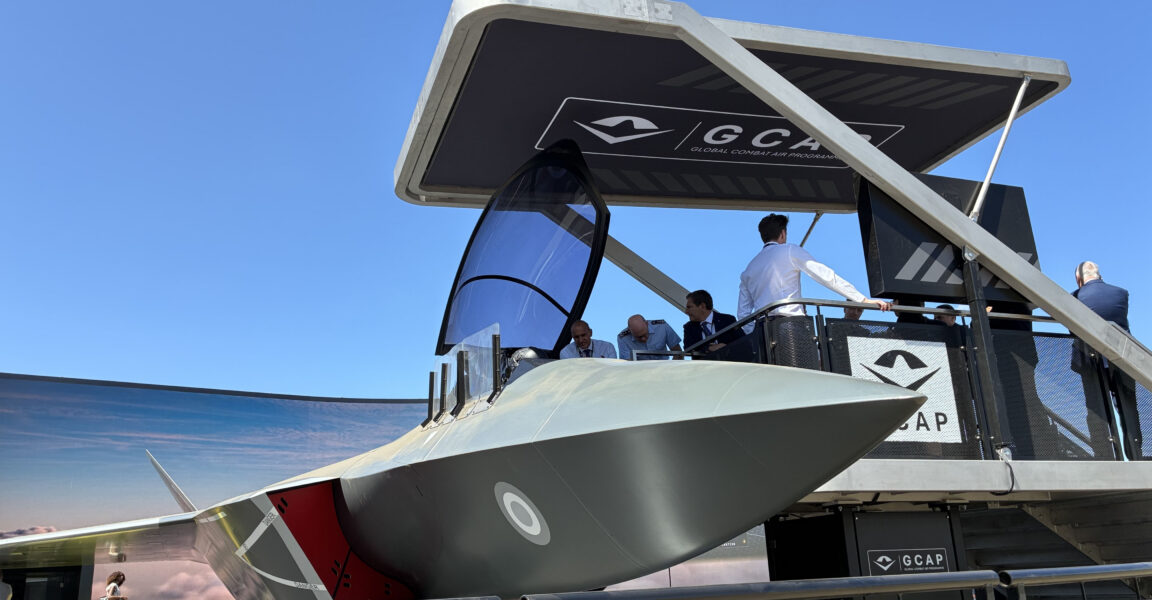
Before GCAP comes into service, BAE Systems is planning the first flight of the UK Combat Air Flying Demonstrator in the “early part” of 2028, according to a senior company executive.
The crewed, supersonic jet is envisioned as a “bridge” from Eurofighter Typhoon fourth-generation technology to a sixth-generation capability, Tony Godbold, FCAS delivery director at BAE Systems told Breaking Defense on the sidelines of the Farnborough air show. (BAE’s FCAS office has no relation to the defunct international project.)
Aimed at de-risking critical technologies supporting GCAP, production is at an advanced stage, ahead of the flight test schedule, which will first focus on validating stealth capabilities, aircraft handling, propulsion and airflow.
Godbold said that almost 90 percent of parts for the demonstrator are at different stages of manufacturing, covering approximately 11,500 components.
“The major units of the aircraft … front, center, rear fuselage, wings, fins, have been in manufacture for over 18 months now,” he added.
Next steps will see the demonstrator’s final assembly process launch in a matter of “weeks,” culminating in a year-end target of transferring the front, center and rear fuselage from company facilities in Samlesbury to Warton, a Eurofighter production site.
Systems integration, flight clearance activities and work toward a military airworthiness certificate will follow.
“Precisely what we’ll start with on the first flight is still being finalized, so that will come in due course,” noted Godbold. “But ultimately, what we’re looking to test are a lot of those six-gen features, size [and] shape of the aircraft.”
He added, “First of all, the handling characteristics of it, propulsion integration, and ensuring we can … get the airflow through a very complex ducting system” which is paramount to meeting low observable requirements.
Despite the non-involvement of GCAP partners Italy and Japan in development of the demonstrator, Godbold noted that both nations will be able to access information about it through Edgewing.
“So the purpose of doing this, of course, is for learning for UK industry readiness,” Godbold said, but “we’re already in the process of a controlled data and information release, [enabling] data sharing with our [GCAP] partners.”
He declined to say how long the demonstrator could fly for but made clear that it could be used to support and validate future GCAP fighter test points.
The demonstrator is funded under a £2 billion investment linked to the UK’s combat air strategy.
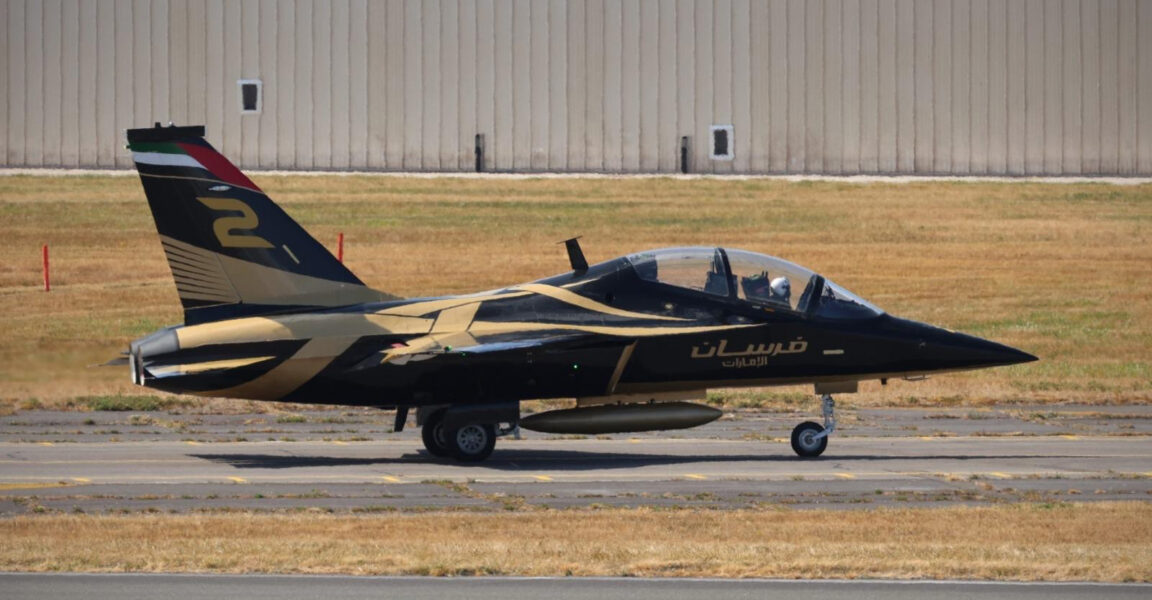
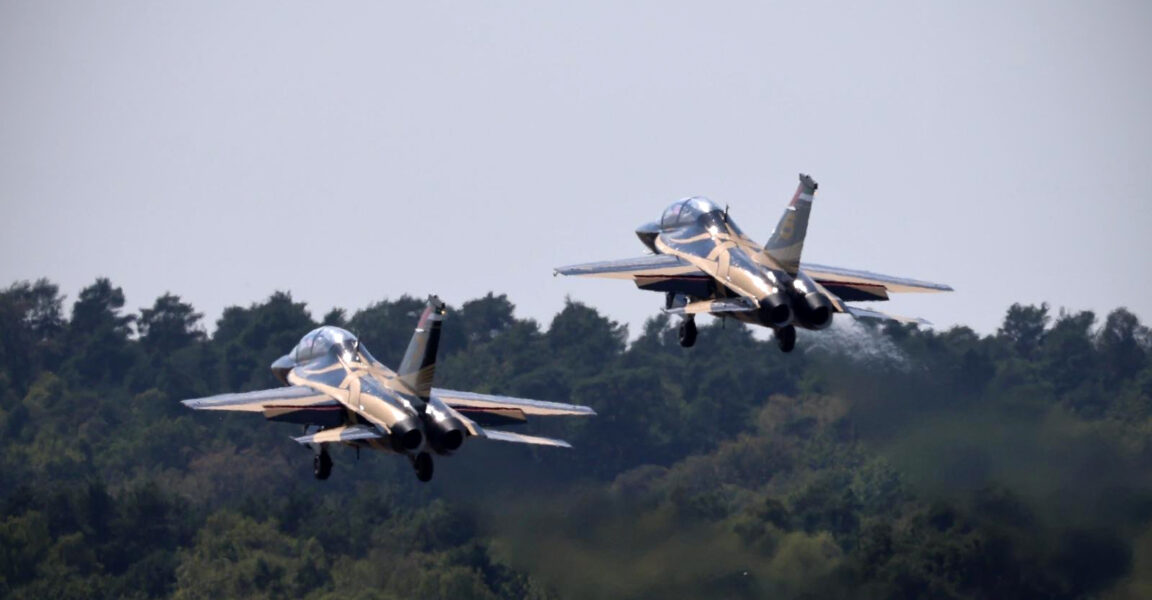
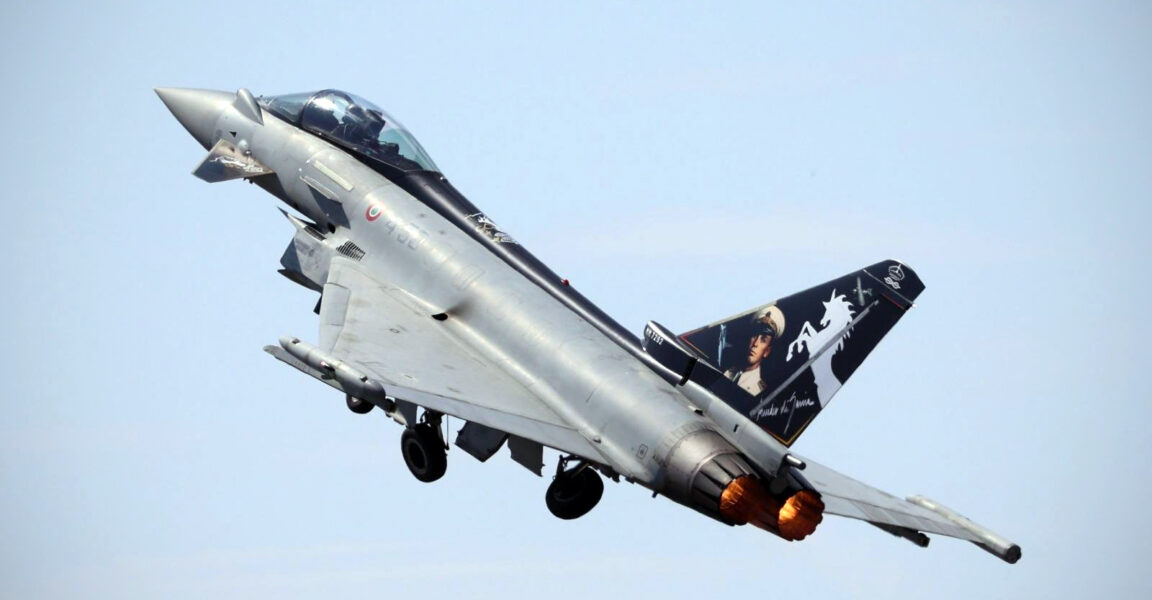
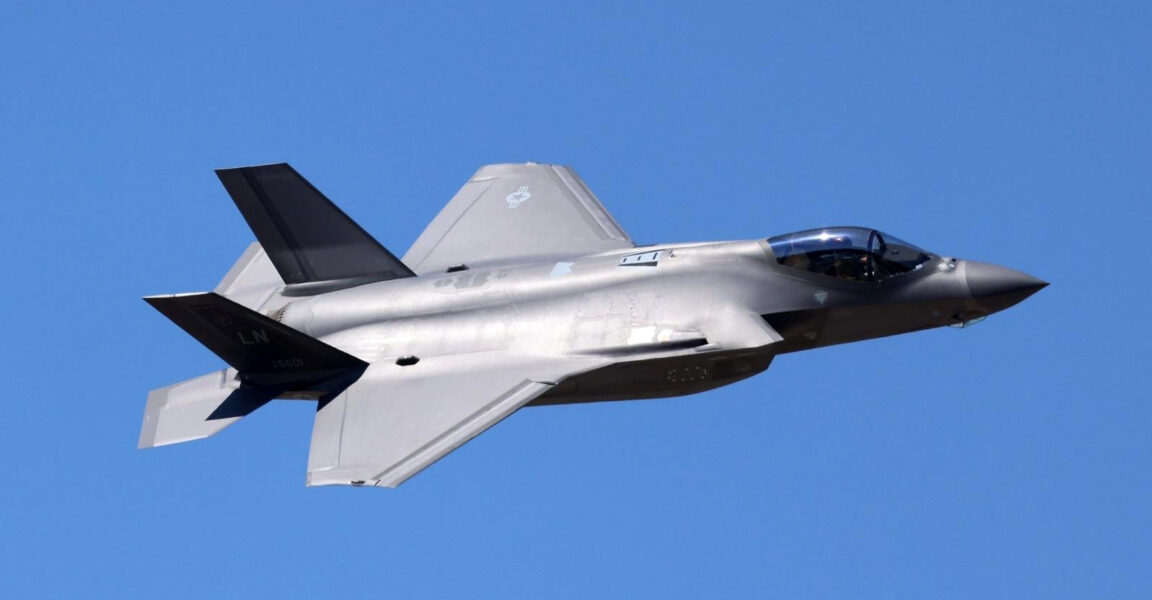
PHOTOS: Farnborough 2026
 Gallery







Breaking Defense Video