WASHIINGTON — A new science and technology strategy [PDF] released this week by the White House outlines a comprehensive, four-tiered priority scheme for military tech, from AI to quantum.
The National Security Science & Technology Strategy, as the 24-page document is titled, also takes a balanced approach to acquisition. While the NSSTS endorses the new wave of high-speed, low-cost innovations the Pentagon is pursuing, especially in expendable drones, it also emphasizes the continued importance of traditional high-cost, “exquisite” mega-programs — even when the threat they’re countering is relatively cheap.
“We will seek optimal combinations of lower-cost (and sometimes lower-tech or attritable) platforms that can be deployed in larger numbers and complement more limited numbers of sophisticated platforms,” the strategy says. This argument is essentially an update of the traditional “hi-lo mix” that dates to the 1970s, when the Air Force decided to buy both expensive F-15s and larger numbers of cheaper F-16s.
Of course, today’s technology is very different from 50 years ago, and the new strategy reflects that. Most obviously, it puts an emphasis on artificial intelligence, which Defense Secretary Pete Hegseth has publicly embraced (with the exception of Anthropic). But new strategy goes beyond AI boosterism to lay out four levels of priorities, from immediate, first-order needs, to second-tier but still “critical” techs, a third-tier of “key enabling technologies,” and finally “potentially transformative emerging technologies” to keep an eye on for the long term.
At the top of the pyramid are the “three priority areas for U.S. battlefield dominance and power projection”:
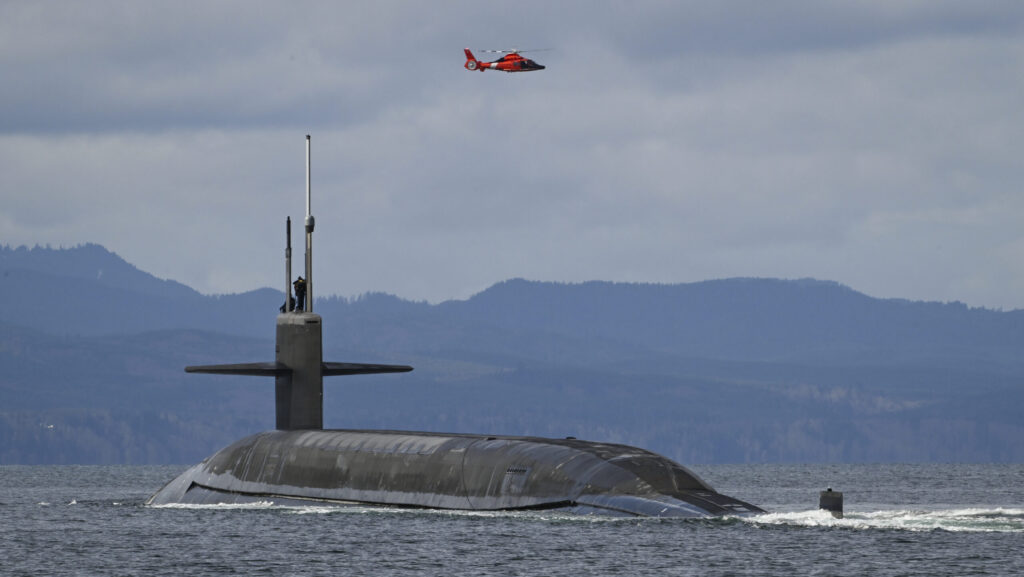
- undersea superiority, both for submarines and anti-submarine warfare;
- space, meaning the ability to not just “detect” threats but also “counter” them, from low orbit to the Moon; and
- AI and autonomy, a “rapidly evolving area” which the strategy doesn’t define as clearly as the other two, but which in prior Pentagon usage has meant everything from strategic planning software to swarming drones.
These three areas are all important elements of the current arsenal, in contrast to the “potentially transformative emerging technologies” named later. They’re also areas widely seen as current US strengths, although in each case challenged by competitors, especially China. A notable nuance: The strategy calls for “clear technological superiority” in both outer space and undersea, but only “competitive advantage” in AI and autonomy. (This week’s NSSTS attributes these three priorities to last year’s National Security Strategy, a much broader and less technology-focused document. In fact, while the 2025 NSS [PDF] does mention all three at various points, it does so alongside other technologies, such as nuclear energy, and without the clear prioritization of the new science-and-technology-specific strategy.)
Supporting these big three techs are three “other areas” that are nevertheless still “critical”: airpower, which the strategy sees as underwritten by stealth, electronic warfare and anti-air defense; long-range strike, meaning the ability to penetrate an enemy defense-in-depth with speed and precision; and C5ISR, an acronym for “Command, control, communications, computers, cyber, intelligence, surveillance, and reconnaissance” — in brief, the eyes, ears, brain, and nervous system of the force. There’s considerable overlap and synergy among these three, since long-range strikes are usually carried out by aircraft and directed by C5ISR.
The base of this pyramid is a long list of “key enabling technologies” that support the higher-priority techs. These enablers range from advanced manufacturing (e.g. 3D printers) to hypersonics, nuclear energy, and semiconductors. The main body of the document list a dozen of these but an appendix, which updates a formal Office of Science and Technology Policy (OSPT) list of Critical and Emerging Technologies (CETs), goes on for three pages.
Finally, in a separate section focused on “building technological resilience,” the strategy discusses potential gamechangers — technologies that, given a future breakthrough, could that upset the strategic balance and take the US by surprise. Here, the strategy says, “the United States will build long-term technology resilience by leading in potentially transformative emerging technologies, where the national security implications and timelines remain uncertain.”
Specifically named in this category are biotechnology, particularly to enhance human performance and counter hostile bio-weapons, and quantum technology, including quantum computers, sensors, and communications. The third example is Artificial General Intelligence — AI and autonomy again, but specifically the potential for a future algorithm to outsmart the human race.