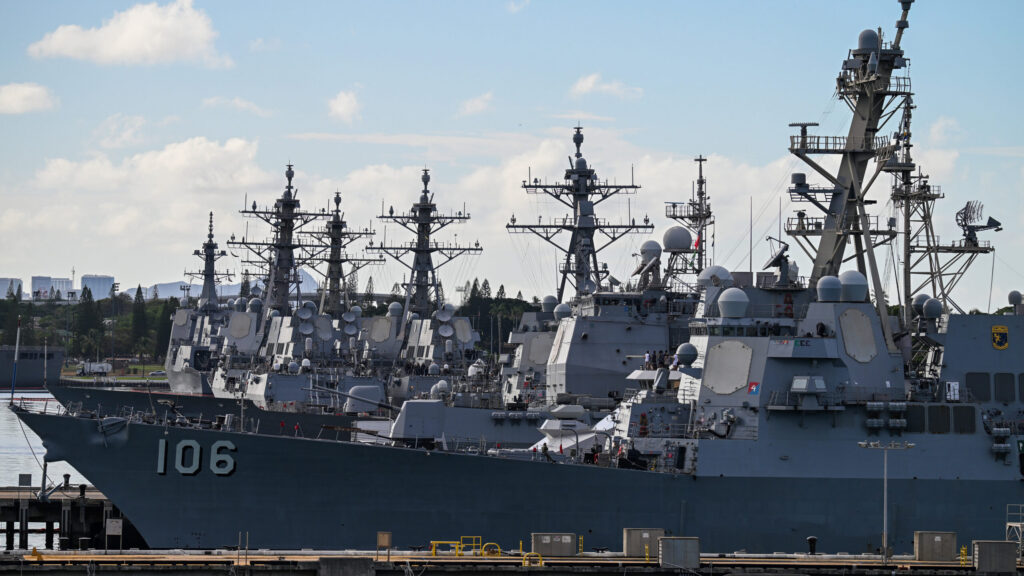
WASHINGTON — With supply lines stretched over thousands of miles, a future war with China would strain US logistics. But what if the military could manufacture key spare parts on demand, even aboard ships at sea? The Naval Postgraduate School (NPS) and its nonprofit partner FLEETWERX tried just that in last month’s 31-nation Rim of the Pacific (RIMPAC) wargames, testing a new, networked approach to 3D printers and other high-tech tools they call distributed advanced manufacturing.
“I don’t think that it’s a state secret that if we got into a high-intensity conflict right now in the Indo-Pacific, it would be difficult to meet all of the repair and resupply needs that we’re going to have out there,” FLEETWERX director Morgan Bower said in an interview. “[We’re] finding those areas where there’s gaps in the supply chain.”
Distributed advanced manufacturing uses a secure but unclassified (IL-4) cloud to link over 50 sites with many different types of 3D printers, computer-controlled tools like CNC lathes and milling machines, and even robotic boats that made unmanned supply runs. Some of the tools were on ships participating in RIMPAC, but many others supported the exercise from bases, depots, universities, and businesses back in the United States, taking orders over the network and then sending the parts out via commercial delivery services.
RELATED: Multinational RIMPAC exercise played ‘primary laboratory’ for cutting edge tech
“Just being able to make everything talk to each other is frankly amazing,” Bower told Breaking Defense. A big part of the project, he said, is just “mapping out where all those resources are, figuring out what their strengths and weaknesses are, and what we can send to them to produce.”
The demand was staggering: Over two weeks, Bower said, “we had 2,741 part requests.”
There was no way the experimental network could meet more than a fraction of that demand, he went on. Some requested parts couldn’t be made with 3D printing and CNC milling at all. Of the requests that were a good fit for the tech, the team managed to produce about 75 different parts.
One notable success was heavy-duty hose clamps, used to keep big fuel lines in place during ship-to-ship refueling at sea. Through normal channels, “we were told it was about two months before we could even get a quote” for a replacement clamp, Bower said. 3D printing produced clamps that were treated with anti-corrosion coatings and passed inspection in a matter of days.
At the same time, he said, other high-demand parts, like batteries and circuit boards, can’t be practically produced by 3D printing. And some parts passed inspection and preliminary testing, only to fail in unexpected ways once installed, like a CNC-milled titanium piece for a helicopter’s hydraulic system that developed a slight leak in pre-flight workups. (A second try at that part is now in testing).
“The Program Of Now”
It’s crucial to understand, Bower explained, that 3D printers aren’t magic boxes that manifest whatever the user wants. They’re not like the replicators in Star Trek, he said, which materialize anything on request and apparently out of thin air.
To start with, 3D printers need raw materials and other supplies to function. The most obvious example is the finely powdered metal or plastic they use to make things, spitting out individual drops of material and then welding them together with lasers. But that welding process is also so delicate that it reacts badly to outside contaminants.
One of the most common contaminants, unfortunately, is oxygen. “It becomes really obvious when you’re inspecting the part,” Bower said. “If you [did] that welding process when there’s oxygen in the chamber, you will very quickly see the porosity, the holes, the bad welds, things that are coming apart.”
That’s why high-end 3D printers do their printing inside an airtight compartment flooded with argon, an inert gas. For RIMPAC 2026, Bower said, FLEETWERX used up “racks and racks” of argon bottles, which took about 7,000 square feet of storage space aboard ship. And argon’s not just bulky: It is also rare — about one percent of the atmosphere — and expensive to produce.
To ease that supply problem, FLEETWERX is looking at argon generators small enough to fit aboard a ship, preferably in a standard shipping container. But aboard the USS Essex during RIMPAC 26, it also tested an alternative gas, nitrogen, which can be captured from the air using devices small enough to bundle with a 3D printer. Nitrogen is more reactive than argon, which means a higher chance of defects — but for many parts, Bower said, it’s good enough.
Figuring out exactly which parts can be made with cheap nitrogen, and which need expensive argon, is one of the challenges FLEETWERX faces next. But it’s already clear to Bower that there’s no one-size-fits-all solution, no standalone 3D printer that can efficiently meet every need. Instead, he said, the distributed network needs a wide variety of different types of printers, CNC lathes, and other tools, along with an AI advisor to help users figure out which tool to use for which job.
FLEETWERX had experimented with AI tools in the past, Bower said, but RIMPAC 26 saw a dramatic advance in their capability. “Last year was a lot of copying and pasting things into NPS’s Microsoft Copilot and trying to get answers,” he told Breaking Defense. “That was not really implementable.”
This year, by contrast, they tried out two different Large Language Models: One chatbot was trained on the official Navy policies, procedures, and technical standards, the second on the capabilities of different 3D printers and other tools. Together, the AIs gave “about 70 percent of the answer” on what tool to use to make which part, Bower said, with human experts making the final call.
That was helpful, he said, but not nearly enough to cope with the almost 3,000 requests that flooded in. The goal, he said, is it get the AI up to 95 percent correct so only minimal human intervention is required, with the network able to automatically match jobs to tools most of the time.
The distributed advanced manufacturing network still need a lot of refinement, Bower emphasized.
“No one has a 100 percent answer right now,” he told Breaking Defense. “Our goal is not to say, ‘our system is going to be the answer and everyone’s going to use this, we’re going to be the program of record.’ I’d say that we are more of the program of now.”