MELBOURNE — It may be more well known as a multinational high-end warfighting exercise, but this year’s Rim of the Pacific (RIMPAC) exercise was also expected to serve as a vast, complex test bed for cutting edge American military tech.
Approximately 40 experimentation initiatives were expected to be completed by the time RIMPAC came to an end last month, all part of the Fleet Experimentation (FLEX) program, with each having a sponsor from the Department of War or Department of the Navy.
These experiments were to include “the largest advanced manufacturing demonstration ever conducted by the U.S. Department of War” as well as an armed unmanned surface vessel launching missiles against a surface target, according to the US Navy’s Naval Postgraduate School.
The RIMPAC exercise, which began June 24, took place in and around the Hawaiian Islands and saw 30 nations take part with 30 surface ships, five submarines, more than nearly 200 aircraft and more than 30,000 personnel, according to figures provided by the Navy on Friday.
As the exercise was underway, Rear Adm. Suzanne M. Bailey, deputy commander of the US 3rd Fleet and the commander of the RIMPAC Combined Exercise Control Group, said that the exercise is the premier venue for fleet experimentation.
“RIMPAC provides the real-world operational environment where all of our participating forces can develop technologies and innovate their current technologies and improve interoperability,” she said during a media call on July 6, adding that “our efforts are focused on exposing the fleet and our partners to emerging capabilities and receiving real-world warfighter feedback very early in the process.”
Bailey specifically noted that integrating uncrewed systems as part of the wider fleet would present “a more complex and unpredictable challenge to any adversary” and is part of the reason why exercises like RIMPAC are critical.
“This exercise is our primary laboratory for operationalizing these platforms and concepts. With our partner nations, we’re learning together on how to combine manned and unmanned platforms into a single, cohesive, and formidable fighting and defensive force,” she said.
The Navy said that “during the at-sea phase, participating forces executed complex combined and joint training, including anti-submarine warfare, maritime strike, integrated air and missile defense, amphibious operations, and logistics. The exercise concluded with a free-play scenario in which opposing forces reacted dynamically to one another in order to evaluate the force’s combined and joint maritime capabilities.”
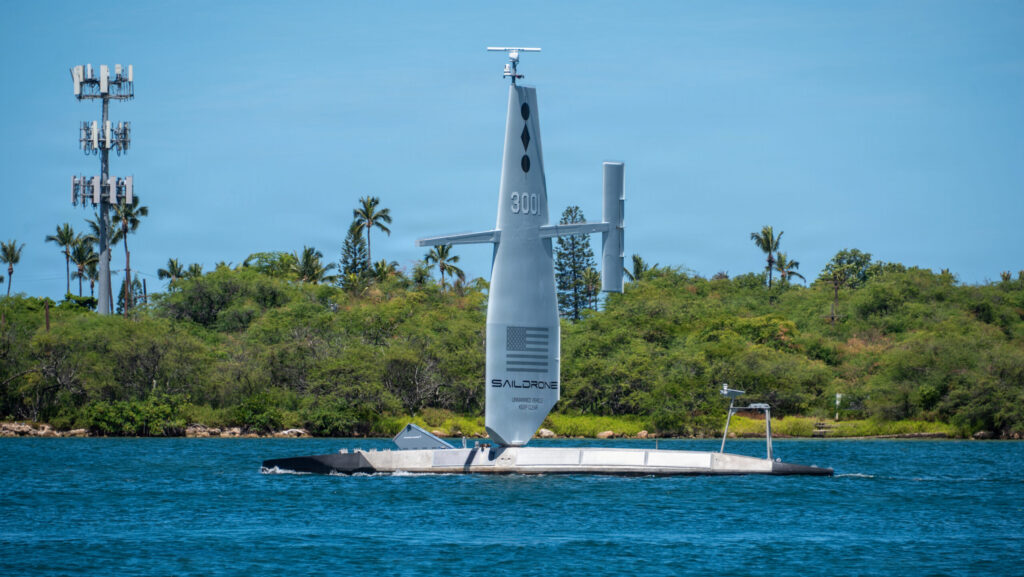
One expected experiment was to have Lockheed Martin AGM-179 Joint Air-to-Ground Missiles equipped on a Saildrone Surveyor Uncrewed Surface Vessel, a Saildrone executive said in April.
Another RIMPAC experiment was to see personnel from the Naval Postgraduate School’s Consortium for Advanced Manufacturing Research and Education (CAMRE) and the Naval Information Warfare Center Pacific run tests and a demonstration of spectral imaging unmanned aircraft detection sensors and 3D-printed rockets for potential applications in a counter-unmanned aircraft system, according to a US Pacific Command (PACOM) news release.
RIMPAC was also expected to focus on 3D printing, and was described as “the largest advanced manufacturing demonstration ever conducted by the U.S. Department of War.”
“Rather than focusing on a single manufacturing technology, the demonstration will execute the complete workflow of expeditionary manufacturing, from receiving a digital request and identifying available production capacity to manufacturing through distributed nodes, transporting and delivering parts in support of operational forces,” said Chris Curran, program manager for CAMRE.
The idea is for commanders to be able to “submit a digital request, identify the nearest qualified manufacturer, produce the part near the operational area, and deliver it directly to forces in the field,” PACOM said in its release.
The PACOM news release adds that RIMPAC also allow NPS researchers to “identify challenges that cannot be replicated in laboratory settings,” as the scale of the exercise “provides the complexity needed to evaluate whether distributed manufacturing can function under realistic operational conditions” by exposing the technologies “to the logistical constraints, coordination challenges, and operational demands they would face during real-world missions.”