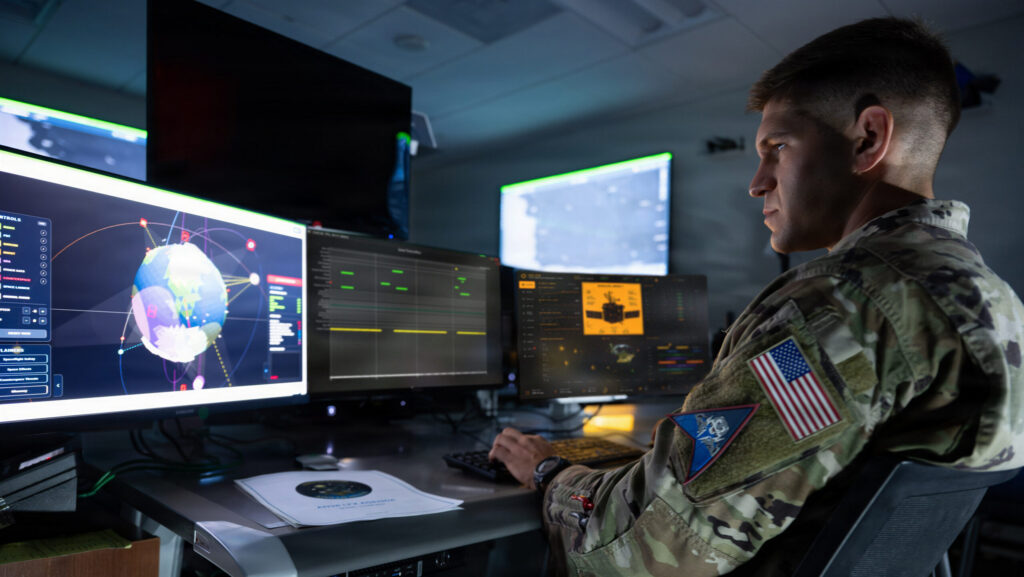
WASHINGTON — Despite the Space Force’s growing efforts to acquire commercial technology, products and data, the service is struggling to be able to integrate these capabilities into its day-to-day operations, according to service officials.
“There’s three barriers, at least, for the Space Force that we continually run into for commercial technology integration. The first one is requirements. … The second one is on classification, and the third one is on operational integration,” Col. Tim Trimailo, head of the Space Systems Command’s Commercial Space Office (COMSO), told the annual Intelligence and National Security Summit in Bethesda, Md., on Wednesday.
COMSO is the Space Force’s unit charged with identifying commercial capabilities of interest to the service and helping to speed those capabilities to the field.
Trimailo’s remarks were partially echoed in a report released the same day by the Government Accountability Office (GAO) that found “hesitancy” within the service about “purchasing and using commercial space data.” Officials in several key Space Force organizations, including the service’s Combat Forces Command that provides trained operators to US Space Command, told GAO they were reluctant to turn to commercial providers, due to worries about “licensing costs, perceived use restrictions, and concerns over long-term access to the data.”
These concerns persist despite the ongoing efforts of the Joint Commercial Operations Cell (JCO), the main service office responsible for buying commercial data and services, to expand its portfolio.
JCO not only buys commercial data and services for the Space Force, but also for the US combatant commands and a number of other government agencies. Its acquisitions go through the contractor-operated Global Data Marketplace and currently are focused on data and services to support the Space Force space domain awareness and “tactical surveillance, reconnaissance and tracking (TacSRT)” missions. The office spent $76.8 million on purchases via the marketplace from January 2023 through September 2025, according to GAO.
The JCO also runs the informal “Cross-Government Commercial Data Sharing Working Group” to coordinate interagency purchases of commercial space data, which includes among other government entities the National Reconnaissance Office and the National Geospatial-Intelligence Agency. It helps iron out issues that arise in obtaining and acquiring that data.

Physics AI is different and changes the way defense systems are designed
Models that replicate real-world physics streamline design, testing and iteration processes.
The problem, GAO found, is a simple lack of communication.
“This working group meets monthly and coordinates purchases. GAO found that many of the challenges reported by Space Force officials could have been addressed with discussions at the working group, but the Space Force officials were not part of the working group and information about the working group is not widely available,” the report explained.
Several Space Force officials told Breaking Defense that problem with integrating commercial space data is representative of a more systemic, and long-standing, gap in communications and understanding between the service’s acquisition corps and its operational units.
“They just don’t talk to each other,” one service official said on the condition of anonymity.
And that divide, that official and two others said, has been exacerbated as the Space Force rushes to obligate its fiscal 2026 investment budget of $18.8 billion plus the $5.9 billion provided in the 2025 budget reconciliation package ― as well as prepare for a hoped-for influx of even more funds for FY27.
The service recently has been buying both new kit and commercial capabilities “willy-nilly,” another Space Force official said, but sometimes failing to adequately consider the subsequent needs, including funding, for training resources, or to fully work out concepts of operations for how new tech can be best used.
Trimailo acknowledged that disconnects remain, while stressing that there are ongoing efforts helping to create bridges.
“We have to have a better linkage between our acquisitions officers, or staff, and our operators,” he told Breaking Defense on the margins of the intelligence summit.
Trimailo pointed to the creation of Mission Deltas, initiated in 2024 to integrate acquisition professionals responsible for maintenance and sustainment into the service’s operational deltas (i.e., the Space Force equivalent of Air Force wings), as one effort to do that.
Further, he said, US Space Command’s new(ish) Apollo Insight tabletop exercises also are aimed at better integration between the two sides, with the added bonus of bringing in commercial firms to allow them to demonstrate innovative capabilities. The first of the planned wargame series was held in March.
Trimailo said his team putting together the SSC’s Commercial Augmentation Space Reserve (CASR) plan to create a kind of civil reserve for space operations is participating in those wargames.
“Things like that, integrated exercises where we bring in together operators, acquisitions, and our industry partners, I think, [are] a model that we should have,” he said.
Trimailo noted that at the moment is unclear where his office will land under the recent reorganization of the Space Force’s acquisition core into Portfolio Acquisition Executive (PAE) offices because its remit crosses a number of missions. However, he said, his best bet would be that it will end up under the Infrastructure PAE.