WASHINGTON — In an unprecedented move, the Defense Department has agreed to give SpaceX exclusive access to the government’s most classified space tracking data, according to a dozen government and industry sources.
One of the sources, a Space Force official, told Breaking Defense a “contractual agreement” has been signed between SpaceX and the Space Force’s Joint Commercial Operations Cell (JCO), trading company access to US Space Command’s (SPACECOM) most detailed version of its High Accuracy Catalog (HAC) of on-orbit objects in exchange for SpaceX giving the JCO data from its Stargaze star-tracking cameras.
It’s unclear when the arrangement began, but in recent days it has sparked concern in the US space tracking industry, sources said. Even though the Space Force official said the high-fidelity information has been provided to SpaceX only for “internal use”, industry and government sources told Breaking Defense it is not clear whether that data is permitted to play a background role in honing the accuracy of products and analysis SpaceX provides to non-military space operators — potentially undercutting the market.
Barbara Golf, head of JCO, referred a question from Breaking Defense to Space Force Space Systems Command, which oversees JCO acquisition. Neither the Space Force nor SpaceX responded to multiple inquiries about the deal.
Jon Herman, SpaceX senior director for Starlink constellation engineering, was asked directly about the purported deal, the data’s value to the company, and its terms of use during a panel at the Advanced Maui Optical and Space Surveillance Technologies (AMOS) Conference in Hawaii last week. In response, he did not address the deal specifically, but explained why the data is helpful.
SpaceX’s Starlink satellites, he said, are “bad at seeing the small stuff,” and therefore “radar data is an extremely valuable tool to supplement Stargaze.”
The Purpose Of Stargazing


A new era of uncrewed airpower: GA-ASI’s lineup for high-tech warfare
GA-ASI is serious about retaining its position as the leading provider of UAS to the United States and its allies.
Star trackers like those used by Stargaze can provide valuable capabilities as they are used to determine a spacecraft’s orientation in three-dimensional space (known as attitude), and are especially important for precisely aiming on-board cameras and intersatellite laser links.
But they also can be used to detect and characterize satellites and space debris, meaning Stargaze, even if its free tracking service is based only on the observations of its own cameras, is at a minimum a market perturbator.
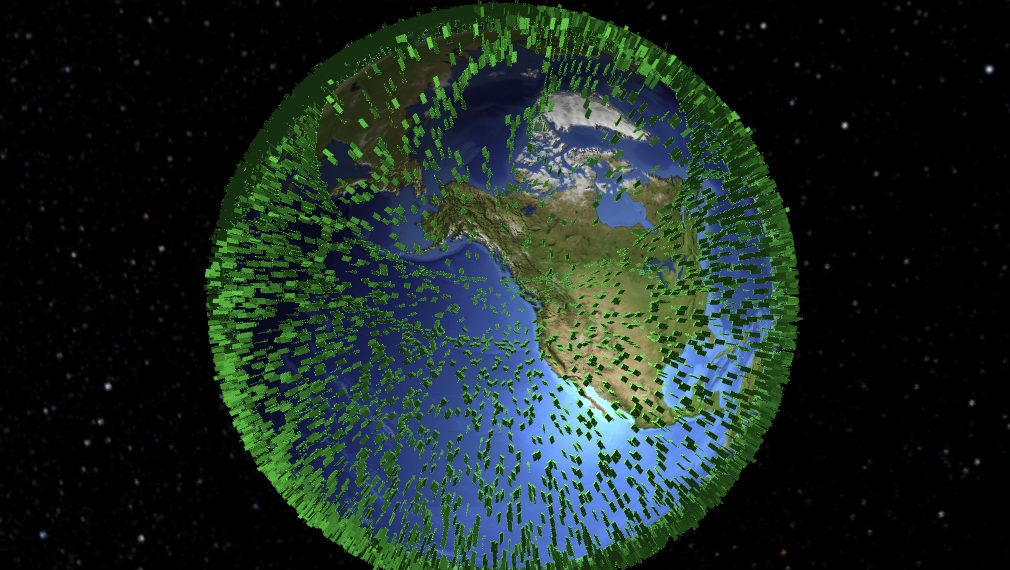
Stargaze currently uses about 30,000 star-tracking cameras mounted on Starlink satellites — SpaceX’s broadband communications network — to keep tabs on the heavens in low Earth orbit (LEO), according to Herman.
“We detect objects that are down to about a meter/half a meter in size, which means that we can see more than 80 percent of the Space Force catalog that is below 600 kilometers (about 373 miles),” he told the AMOS conference on Sept. 17.
Most current military and commercial radar and telescopes based on the ground, meanwhile, can see and routinely track objects down to about 10 centimeters in LEO. But while Stargaze’s resolution is not as good for small things as that offered by other providers of LEO space tracking information, Herman said the advantage is in the fact that the cameras can take “tens to hundreds” of pictures of an object in a given period of time — which allows better tracking over time of an object’s orbital path.
The star-tracker observations are entered into a database that catalogs objects seen, and then processed to create a picture of what is in space where and when. For SpaceX, this allows it to keep its roughly 11,000 Starlink and Starshield satellites safe from collisions.
That Stargaze catalog of space objects itself is not shared publicly, or with other operators who agree to share the whereabouts of their own satellites in exchange for services, Herman said. Rather, he said, those participating operators will receive products and services, such as information about potential collisions — known in space industry parlance as conjunctions — derived from it.
“The way this works is you send us your [emphemeris], and then we screen you against every Starlink trajectory as well as the entire Stargate catalog,” he said. “You’ll see all these scary things that we see in Stargaze.”
There are about 100 operators currently “onboarded” with Stargaze, Herman added.
For JCO, access to the Stargaze tracking data could improve the fidelity of fused commercial space surveillance data available via the Unified Data Library.
Competitors Wary
SPACECOM specialists are responsible for monitoring the heavens, with a particular eye toward adversary satellites. They also are responsible at the moment for providing warnings of close approaches and possible collisions to all satellite operators.
They do this by generating three types of space object database reports, each with a varying level of accuracy, for plotting the trajectories of on-orbit objects, according to public information and industry sources. The catalogs use observational data about satellites and space debris gleaned by the Space Surveillance Network (SSN) of radars and telescopes around the world, but are created using different methodologies.
The public version, contained on the Space-Track.org website with explanatory information accessible to anyone, includes what are known as two-line elements (TLEs) showing a snapshot of a space object’s position and velocity at a certain time. How often those snapshots are provided varies from object to object, and this is the least precise of the three report types.
A second version is called the Special Perturbations-High Accuracy Catalog (SP-HAC), which uses a higher fidelity mathematical model to predict a space object’s trajectory. It is not public, but industry officials explained that access is provided to those companies and foreign governments that sign a sharing agreement with SPACECOM. SPACECOM also bases the Conjunction Data Messages it provides for free to US and foreign satellite operators warning them of potential close approaches to other space objects on the SP-HAC, according to explanatory information on the Space-Track.org website.
The third and most precise version of the HAC is embodied in what are called Vector Covariance Messages (VCMs), industry sources said, which in addition to being based on SP-HAC’s high-fidelity mathematical model also include volumetric margin of error bubbles, called covariances, that allow more precise plotting of potential collisions. In the past, those error bubbles have been classified and largely kept for internal military use, in order to ensure against reverse engineering of the SSN sensors’ capabilities.
According to the industry sources, while some commercial entities have been given limited access to VCM data in the past, no other firm besides SpaceX has been given routine access to VCM and the error bubbles for non-government uses. (After a long negotiation, the Pentagon also shares the covariances with the Commerce Department for its troubled Traffic Coordination System for Space program.)
The JCO-SpaceX agreement, the Space Force official said, does contain certain restrictions on use of the data.
“We do have stipulations on it that they’re not allowed to use that for any sort of commercial gain or benefit. It’s only for their internal use,” the official said on the condition of anonymity.
This implies that SpaceX is permitted to integrate the VCM-type tracking and covariance data into its Stargaze catalog to plot safe maneuvers for its own satellites.
Herman said the Starlink satellites perform “20,000 maneuvers every single day.” He added that 1,000 of those daily maneuvers are to avoid collisions, “so the majority is either station keeping or orbit transfer.” The “collision avoidance burns are overwhelmingly for non-Starlink objects,” he added.
Several industry analysts said that if SpaceX is using the covariance data only for ensuring the safety of Starlink/Starshield satellites, that is to be welcomed for space safety reasons since the SpaceX satellites make up more than half of the traffic in LEO.
However, industry sources said, since SpaceX provides Stargaze services to others for free, there’s lingering concern over what restrictions based on terms like “commercial benefit” might mean practically and whether the “internal use”-only data could influence the Stargaze services. In other words, industry officials said they are worried that if Stargaze is using an integrated catalog, SpaceX may well siphon off customers from other space tracking providers who cannot provide the same level of accuracy about LEO space traffic even for a price.
Since the terms of the agreement with the JCO have so far been kept secret, there is widespread worst-case speculation.
And of course, the more satellite operators provide their data to Stargaze, the more accurate its tracking capabilities become — further undermining for-profit providers.
No sources were able to point to evidence the deal has influenced Stargaze products, but industry reps fret that if it did, it could lead to a feedback loop: Stargaze, a free service owned by the world’s richest man and armed with the covariance data, becomes the killer app for LEO tracking that everyone signs up to, driving competitors out of business while continuously improving its own data set. And, in a doomsday scenario envisioned by several sources, once the competitors are out of business, Stargaze could in theory then turn around and start charging once it is a monopoly.
“It’s very very hard to compete with free when you have costs,” Audrey Schaffer, senior vice president for global policy and government strategy at Slingshot Aerospace, told the AMOS conference on Sept. 17. This applies, she said, whether it’s data provided by government agencies or by free private services like Stargaze.
Some industry and government sources also fretted that Stargaze ― despite its current shortcomings — could become viewed as a private substitute for TraCSS, which would wipe out another potential source of revenue for current space tracking firms. (However, Stargaze currently only looks at LEO, while TraCCS covers other orbits as well.)
“It absolutely is gives SpaceX an unfair market advantage,” one industry analyst alleged.
Perhaps adding fuel to industry concerns is an in-depth analysis by Quilty Space published Aug. 28 that shows that the Pentagon’s Defense Advanced Research Project Agency (DARPA) provided $107.7 million in contracts to SpaceX for work leading to Stargaze under a program called Space-WATCH.
DARPA launched Space-WATCH, for Space-domain Wide Area Tracking and Characterization, in 2023, and Quilty said that as of now, “SpaceX is the only known supplier.”