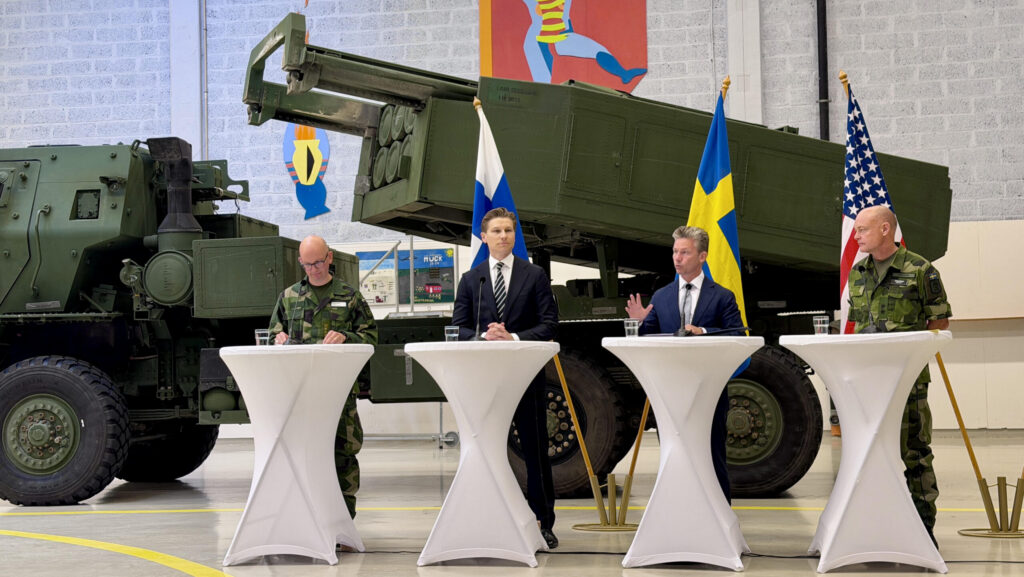
ÄRNA AIR BASE, Sweden — Sweden today announced it has signed a SEK 7 billion ($732 million) deal to procure the Lockheed Martin’s M142 High Mobility Artillery Rocket System (HIMARS), as part of an ongoing overhaul of NATO’s newest member’s long-range strike options.
The announcement came in front of a US Army HIMARS launcher that had been transported from an undisclosed location in Europe to the hangar here at the air base just outside Uppsala, and was made alongside officials from Finland, Sweden’s close neighbor which will play a role in helping Sweden bring the capability online.
The acquisition comprises “just over” ten launchers together with a “substantial quantity” of ammunition, Defense Minister Pål Jonson said to the reporters in the hangar, without being more specific. The first deliveries of launchers and ammunition are set for 2027, as part of a deal the defense chiefs said. This is the first contract of a deal the the American Government approved in March
Jonson said that the system will also enable “future use” of the Precision Strike Missile (PrSM), with a range of up to 500 kilometres, “capable of striking high-value targets in depth.”
“The long-range precision capability that you get with HIMARS is something we [the Army] don’t have in our toolbox at the moment. We have it in the Air Force, but we also need it in the Army,” the head of the Swedish Army, Maj. Gen. Johan Pekkari, told Breaking Defense on the sidelines of the press briefing.
He stressed that it is a deep-strike capability that will add to the recently operational Taurus missiles the Air Force’s Gripens can now carry.
Alongside the procurement, Lockheed Martin and Sweden’s defense giant Saab have signed a letter of intent to explore integrating Saab’s Ground-Launched Small Diameter Bomb (GLSDB) and producing munitions for HIMARS and other systems, including the Patriot air-defense system (PAC-3).


MQ-9B and Gambit Series: Advancing European Defense Capabilities
GA-ASI will build Gambit aircraft in Europe, partnered with European-based companies, with airframes available for international procurement starting in 2027.
“We need to produce a lot more munitions in Europe and in Sweden. I am particularly glad that Saab and Lockheed Martin are teaming up on this, and this includes everything from the GLSDB that Saab and Boeing have developed, in combination also with PrSM, or potentially other long-range strike capabilities,” Jonson told Breaking Defense.
During the press briefing, he said the “first steps” are now being taken toward “joint production in Sweden” of rocket artillery ammunition. However, production will start at Saab’s factory in Grayling, Michigan.
“I think it’s great if they [Saab] could expand production there [the factory in Grayling] or elsewhere. We want to ensure that we have a good security of supply on the munitions side; that’s absolutely crucial.”
The head of Saab Dynamics, Görgen Johansson, told Breaking Defense that this is a first step toward production in Europe.
“It is still only a letter of intent, but we are setting up a production area right now in Grayling, Michigan. Over time we are open to seeing whether we could do something in Europe as well,” Johansson said, on site in the hangar.
Finland As Sustainment Center
Since Sweden does not yet operate their own HIMARS, Finland will help with maintenance and training. Lockheed Martin is also setting up Europe’s first HIMARS maintenance center in the Finnish city ofTampere — a move Finland’s Defense Minister Antti Häkkänen said was deliberate.
“We made a deal with Lockheed Martin that the center will come to Finland, which will support the whole of Europe” he told Breaking Defense adding, “We hope allies procuring new HIMARS will also use our center for sustainment. Sweden is now the first one, and that’s why I’m here [for the signing ceremony].”
Finland already operates Lockheed’s tracked MLRS variant, which uses the same munitions family, so the defense pact signed today by the Swedish and Finnish defense ministers goes well beyond sustainment. “Well, sustainment, spare parts — and we are now also starting cooperation on ammunition, because of the interoperability between MLRS and HIMARS. That’s a big one,” Häkkänen said.
However, the defence chiefs in the hangar today were certainly aware of repeated reports of delays in deliveries of American-made weapons because of the war in the Middle East. This spring, several European countries were informed by the US government of possible delays to already purchased weapons. Estonia had previously signalled delays in HIMARS deliveries. But that doesn’t seem to bother the Swedish defence minister.
“No, it doesn’t. That is based on the fact that we can build up security of supply on the industrial side between Saab and Lockheed Martin. I think that’s good for all countries who are operating the HIMARS system” Jonson told Breaking Defense.