
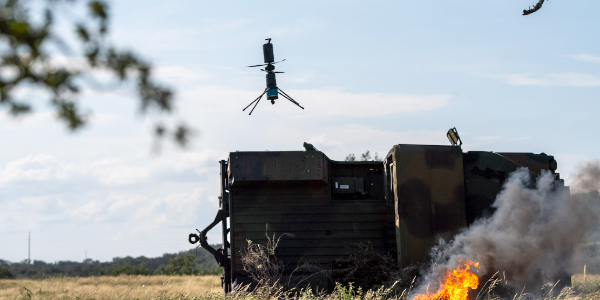
The Pentagon’s Drone Dominance program is testing more than industry’s ability to field new drone designs. It is also testing whether industry can repeatedly manufacture reliable, affordable unmanned aircraft at scale, sustain the supply chain under them, and integrate new capabilities, payloads, and mission systems as requirements evolve.
It’s that shift from innovation to industrialization that is the next phase of UAS competition.

“Producing a capable aircraft is one challenge; producing thousands of them that perform consistently is another”, according to Paul Fermo, president of Robinson Unmanned, the UAS business unit of Robinson Helicopter. “Innovation is interesting, but it’s not necessarily combat capability or capability at a fleet level,” he said. “In order to get there, you have to be able to have repeatable standards of production.”
The distinction matters because the drone sector has spent years rewarding innovation. New platforms, autonomy software, sensors and other payloads have emerged at a pace rarely seen in traditional defense aviation. Ukraine has only accelerated that cycle, demonstrating how its industrial base can quickly adapt at scale to address electronic warfare, countermeasures, and changing battlefield requirements.
From innovation to industrialization
The UAS industry has historically been optimized for rapid innovation and low-volume production, not repeatability at fleet scale. The result, Fermo said, can be “unique snowflakes” rather than standardized systems. Industrialization changes that equation by requiring manufacturers to vet incoming components, control production processes, build to consistent standards, and test repeatedly so operators can expect the same capability from one aircraft to the next.
That manufacturing argument is central to Robinson Helicopter’s creation of Robinson Unmanned. The business traces its small-UAS lineage to Ascent AeroSystems, founded in 2014 and acquired by Robinson Helicopter in 2024. Rebranded as Robinson Unmanned in 2026, it is now Robinson Helicopter’s UAS business unit that offers systems from the sub-250-gram HELIUS nano UAS to the Blue UAS-cleared SPIRIT coaxial drone and its larger SPARTAN system, as well as remotely piloted and autonomous versions of the R44 and R66 helicopters that are built on more than half a century of rotorcraft production experience.
Rather than manufacturing one platform and stretching it across every possible mission, Robinson Unmanned starts with the premise that different operations require different autonomous aircraft. Spirit and Spartan support intelligence, surveillance, and reconnaissance, as well as force protection, search and rescue, and kinetic effects at small-unit and tactical levels. At the other end of the portfolio, the larger R44s and R66s can perform resupply, casualty evacuation, and other logistics missions where weather, operating conditions, or enemy threats make putting a crew aboard undesirable.
These vertical-lift systems can operate in confined spaces and urban environments, require less landing infrastructure, and can hover and place payloads precisely, giving them advantages for expeditionary missions, in particular.
Manufacturing credibility matters
They all benefit from Robinson Helicopter’s established US production infrastructure and an FAA-certified manufacturing culture that stands in contrast to a UAS industry historically characterized by much smaller production runs. Fermo described a vertically integrated factory in which raw material enters one end and completed vertical-lift aircraft emerge from the other. Robinson Unmanned says that infrastructure has already scaled SPIRIT production capacity to as many as 10,000 systems annually, with room to scale higher.
The company is also identifying smaller components it can manufacture internally rather than depend on potentially constrained outside sources. Bushings and blade grips, for example, may lack the visibility of an autonomy stack or advanced sensor, but a shortage of inexpensive components can stop an assembly line just as effectively as a shortage of engines.
“With the manufacturing capability that Robinson has, we can bring that stuff in-house and build it ourselves from raw materials to a usable component,” Fermo said.
That experience is now being tested through the Pentagon’s Drone Dominance effort. Robinson Unmanned is delivering 1,600 Spirit FPV systems under a Gauntlet 1 award and was invited to participate in Gauntlet 2 after meeting additional qualification requirements. Fermo views the initiative as more than an aircraft competition. It is also revealing where the broader US drone industrial base has inadequate capacity, overly concentrated suppliers, or dependencies on foreign sources.
In that sense, Drone Dominance is testing two things at once: what an aircraft can do and whether the industrial system behind it can continue producing that capability in quantity.
Scale only matters if the technology can keep evolving
Manufacturing scale solves only part of the problem. A drone manufactured by the thousands can still become obsolete quickly if it cannot accommodate new software, sensors, weapons, or communications technology. That’s where modular open architecture comes in.
Rather than trying to own the complete technology/autonomy stack, Fermo said the company will continue to concentrate on building reliable, high-performance aircraft and then integrating the best hardware and software technologies developed by specialists. The company has worked with: Sikorsky; Textron Systems; Dynetics, a Leidos company; Shield AI, and others.
The Robinson Unmanned portfolio illustrates this strategy at several levels. At the large end, the unmanned R44 AIRTRUCK, powered by the RPX Flight System autonomy software, is aimed at logistics and resupply, while the R44 SPRAYHAWK applies the same basic aircraft family and autonomy suite to agricultural spraying.
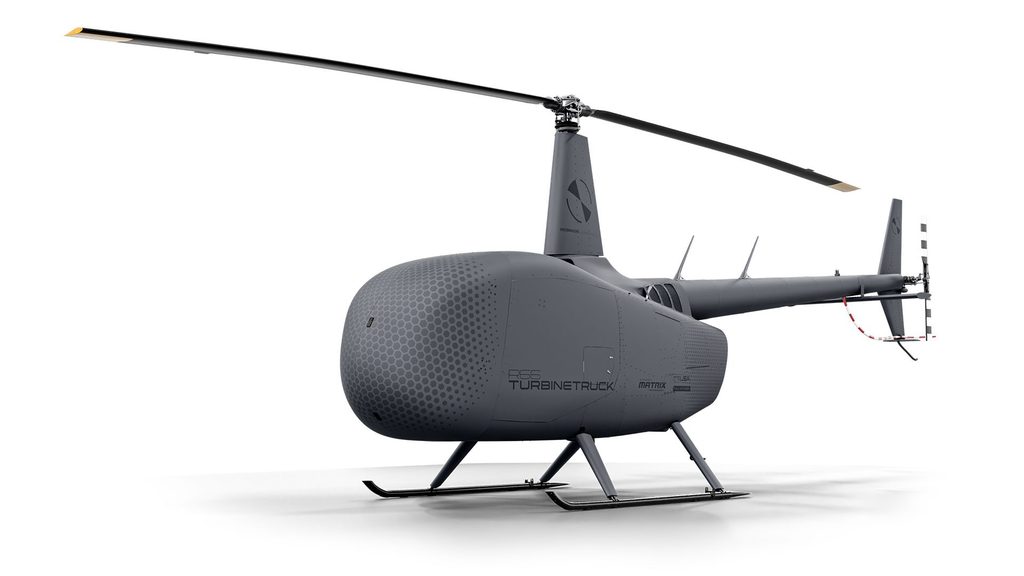
The R66 TURBINETRUCK expands the concept into a larger turbine-powered aircraft and is being used for the Marine Corps’ MARV-EL, or Medium Aerial Resupply Vehicle-Expeditionary Logistics, effort with Sikorsky’s MATRIX technology providing the autonomy component.
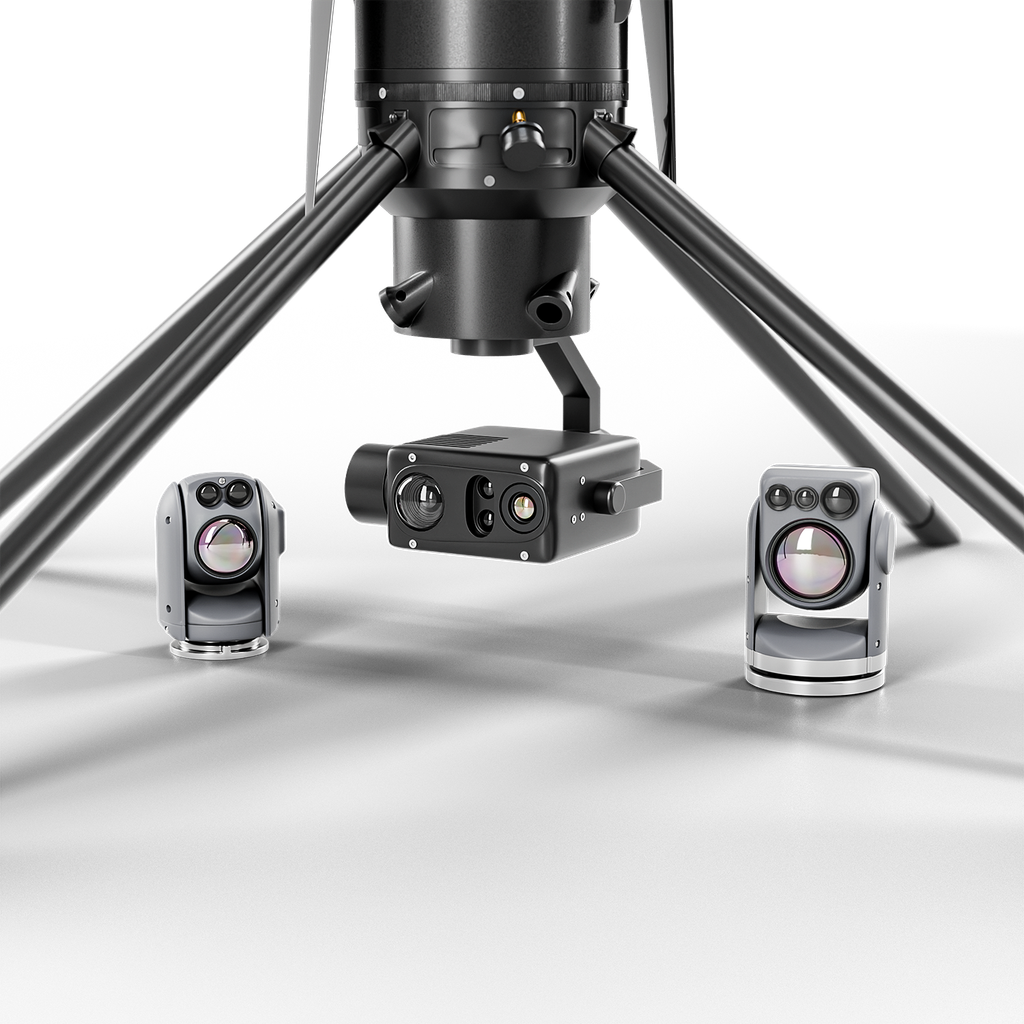
Smaller SPIRIT and SPARTAN UAS take the same approach, accepting mission-specific payloads that can shift the aircraft from sensing to communications to effects as needed. Depending on the platform and the mission, integrations can include EO/IR and multispectral imaging, biometric and CBRNE sensing, communication relay and electronic warfare payloads, and kinetic configurations.
Modularity beyond the payload
In addition, Robinson Unmanned’s definition of modularity extends beyond what can be integrated onto a drone. The cylindrical form factor of its small SPIRIT and SPARTAN UAS, for example, is particularly well suited for integration into larger systems and deployment through a variety of modalities.
“When we think about integrating best-in-class capabilities, oftentimes it’s about people thinking about the drone and then taking capability and putting it on the drone,” Fermo said. “But it also means taking that drone and integrating it into another system as a system of systems.”
Fermo said its small UAS have been successfully deployed from common launch tubes, as well as from both crewed and uncrewed airborne, maritime, and ground-based platforms.
The company is also already working on deployment approaches in which its R-series rotorcraft carry and release its smaller Group 1 drones to operate alongside them. Instead of viewing the portfolio as separate product lines, the longer-term objective is for aircraft across Groups 1 through 4 to share information and operate collaboratively.
There is already a civilian example. In firefighting applications, multiple SPIRIT aircraft can communicate with one another, identify hotspots, maintain a common operating picture, and rotate aircraft as batteries run low so operators do not lose coverage.
The result is a broader definition of an autonomous aviation ecosystem – not one drone, one autonomy stack, or one mission, but multiple aircraft sizes connected by a common manufacturing infrastructure, modular interfaces, integration with outside technology partners, and the ability to operate together.
“I think one thing that we’re learning in the industry is that it’s no longer enough to produce a single capable system or an interesting innovation,” said Fermo. “The companies that will win in the future will be the ones that can take that capability and build it at scale over and over again in the thousands.”
For a Pentagon seeking not merely more drones but a sustainable US unmanned industrial base, that combination may ultimately matter more than which company produces the most eye-catching prototype.